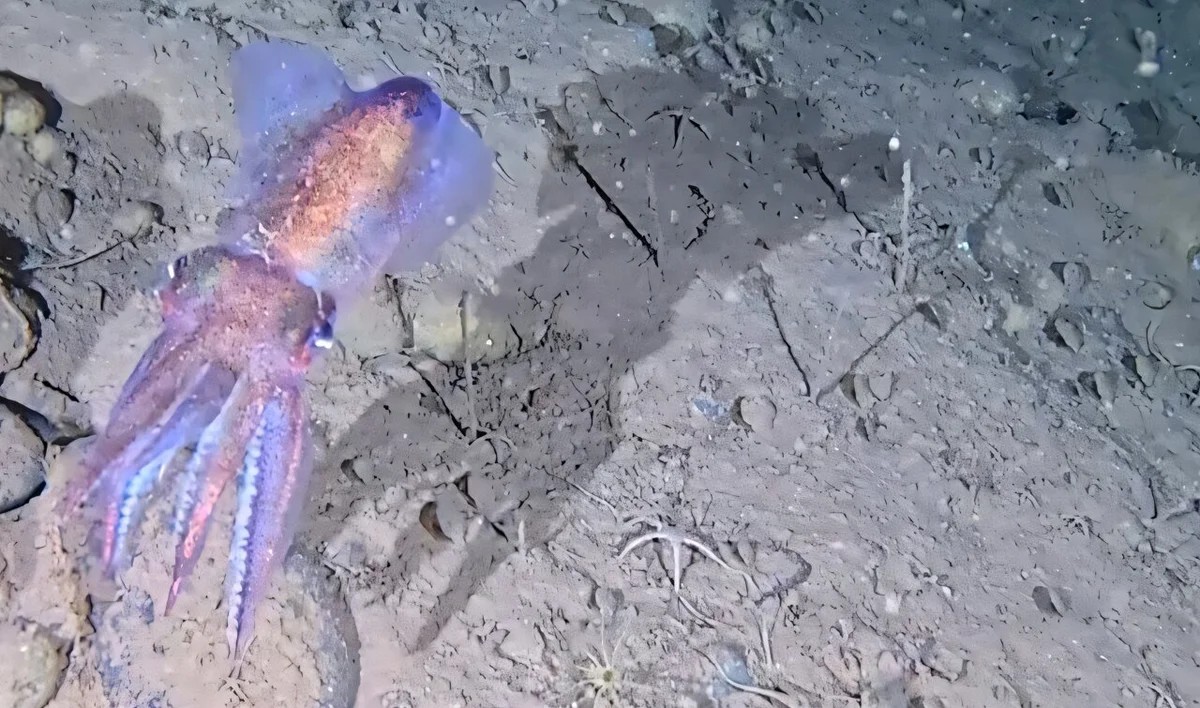
The water temperature was hovering right around -1.6°C. Not exactly a beach day. Yet, there she was. A mature female Arctic bobtail squid (Euprymna scolopes ) tending to a clutch of eggs at a depth of 50 meters in the North Atlantic. It’s an image that shouldn’t necessarily work. The Arctic is one of the harshest environments on the planet. But it does anyway.
For the first time, researchers have captured video proof of this elusive cephalopod not just surviving, but reproducing in such extreme cold. The footage comes from a remote corner of the world that remains largely a blank space on ecological maps: Northeast Greenland National Park.
This isn’t just about documenting a cute moment with eggs. It’s evidence of biological resilience where few dare to look. And it raises serious questions about how climate change is reshaping life at the top of the world.
Why this Arctic bobtail squid sighting matters
The study, led by Paige Maroni from the University of Western Australia and published in Polar Biology, provides a critical baseline. We often assume polar ecosystems are fragile, static, or simply shrinking under the heat of global warming. This finding complicates that narrative.
These creatures occupy a pivotal spot in the food web. Squid and octopuses are both predators and prey. They eat smaller stuff. They get eaten by bigger stuff. Because they’re so central to that dynamic, they act as a sensitive barometer for ecosystem health.
“Establishing knowledge of the biodiversity in this region has crucial for understanding ecosystem function and resilience,” Maroni noted. “This study provides a valuable new baseline.”
If the bobtail squid is thriving in -1.6°C water, what else is hiding in the ice? More importantly, can the wider system handle the stress of accelerating warming? We don’t know yet. But knowing they are there is step one.
Where to find them in Northeast Greenland
The discovery took place within the bounds of Northeast Greenland National Park. It is the largest national park on Earth. It is also one of the most inaccessible and least explored places left on the map.
Deploying cameras in such conditions requires precision. The team used a remotely operated underwater vehicle (ROV) to navigate the dark, freezing waters. When the camera lenses caught the glow of the squid’s presence, the data was undeniable. A mother squid. Eggs in tow. No human hands touching them. Just nature doing what nature does, even when the temperature drops below freezing.
This location is key because the Northeast Atlantic Arctic is warming faster than almost any other marine environment. Tracking species distribution here isn’t academic window-dressing. It’s a race to see what stays, what moves, and what vanishes.
How climate change affects Arctic cephalopod habitats
Arctic ecosystems are shifting. The ice is receding. The water is warming. For some species, this is an open door. For others, it’s a closing trap.
Squid and octopuses in these northern latitudes are particularly sensitive to thermal changes. Their metabolic rates, reproduction cycles, and hunting efficiency are all tied to temperature. If the bobtail squid can maintain a population in such cold, it suggests a level of adaptability we may be underestimating. Or, it suggests they are already on the brink, stretched to their physiological limits.
Understanding these limits is why this footage matters. It’s not enough to know the species exists. We need to know if it’s reproducing successfully. If it’s raising young in these conditions, it offers insight into potential resilience under climate stress. If the clutch fails next year? That’s another data point. But right now, the evidence points to viability.
Who funds polar science expeditions today?
There is a logistical twist here that changes how science gets done in remote areas. The team wasn’t on a dedicated, government-funded research vessel burning expensive fuel. They were aboard the Secret Atlas Expedition Micro Cruise ship, supported by an initiative called Yachts for Science.
This model pairs paying travelers with working scientists. Critics might call it eco-tourism dressed up as research. The results say otherwise.
“Low-impact science and expedition tourism can help major biodiversity gaps in remote polar regions.”
Maroni argues that this partnership is proving useful. It allows for data collection in poorly studied ecosystems without the massive carbon footprint or cost of traditional polar expeditions. It’s a practical solution to a massive problem: we simply don’t have enough researchers, time, or money to cover the Arctic properly.
Even a single verified observation in these waters provides insight into species distributions. One mom with her eggs is more than a cute photo. It’s proof of concept. For science. And for survival.
The ice is still cracking. The water is still rising. But in the dark, cold depths, something is still hatching. Whether it’s enough to outpace the warming remains the question we’re still trying to answer.