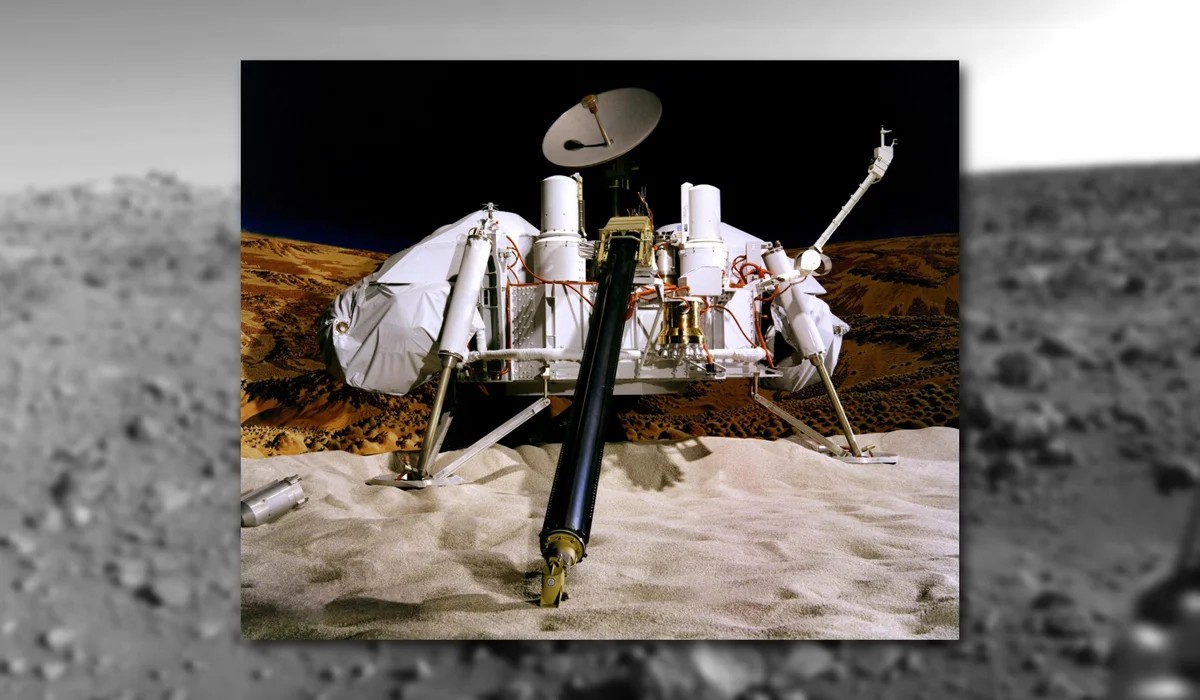
On July 20, 19 76, the ground shook—metaphorically speaking, as there were no feet on Mars. The Viking 1 lander touched down, the first U.S. craft to survive the descent and send back a grainy, pebble-strewn panorama of a desolate world. It was anticlimactic.
“I don’t think we’d have been shocked if we’d seen blades of grass,” Tom Young, Viking’s mission director, recalled decades later.
Scientists had imagined much more. Some, including the famously whimsical Carl Sagan, speculated about polar-bear-sized monsters lurking in the ice. Most expected simple microbes. They got silence.
For over a century, humanity has “discovered” life on Mars and then had to take it back. Each time we sharpened our lenses, the aliens evaporated. By 1976, orbital data showed a dead, dry planet. Or so it seemed.
The Ambiguity of Viking 1
Viking 1 and its sister ship, Viking 2, were not just rovers. They were biology labs. Their mission: look for extant alien life in the soil.
The results? Confusing.
To this day, the data remains ambiguous. The majority consensus holds that Viking found no definitive organisms. A vocal minority disagrees. This split isn’t just academic pedantry; it highlights a fundamental crisis in astrobiology. How do we recognize life if we don’t even agree on what life looks like?
Our understanding of biological limits is woefully incomplete. We risk two errors: declaring life where there is none, or missing genuine biology hidden in plain sight.
Sagan’s Burden of Proof
Astrobiologists have long adhered to Carl Sagan’s famous adage: “Extraordinary claims require extraordinary evidence.”
It’s a sensible rule. It prevents us from seeing angels in toaster ovens. But what if the rule is backwards?
If the universe is teeming with life—ordinary, unremarkable, abundant life—then demanding “extraordinary” evidence for Martian microbes is counterproductive. We might be looking for Life with a capital L, when we should be looking for dirt that smells funny.
“If we live in a universe where life is not extraordinary… setting such a high bar can backfire,” one perspective suggests. What if Viking did find life, and our skepticism blinded us?
The Case for Ancient Habitation
Ancient Mars, 3.5 billion years ago, was a party.
Warmer. Wetter. Protected by a global magnetic field. It had seas, rivers, and a thick atmosphere. Today, it’s a frozen desert that lost its magnetosphere and boiled away its oceans. But during those prime years, the conditions for life existed.
Plus, space is messy. Organic compounds—life’s raw ingredients—rain down on Mars constantly via meteorites and cosmic dust.
“Something should have started happening,” says David Grinspoon, astrobiologist. “Either life originated on Mars—or we’re wrong about something on Earth.”
Modern Clues: Leopard Spots and Alkanes
The Curiosity rover (in Gale Crater) and Perseverance (in Jezero Crater) have been digging up the goods. The data is accumulating.
Perseverance found red mudstone dappled with “leopard spots.” These are mineral assemblages of altered iron and organics. On Earth, similar spots are often created by microbes munching on minerals. No known abiotic (non-living) process easily replicates this chemistry on Mars without invoking a series of highly improbable events.
Curiosity, meanwhile, found long-chain alkanes. These carbon-based molecules are found in fatty acids—like those in cell membranes. Martian radiation likely broke them down over eons, leaving fragments. But the original molecules? Too long to have arrived intact on a meteorite.
“It’s permissive evidence of life,” says Chris McKay. “It could be microbes. But it’s not persuasive.”
The Sample Return Dilemma
To prove it, we need samples in an Earth lab.
NASA planned a Mars Sample Return mission. Complex? Yes. Expensive? Astronomically. The result? Congress pulled the plug.
Astrobiologists are frustrated.
“I think that’s really important for us do,” says Tom Young. “Every leader who passes on returning those samples puts a dark mark on their leadership. The mystery of our cosmic solitude could be solved right there on Mars, waiting in the dirt.”
The Quantitative Gap
So, what constitutes proof?
A trilobite? Sure. A radio transmission in prime numbers? Easy.
But for ancient microbial life, the line is blurry. We need a quantitative method—a statistical framework that separates “life” from “not life” based on probability.
“Right now, it’s all just hand-waving,” says David Catling. We need to answer: At what point do we stop saying “potential biosignature” and start saying “biosignature”?
If you have 100 rovers finding slightly weird chemical anomalies, and geology can’t explain them all without stretching credibility, do you conclude life is likely?
Morgan Cable argues we need to treat the “hypothesis of last resort” symmetrically. Instead of assuming abiotic until proven otherwise, we should weigh the biological hypothesis with the same rigor.
“If only we let rareness guide us, we may miss ordinary life,” says Michael Wong. “Or we may mistake extraordinary non-biological processes for life.”
The Iconoclastic Minority
Not everyone is waiting for a consensus.
Steven Benner, an independent astrobiologist, thinks the science community is too cautious. Too afraid of being wrong.
“More likely than not,” Benner argues, “there is life on Mars today. And the Viking landers found it.”
He claims the Viking biology experiments—gas exchange, radioactive tracers, photosynthesis assays—showed metabolic activity. The data was weird, sure. But Benner argues it’s biologically weird, not geologically weird.
His peers disagree. They find his views controversial, to put it mildly.
But the skepticism is understandable. The history of Mars life claims is a graveyard of retractions. Still, Benner argues the current caution is obscuring the obvious.
The Verdict? Not Yet.
Viking 1 didn’t find aliens. But it didn’t find the absence of life, either. It found a question mark the size of a planet.
As of now, we lack the “extraordinary evidence” to confirm life. We have a growing pile of “permissive” clues. Leopard spots. Fatty acid fragments. A planet that should have hosted life.
The burden of proof remains high. The tools are improving. The samples are still waiting.
Until we can bring those rocks home, or land a rover with better lab equipment, the debate rages. Is it biology? Is it geology? Or is it both, playing tricks on our minds?
One thing is certain: Mars is keeping its secrets tight. And we’re still guessing.