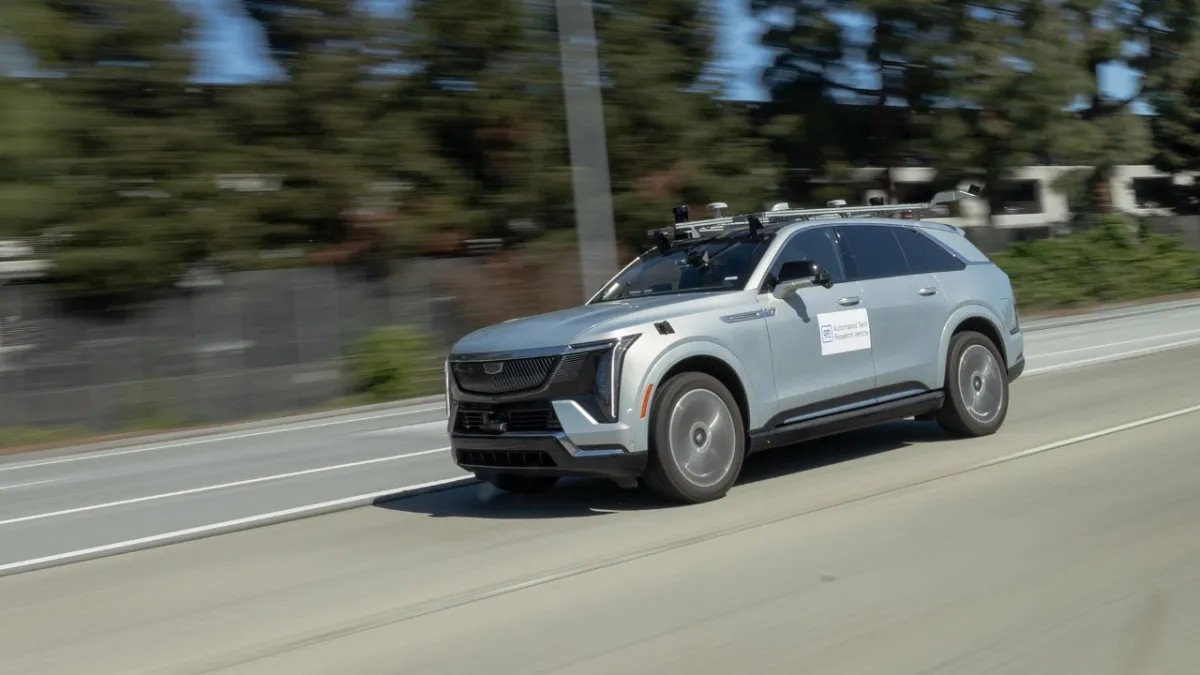
General Motors is moving beyond simple vehicle automation to master the far more complex challenge of human psychology. In a high-tech research lab in Warren, Michigan, engineers aren’t just testing how cars drive; they are measuring how drivers feel. By combining immersive virtual reality with advanced biometric sensors, GM is using human nervousness as a critical data point to refine its autonomous driving systems.
The Virtual Test Track
The scene appears deceptively real: blue skies, fluffy clouds, and even a sign for a nearby gas station. However, the Cadillac Lyriq being driven is not on a road. It is a “vehicle buck”—a physical mock-up of the car’s interior—surrounded by curved screens projecting a digital environment. Seven high-powered projectors beam the road ahead, creating a convincing illusion of motion.
Sensors are attached to the test subject’s head, hands, and fingers. A pulse oximeter monitors heart rate, while cameras track eye movements and skin conductance (perspiration). This biometric data reveals the driver’s physiological state in real-time. AI algorithms then analyze these inputs to understand stress levels, attention spans, and reaction times.
“The data doesn’t lie.”
This approach allows GM to run millions of simulations daily, equivalent to tens of thousands of human driving days. Engineers introduce unpredictable virtual scenarios—odd traffic patterns, sudden obstacles, or confusing signage—to test how the system handles edge cases. As one researcher notes, “truth on the road is often stranger than fiction,” and these simulations help prepare autonomous vehicles for the unexpected.
Beyond Driving: AI in Battery and Aerodynamics Research
While autonomous driving gets the spotlight, GM’s research and development (R&D) division, led by aerospace veteran Linda Cadwell Stancin, is leveraging AI across multiple engineering disciplines. The company, a cornerstone of Michigan’s economy, is applying futuristic technology to legacy automotive challenges.
Key R&D Innovations:
- LMR Batteries: GM is developing Lithium Manganese-Rich batteries. While they have lower energy density than current standards, they are cheaper to produce and rely on fewer rare minerals like cobalt, addressing supply chain and cost concerns.
- AI-Powered Aerodynamics: Traditional wind tunnel simulations for electric vehicles (EVs) can take weeks to compute aerodynamic drag—a major factor in battery efficiency. GM’s new AI virtual wind tunnel provides instantaneous feedback, allowing engineers to optimize vehicle design in real-time. Since aerodynamic drag can consume up to 50% of an EV’s battery energy, this speed is crucial for improving range.
- Atomic-Level Modeling: Technicians use atomistic simulations to model changes in battery chemistry, instantly predicting the impact of material adjustments without lengthy physical trials.
Decoding Human Emotion for Safer Handovers
GM plans to debut its fully hands-off, eyes-off autonomous driving system in 2028 with the all-electric Cadillac Escalade IQ. A critical hurdle for this technology is the “handover”—the moment control shifts from the car back to the human driver.
To study this transition, researchers ask test subjects to perform distracting tasks, such as playing Candy Crush, while driving in simulation. The goal is not to test gaming skills, but to measure how quickly and safely a driver can shift from a passive, distracted state to an active, attentive one.
Omer Tsimhoni, a GM technical fellow, explains that the system uses “pupillometry” to measure pupil dilation and reactivity, alongside “galvanic skin response” to detect sweat. This data is processed by Emotional AI, which interprets facial expressions and voice tones to gauge stress, confusion, or satisfaction.
If a driver claims the experience was “great” on a survey but their biometric data shows elevated heart rates and pupil dilation indicating stress, the system flags the discrepancy. This objective feedback loop ensures that the autonomous system understands not just what the driver says, but what they actually experience.
Conclusion
GM’s strategy highlights a shift in automotive engineering: success is no longer defined solely by mechanical performance, but by the seamless integration of human and machine. By using AI to decode human stress and optimize every aspect of vehicle design, from battery chemistry to aerodynamics, GM aims to make autonomous driving not just possible, but intuitively safe and comfortable for the average driver.