Betelgeuse. Just saying the name feels like an incantation.
Astronomers have wanted a neighbor for this iconic red supergiant for a century. Theories have been piled on theories. Observational hints have flickered in and out of view like bad radio signals. Now, after years of digging, the proof has arrived. It is real.
Betelgeuse isn’t just any star. It’s the glowing red dot marking Orion’s right shoulder. You’ve seen it. If you replaced our sun with Betelgeuse, it wouldn’t just bathe Earth in red light; it would swallow Mercury, Venus, and Earth, reaching all the way to Mars. We know it’s big. We know it’s bright. But we didn’t know if it was single or a binary system until now.
Why This Detection Matters
Speculation about a companion star started nearly 100 years ago. Evidence? Scarce. A preprint published in January (officially in February) suggested Hubble Space Telescope data showed a possible second star passing in front of Betelunge every six years. Suggesting isn’t confirming.
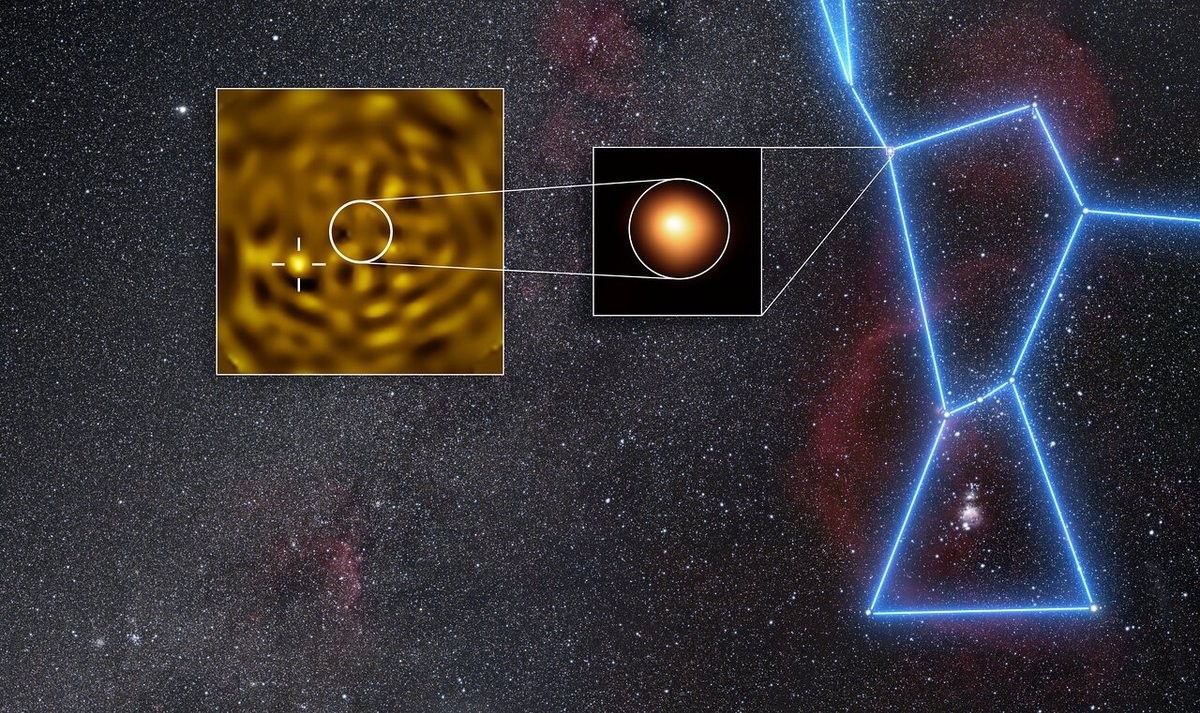
To settle the matter, researchers turned to the European Southern Observatory’s Very Large Telescope (VLT) in Chile. Specifically, the SPHERE/ZIMPOL instrument. It’s a custom-built beast for high-contrast imaging. Its job is to spot the faint wisp of light from an exoplanet or small star against the blinding glare of its primary host.
Betelgeuse does not cooperate with subtle observation.
The star’s glare is overpowering. So the team had to be patient. They waited for December 2024. Previous work had predicted that at this specific time, the companion would be at its maximum separation from the primary and wouldn’t be obscured. They waited. They processed months of data.
Then, on the monitors, a faint blip appeared.
Betelgeuse B had been found.
How We Knew It Wasn’t a Trick
Seeing isn’t always believing in astronomy. A distant background galaxy or a swirl of dust can masquerade as a planet. But this detection feels robust.
Andrea Dupree, a study co-author at the Center for Astrophysics | Harvard & Smithsonian, calls it a “gorgeous detection.”
“I mean, it’s really there,” she says.
The data indicates Betelgeuse B is a red dwarf. It has about three solar masses. Heavier than previous, piecemeal estimates suggested.
Meridith Joyce at the University of Wyoming wasn’t involved in this study. She trusts the results. Her own work, published recently, suggested a slightly smaller mass, but she notes her data library for stellar models was sparse and imperfect. The discrepancy is minor. The consensus is shifting. The companion is there.
The Great Dimming Myth
Betelgeuse has a temper. It brightens. It dims.
In 2019, the star underwent the “Great Dimming.” It faded so severely that supernova predictions circulated widely. People worried the giant was dying. It wasn’t. The brightness returned by 2020.
Dupree clarifies this now: The dimming was likely a coronal mass ejection. A huge expulsion of material. Unrelated to Betelgeuse B. The companion didn’t cause the fade.
What Comes Next
The February paper, which Dupree also contributed to, already offered a hint. Using smaller telescopes, researchers saw ripples in Betelgeuse’s atmosphere. We now know those ripples are wakes created by the gravitational pull of the hidden companion.
With Betelgeuse B confirmed, the methods can be scaled up. Dupree wants to monitor other massive stars. A better census of binary supergiants could help explain star formation. How do they live? How do they die? The answers are likely hidden in the dynamics of their unseen partners.
For now, caution remains the default mode. The authors call for further observation. They need to see the point of light orbit. They need to watch it disappear behind Betelgeuse periodically. If that happens, the discovery becomes undeniable.
“We’ll see,” Dupree says.
Until the next orbit, the red giant has a partner. The sky is full of secrets, and we’re only just learning how to ask the right questions.