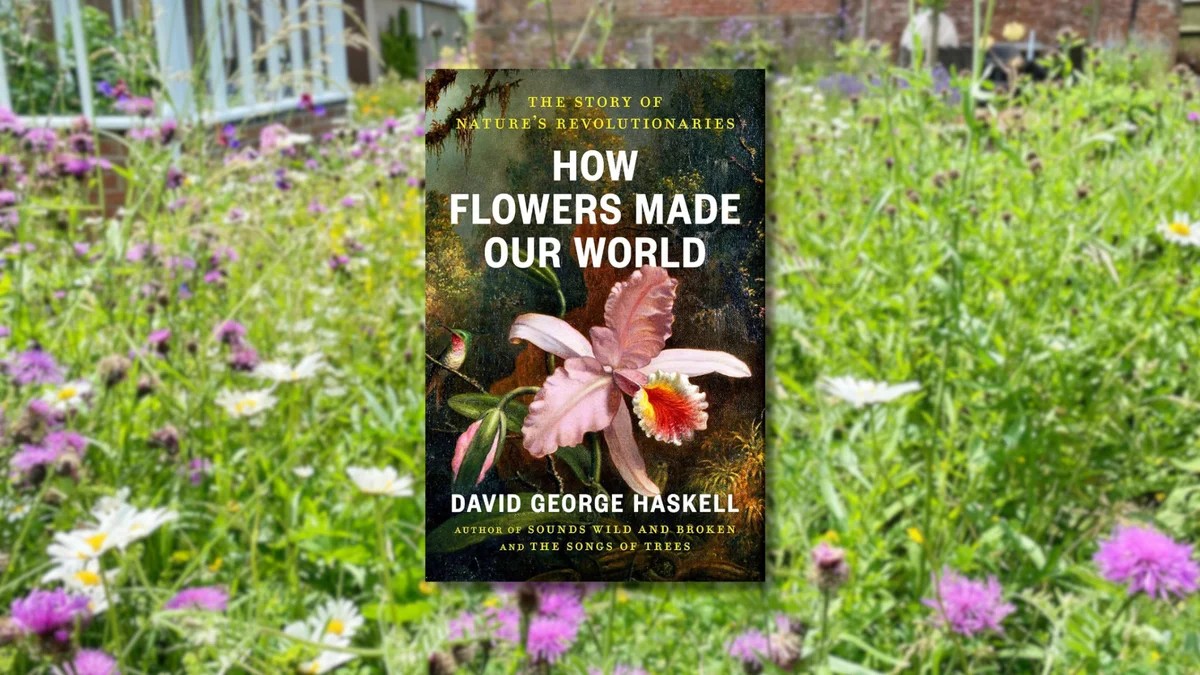
We take them for granted. Roses at funerals. Tulips on birthdays. Lilies on dinner tables. We wear their scents. We live in their shadows. But flowers are not passive decoration. They are active agents. They built the ecosystems we inhabit.
David George Haskell’s new book, How Flowers Made Our World, argues that we have overlooked their radical history. It is a story of diversity. Of community. Of evolutionary paths that would terrify a biologist and delight a poet.
The book doesn’t start in a lab. It starts at a bar. Haskell insists on a floral garnish for his cocktail. That wry indulgence sets the tone. The book is about how nature’s revolutionaries reshaped the planet. And us.
Magnolias: The First Revolutionaries
Consider the magnolia. It is one of the oldest flowering plants. Fossils show it predating bees. Predating many modern insects. Yet it thrived.
Haskell calls them “green Prometheus” figures before grasslands took over. But let’s look at the anatomy. Magnolias overturned the old botanical order. They did it through beauty, bisexuality, and what you might call motherhood.
The structure matters. A flower acts as a billboard. A sensorium of delight. As the flower matures, the ovary becomes fruit. The fruit encloses seeds. This is botanical motherhood. Intergenerational care. Most non-flowering plants don’t have this level of protective interdependence.
Then there is bisexuality. Biological hermaphroditism. Magnolias combine male and female functions in the same structure. Efficiency. They work with pollinators better than asexual or strictly single-sex plants. Today, 90 percent of flowering plants share this trait. But magnolias led the way.
Orchids: The Antimagolias
Orchids came later. They are essentially antimagolias.
Magnolias are open cups. Generalists. Any pollinator can land, taste pollen, sip nectar. It is a public park.
Orchids are speakeasies. Massively specialized. Often locked onto one or two insect species. Their sexual parts are miniaturized to the extreme. You wouldn’t notice them without a magnifying glass. The petals might be huge and crazy, but the reproductive core is tiny.
This specialization is a gamble. Sometimes cooperative. Often deceptive.
Why deceive? Efficiency. Natural selection favored orchids that sent faithful couriers. By mimicking the appearance of flowers with plenty of pollen, orchids tricked insects into visiting without offering a reward. No nectar wasted. Then came the aromas. Mimicking sex pheromones.
A male wasp gets the scent. He thinks he’s found a mate. He tries to copulate with a flower. Pollen sticks. He flies to another flower. Repeat.
It sounds ridiculous. Is it? It makes the plant vulnerable, sure. If that one insect species dies out, the orchid is stuck. But when it works? It is evolutionary genius.
Grasslands and the Fire Trade
Grasses are flowers too. Their blooms are inconspicuous. Wind-pollinated. Invisible. But they are vital. We evolved to live in grassy habitats. We eat them.
Restoring native grasslands is hard. Conservation groups struggle with soil health, invasive species, and climate change. But there is a key factor often ignored. Fire.
Grasses co-evolved with fire for tens of millions of years. A grass grows by slithering along the ground. It sends up temporary blades for photosynthesis. These blades die and dry out. They catch fire.
Why burn yourself? Because it eliminates competition. Ash fertilizes the soil. The next spring, the grass leaps back.
Haskell participated in a prairie restoration. He watched acres burn. It was terrifying. Acoustically rich. A roar. Not a quiet spark. The ground turned to ash. Then, the next spring? Green sprouts. Songbirds breeding. Butterflies emerging. Wildflowers returning.
Grasses domesticated fire. They brought it down from the gods. They used it as a tool. Without controlled burns, these ecosystems collapse. With them? They thrive.
The Scandal of Botanical Sex
Why were early plant descriptions so scandalous? Look at Carl Linnaeus. He gave us the classification system we still use. Genus. Species. Order. Class.
He built it on sexual organs. The number of stamens. The number of pistils. He was obsessed.
Teachers resisted. They didn’t want students studying the “male” and “female” parts of flowers. It was considered morally corrupting. Linnaeus leaned into it. He described multiple “husbands” in a “bed” with a single “wife.”
It caught on because it was edgy. But also because it was practical. You could learn to count anthers in an afternoon. It was a quick, reliable code for a chaotic world.
Linnaeus’s legacy is mixed. The classification system stands. The racist extensions he applied to humans later on… do not. We still use his plants. We ignore his prejudices. Or we critique them. But the sexual language? It stuck.
Why We Love Roses We Don’t Need
We spend billions on rose perfume. We grow roses in gardens we didn’t ask permission for. We distill them into oils.
Here’s the kicker. Humans aren’t pollinators. We don’t eat rose fruits as a staple. We didn’t evolve with them.
Roses evolved their aromas millions of years ago to attract bumblebees. To speak to insects. The scent is a language for pollinators.
Humans hijacked it. We find it beguiling. Irrational, really. We are attracted to human scents because they signal friends, mates, family. But a rose? It’s a misdirected affection.
Or is it?
There is a beauty in the error. When I wear rose perfume, I am hybridizing myself. I am dissolving my individualism into a floral community. It is self-expression through connection.
Flowers teach us community action. They show us how to rely on others. Bees. Wasps. Grasses. Fire.
We think we control them. We arrange them in bouquets. We prune them into shapes. But they arranged us first. They built the world. We just moved in.
The question isn’t how we shaped flowers. It’s how they shaped us. And that story is still growing.