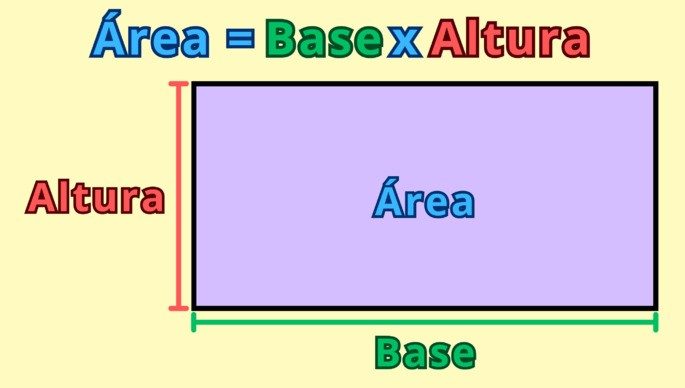
A rectangle is one of the most common shapes in geometry, and for a good reason. It’s defined by having four straight sides and four right angles. You see them everywhere, from the screen you’re reading this on to the floor tiles in your kitchen.
The math behind it is straightforward. To find the area of a rectangle, you multiply its base by its height.
The area of a rectangle equals the base multiplied by the height.
This calculation works because you are essentially counting how many unit squares fit inside the shape. If you know the length of one side (the base) and the adjacent side (the height), you have all the information you need.
You already know the drill. To find the area of a rectangle, you just multiply the base by the height. It is that simple. But here is where people get tripped up.
In geometry, “base” isn’t just any side. It is usually the longer side. The “height” is the shorter side, sometimes called width. This matters because if you swap them by accident, you still get the right number. Multiplication is commutative. $5 \times 10$ is the same as $10 \times 5$. The area doesn’t care which way you look at it.
However, getting the concept right helps when you move to more complex shapes. Understanding which part is the base and which is the height lays the groundwork for trapezoids and parallelograms later on.
Practice Finding Rectangle Area
Let’s put the formula to work. Here are some exercises to test your understanding. We will stick to the basic properties: opposite sides are equal in length.
Exercise 1
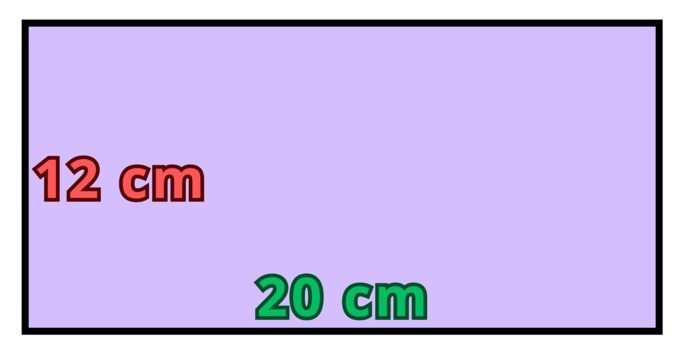
Imagine a rectangle with these specific dimensions:
Finding the Shorter Side First
The second problem adds a twist. You are given the long sides: 15 centimeters. The short sides? They are just one-third of that length.
Don’t guess. Calculate.
Take the 15 cm. Divide by three.
$15 \div 3 = 5$ cm.
The short sides are 5 centimeters long. Now you have the base and the height. Multiply them.
$15 \times 5 = 75$ cm².
The area is 75 square centimeters. Simple math, but only if you don’t skip the step of finding the missing dimension.
Rectangles A and B
Now we look at two shapes side by side. Rectangle A and Rectangle B.
The text cuts off here. Usually, this setup asks you to compare them. Maybe find the perimeter difference. Maybe calculate the total area. Or perhaps it asks which one has a larger area-to-perimeter ratio.
Without the full numbers for A and B, we can’t solve it. But the method stays the same.
- Identify the length.
- Identify the width.
- Multiply.
If they want the total area of both shapes combined, just add the results. If they want the difference, subtract.
The formula doesn’t change. It is always length times width.
What happens if the shapes share a side? You might need to subtract that shared length from one of the dimensions. Geometry problems often hide simple tricks in plain sight.
Keep the pencil moving. Measure twice. Multiply once.
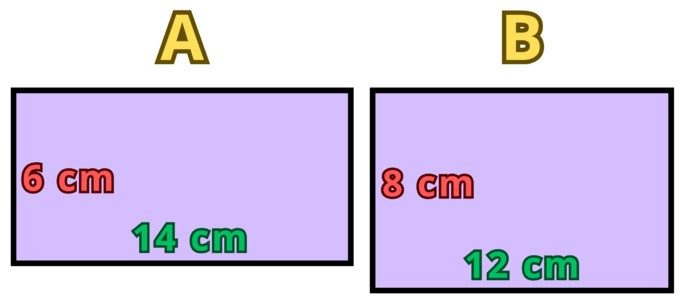
When you are trying to figure out which rectangle is larger, you cannot just guess based on how long one side looks. You have to look at the total space inside. Let’s look at two specific shapes to see how the math works in practice.
Comparing Rectangle A and Rectangle B
We have two figures. To know which one holds more space, we calculate the area for each using the standard formula: length times width.
For the first shape:
Area A = 14 cm x 6 cm = 84 cm²
For the second shape:
Area B = 12 cm x 8 cm = 96 cm²
The answer is clear. Figure B is the bigger one because 96 is greater than 84.
But what if you need to know exactly how much bigger it is? You subtract the smaller area from the larger one.
96 cm² – 84 cm² = 12 cm²
The difference between the two rectangles is 12 square centimeters. It is a simple subtraction, but it gives you a precise measure of the gap between them.
Expanding Agricultural Land
Real-world applications of area calculations often involve scaling. Consider a farmer who owns a corn field shaped like a rectangle. The current dimensions are 200 meters long and 100 meters wide.
First, find the current size.
Area = 200 m x 100 m = 20,000 m²
The farmer wants to expand this land five times its current size. This is a multiplication problem, not a geometric one. You take the total area and multiply it by the expansion factor.
20,000 m² x 5 = 100,000 m²
The new field will be 100,000 square meters. To put that in perspective, that is 0.1 square kilometers. It is a significant increase in space.
Starting a New Problem
Now we move to the next exercise. We are given a rectangle with specific data points, though the details are cut off here. The method remains the same. Identify the length and width, multiply them, and you have your area.
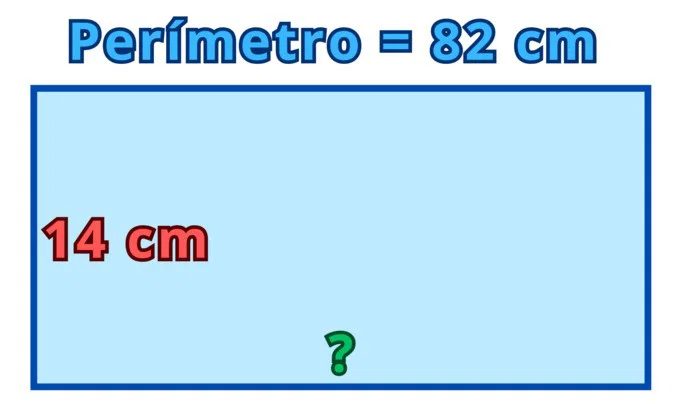
We are looking at a rectangle where the base isn’t immediately obvious. The image provides two essential clues: the height is 14 centimeters, and the total perimeter measures 82 centimeters. You might wonder how to proceed without the base length. The solution lies in reversing the perimeter formula.
Solving for the Rectangle Base
The perimeter of a rectangle is defined by the sum of all its sides. The standard formula is:
Perimeter = 2 x Base + 2 x Height
To find the missing base, you need to isolate that variable. Rearranging the equation gives us:
Base = (Perimeter – 2 x Height) ÷ 2
Now, plug in the numbers provided in the problem. Start by calculating the contribution of the two heights.
2 x 14 cm = 28 cm
Subtract this from the total perimeter.
82 cm – 28 cm = 54 cm
This remaining 54 centimeters represents the combined length of the two bases. Divide by two to get the length of a single side.
54 cm ÷ 2 = 27 cm
The base of the rectangle is exactly 27 centimeters.
Calculating the Area
With both the base and the height known, finding the area is straightforward. The area of a rectangle is simply the product of its length and width.
Area = 27 cm x 14 cm
Multiplying these values yields:
Area = 378 cm²
The total surface area of this shape is 378 square centimeters.
Moving to the Next Problem
Exercise 6
You are now presented with a new rectangle.
Most people know the formula for the area of a rectangle is simply length times width. But what happens when you don’t have the width? Or the height?
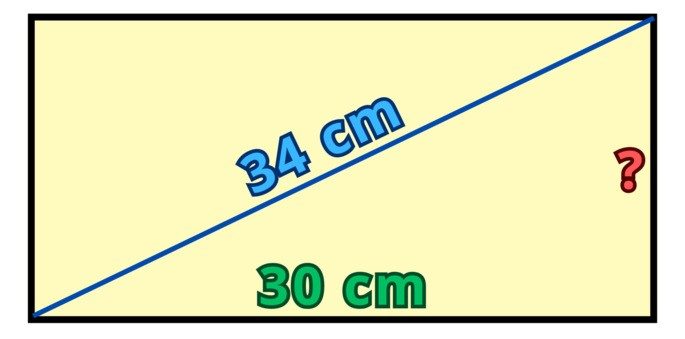
You might be staring at a problem that gives you the base and the diagonal but leaves the vertical side missing. It feels like a dead end until you remember one crucial geometry fact: the diagonal, the base, and the height of a rectangle form a right-angled triangle.
This is where the Pythagorean theorem saves the day.
Solving for Missing Height with Pythagoras
Let’s look at a specific scenario. Imagine a rectangle with a base of 30 cm and a diagonal of 34 cm. You need to find the height and then the total area.
“If you look closely, the diagonal, the base, and the height describe a right-angled triangle.”
Because these three lines form a right triangle, we can apply the classic formula:
D² = B² + A²
Where:
* D is the diagonal
* B is the base
* A is the height (the unknown side)
Rearranging the formula to solve for the height (A ):
A = √(D² – B²)
Now, plug in your numbers:
- Square the diagonal: 34² = 1,156
- Square the base: 30² = 900
- Subtract the base squared from the diagonal squared: 1,156 – 900 = 256
- Take the square root of 256: √256 = 16
The height is 16 cm.
Calculating the Final Area
Now that the puzzle piece is in place, the rest is straightforward arithmetic. You have both dimensions:
- Base = 30 cm
- Height = 16 cm
Multiply them together to get the area:
30 cm × 16 cm = 480 cm²
The total area of the rectangle is 480 square centimeters.
It’s a useful trick. Whenever you’re stuck on a rectangle problem because a side is missing, check if a diagonal is provided. If it is, you’ve got a triangle. And if you have a triangle, you have a solution.
Ejercicio 7
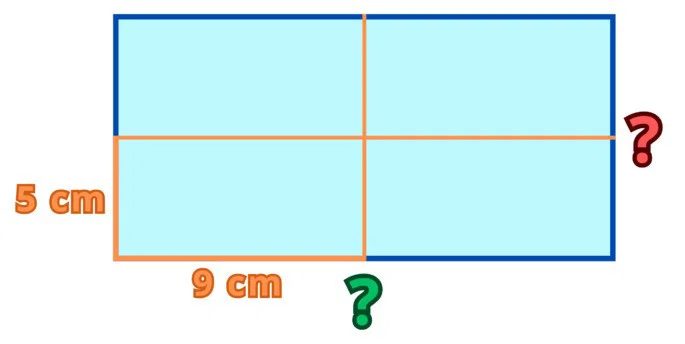
The following rectangle has been divided into four smaller rectangles with the following dimensions:
The answer is 180 cm2. But getting there isn’t just about memorizing a formula. You can actually solve this problem in two distinct ways. Both lead to the same number, but they test different parts of your geometric intuition.
Method 1: Calculate the Small Rectangle First
Start with what you know. The figure includes a smaller rectangle with a base of 9 centimeters and a height of 5 centimeters. You can find its area by multiplying these two sides.
9 cm x 5 cm = 45 cm2.
Now look at the bigger picture. The large rectangle is made up of four identical small rectangles. You don’t need to measure the whole thing again. Just take that 45 cm2 and multiply it by four.
45 cm2 x 4 = 180 cm2.
Simple. Direct. No guesswork.
Method 2: Determine the Large Dimensions First
The second approach flips the logic. Instead of looking at the pieces, look at the whole. Pay attention to the layout. The base and height of the large rectangle are exactly double the length of the small rectangle’s sides.
So, you scale up first.
- Base: 9 cm x 2 = 18 cm
- Height: 5 cm x 2 = 10 cm
Once you have the full dimensions, apply the standard area formula.
18 cm x 10 cm = 180 cm2.
Same result. Different path.
Exercise 8
Look at the next figure carefully.
How to Find Rectangle Height from Area and Base
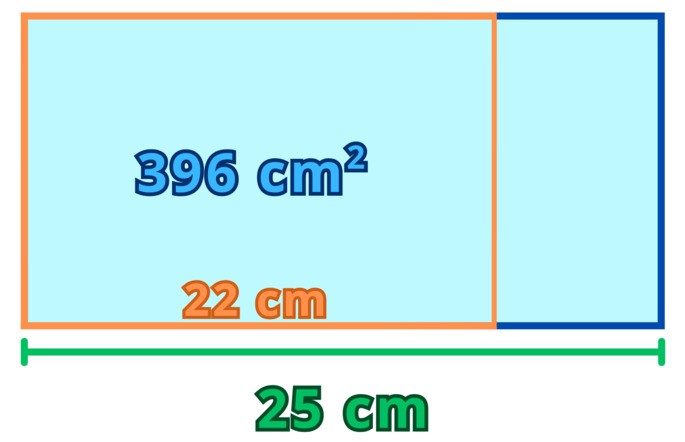
The problem gives us a small rectangle with an area of 396 square centimeters and a base of 22 centimeters. The goal? Find its height and then use that to get the area of a larger rectangle.
Most people know the area formula: Area = Base × Height. But when you’re stuck with the area and base, and need the height, you just flip the operation.
Height = Area ÷ Base
It’s that simple. You take the known area (396 cm²) and divide it by the known base (22 cm).
396 ÷ 22 = 18
So, the height of the small rectangle is 18 centimeters.
Why the Big Rectangle’s Height Doesn’t Need New Math
Here’s the tricky part that often trips students up. The problem doesn’t explicitly state the height of the larger rectangle. It just shows them side-by-side or stacked in a diagram.
Look at the geometry. If the rectangles share a vertical alignment or are part of the same composite shape, the height of the smaller one often dictates the height of the larger one. In this case, the visual evidence confirms they share the same vertical dimension.
Therefore, the large rectangle’s height is also 18 cm.
Calculating the Final Area
Now that we have both dimensions for the larger rectangle, the final step is straightforward.
We know:
– Base = 25 cm
– Height = 18 cm
Multiply them.
25 × 18 = 450
The area of the larger rectangle is 450 square centimeters.
Breaking Down the Logic
It’s easy to overcomplicate geometry problems by looking for hidden variables. Here, the only “hidden” variable was the height of the small rectangle. Once you solved for that, the rest followed directly.
Key takeaways for similar problems:
– Always start with the complete data. You had area and base for the small shape.
– Use inverse operations. Division is just multiplication in reverse.
– Trust the visual context. If shapes align, their dimensions often overlap.
This method works for any rectangle where you know two of the three variables (area, base, height). You can always solve for the missing one.
The math holds up. The logic is sound. And the answer, 450 cm², is ready for whatever comes next in your homework.