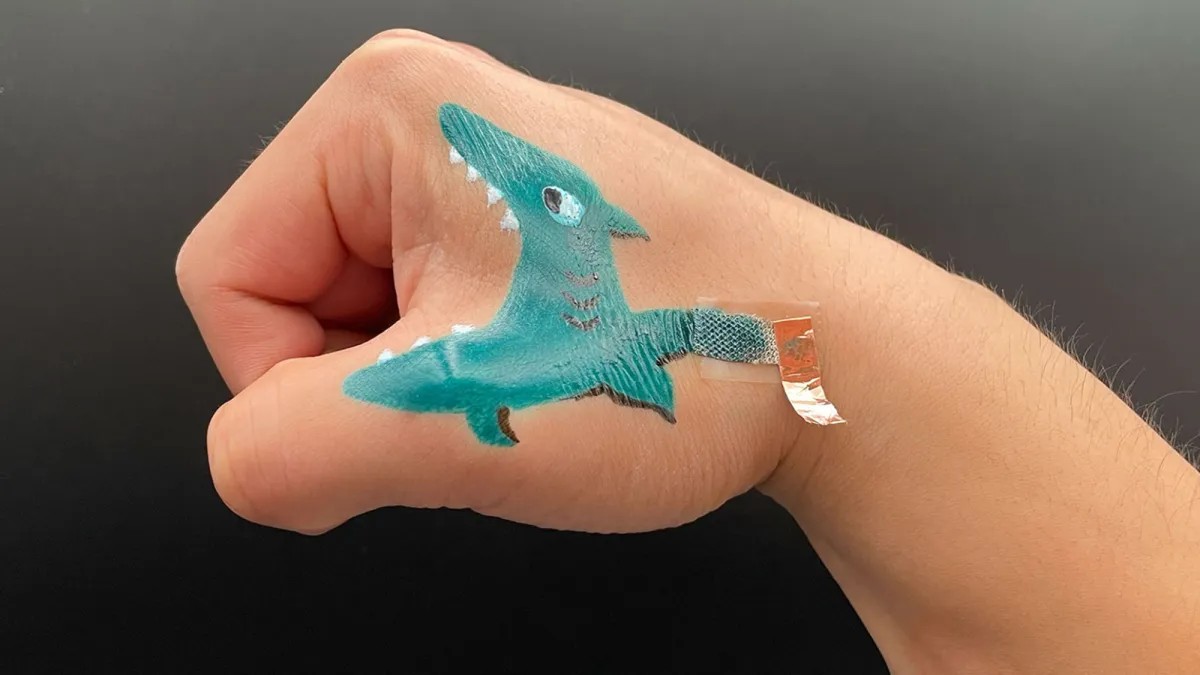
A tiger tattoo. A rainbow stripe. Something that looks like face paint but reads your brain waves instead.
Engineers at Penn State have it. They filed a provisional patent for wearables you paint directly on your skin. These aren’t rigid metal pads taped on for an hour in a clinic. They are customizable sensors described in the Proceedings of the National Academy of Sciences. They bond with skin better. They stay there when you move. And yes they look good.
Why stickiness fails
All wearable health tech runs on electrodes. These things touch the body and pick up electrical signals. Your brain sends EEG data. Your heart broadcasts ECG. Your muscles twitch in EMG. Standard gear uses rigid metal contacts. They offer stability sure. But they peel off the moment you raise your arms or break a sweat.
Researchers tried fixing this with hydrogels. Soft jelly materials. They absorb water and swell. They stretch with your body. Great in theory. But the water evaporates. The gel dehydrates. Then the sensor falls off. Or worse it lies to you.
Wanqing Zhang a PhD student on the team notes another problem. The air gap. Most commercial electrodes are prefabricated slabs slapped onto the skin. Air gets trapped between the factory plastic and your epidermis. That air blocks signals.
“To address this we’ve developed conductive ink that can be brushed directly to the skin.”
Glue or art?
The new material is a water-based mix of polymers and acidic additives. It starts thick like glue. Then it dries in under ten minutes. Want it faster. Blow a hairdryer on it.
Larry Cheng another co-author compares the experience to painting.
“It starts out almost transparent.”
You add food dye. Red blue green whatever you like. Draw a Superman logo. It becomes an electrode. Because there is no intermediate layer no plastic shell no factory stamp the ink conforms perfectly to the microscopic texture of your skin. This changes everything. Better contact means cleaner signals.
For durability the team paints a connector section onto a porous silver textile. Think metal mesh. The ink soaks into the weave hardens and anchors to the skin. Then it clips to a wireless module tucked under clothes. The signals fly via Bluetooth. The mesh stretches to 150 percent. Sweat passes right through it instead of pooling and causing rashes or disconnecting the wire.
Robotic hands and toddlers
In trials the sensors tracked heart rates for 12 continuous hours during normal life. Another test tracked exercise performance with high fidelity. Most interesting they captured muscle signals from a forearm. Those signals drove a robotic hand. The user moved their wrist and the prosthetic followed no physical tether needed.
Is it permanent. No. You wash it off.
Reapply as needed. One bottle might last a week or more. This suggests a future where the expensive computer parts stay in the pocket while the sensors themselves are disposable fluid art.
Pediatricians might find this useful. Getting checked up sucks for kids. Painting a dragon on their chest that monitors their heart is far more engaging. The team looks at glucose and cortisol next.
Maybe we all deserve to feel a bit like superheroes while checking our vitals. Or maybe it is just glue with electricity in it.
Only time will tell if it holds up when it rains. 🎨⚡