Get the newsletter. Breakthroughs and discoveries delivered six days a week.
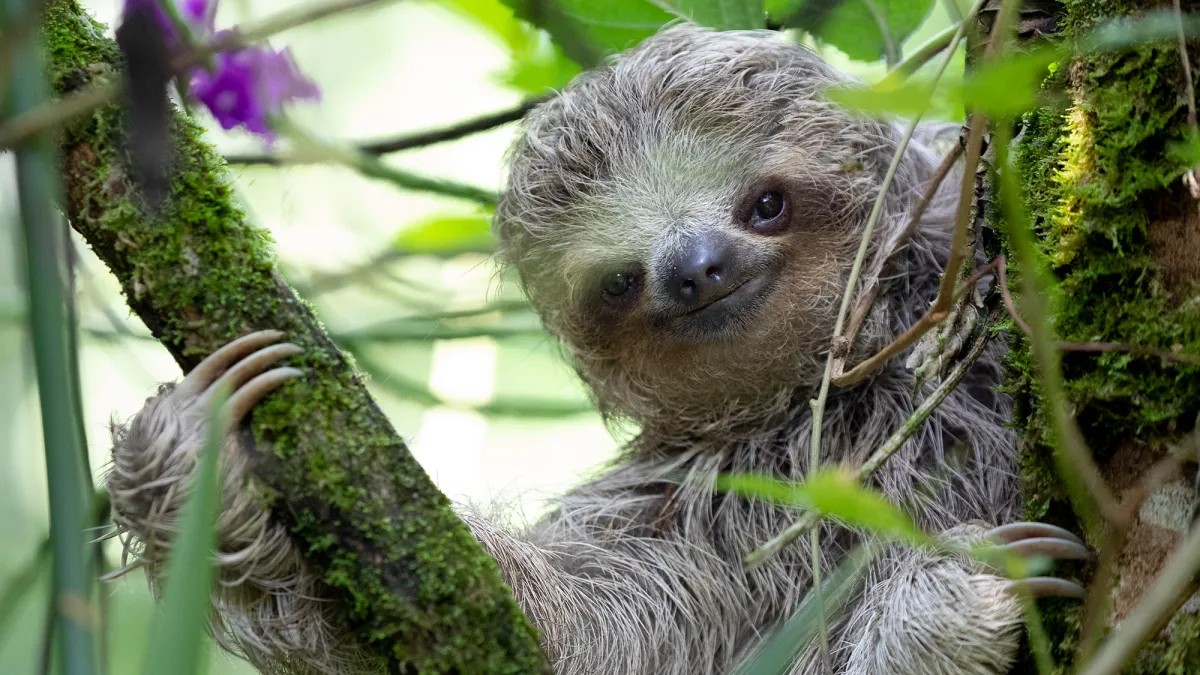
Every single week, the three-toed sloth does something terrifying. It leaves its tree. It climbs down to the forest floor.
It all happens for a bowel movement. A “bio-break,” as any remote worker would say.
But there’s a catch. Predators are everywhere near the ground. Falling or descending is the fastest way to die. On top of that, sloths move so slowly their metabolism is practically comatose. That short hike to the bathroom is an exhausting sprint, burning energy reserves that take days to replenish.
Jonathan Pauli, a wildlife ecologist at Wisconsin-Madison, puts it bluntly. It is like running five miles in the middle of a highway just to pee. Costly? Yes. Risky? Extremely.
So why do they do it?
You might think they could just let go from the safety of the branches. But that would break a fragile ecosystem.
The Moth Connection
The answer isn’t just about waste. It’s about a relationship. A mutualistic loop involving sloths, moths, dung, and algae.
Start with the moth. Cryptoses choloepi, the sloth moth, is flightless as an adult.
Here’s how it works:
- Adult moths hatch from dung and fly up to a sloth in the canopy.
- Once on the fur, they lose their wings’ purpose. They can no longer fly. Ever.
- They ride the sloth everywhere. Including that dangerous trip down.
When the sloth finally drops its load on the forest floor, the cycle resets.
Pregnant female moths jump into the fresh pile. They can’t fly into it; they literally hop. Then they lay their eggs.
This is their end. The adult dies.
“The larvae then pupate within that chamber,” Pauli says, noting that they actually chew hollow spaces into the dung itself.
Inside the waste, new larvae feast on the nutrients. They grow. They pupate.
And then, briefly, they become moths again. Wings unfold. They drift back up the tree trunk to find a new host. A new home. They settle in, lose the ability to leave, and wait for their offspring to make the journey again.
Living Camouflage
Now bring algae into the mix.
The third player.
Remember those flightless moths? Many die right there in the fur. Their bodies decompose. This releases nitrogen and phosphorus into the coat.
Sloth fur is weird. It has special channels that hold water and nutrients. Think of it as a hydroponic farm on an animal.
Decaying moths = fertilizer.
That fertilizer feeds algae. Specifically, Trichophilus. This algae doesn’t exist anywhere else on Earth except on sloths.
More algae means a thicker coat of green fuzz. It acts like a ghillie suit. The sloth becomes a blur against the canopy. A perfect camouflage trick.
But is there more?
Are They Farming Food?
Maybe the sloths are farming this green coat for food, not just cover.
Pauli’s team needed to check if the algae ended up in the sloth’s stomach. Their method was aggressive. They pumped the stomach contents of roughly twelve three-toed sloths.
What came out wasn’t entirely surprising. Lots of Cecropia leaves, the standard sloth diet. But there was something else.
Algae.
Since this specific algae lives nowhere but on the sloth, it had to come from there. The sloth eats its own fur. Or licks it clean enough to ingest the biomass.
Lab tests showed the algae is digestible. It’s rich in lipids. For an animal living on poor nutrition leaves, that’s a decent supplement.
So are they deliberately harvesting their own coat for snacks?
Or is it just a weird accident?
“It could be totally trivial,” Pauli suggests. Imagine eating a candy bar fast and accidentally swallowing a bit of wrapper. Not planned. Not intended.
It’s probably not conscious behavior. A sloth doesn’t think, “I need to re-stock my algae supply today.”
Instead, it’s evolution doing the steering. Sloths that interacted with these moths and grew this algae survived better. The traits persisted.
The Suicidal Commute Pays Off
Back to the climb down.
Why risk the jaguar? Why risk the exhaustion?
If they stay in the tree, the moths never get to the dung. The cycle breaks.
No ground trip means no egg-laying in fresh waste. No eggs mean no new moths. No new moths means no dead bodies to fertilize the fur.
No fertilizer means no algae bloom.
No algae means you stand out as a snack against the green background. And you lose your secret snack source too.
It’s not just a bathroom break. It’s system maintenance. The sloth sacrifices comfort for camouflage and nutrition.
Not a bad trade, really, if you don’t mind getting eaten on the way.
Ask Popular Science anything. We answer the questions you’re afraid to say out loud. Have a bizarre wonder? Drop it here.