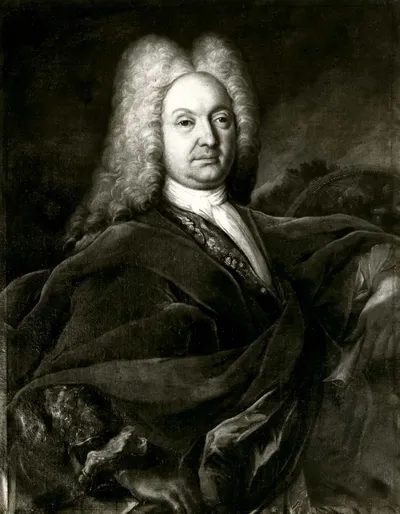
Johann Bernoulli is more than just a name in a textbook. He was a force of nature in 18th century mathematics. He was born in Basel, Switzerland in 1667 to a family obsessed with numbers. The Bernoulli brothers were the mathematical rock stars of their time. Even in that crowded room, Johann stood out.
He explored the new, messy and dangerous field of calculus, observing structures that others considered chaotic. He used it to measure curves. He used it to solve differential equations. He applied it to mechanical problems of practical importance.
From Medicine to Math Against All Odds
His path is not straight. His father is a pharmacist. Naturally, he wanted Johann to follow. Instead, Johann studied medicine. He received his Ph.D. degree in 1694. His dissertation focused on muscle contraction. This is solid work. But his heart was not anatomical.
Anyway, he turned to mathematics. His father was not happy about this. The younger generation ignored these warnings. By 1691, Johann was writing about calculus and integral calculus. They remained unpublished for many years. That patience paid off.
In 1692 he did something brave. He taught calculus to Guillaume-François-Antoine, the Marquis de L’Hôpital. It’s not just about coaching. This is the deal. L’Hôpital agreed to pay Johann for his mathematical discoveries. In fact, it was an early form of intellectual property.
Teach the best minds in the world
Johann did not stay long in Basel. Between 1695 and 1705 he taught at the University of Groningen in Holland. Then his younger brother Jakob died and he returned to Basel. He took a professorship. Sibling competition is fierce. The game ended with Jacob’s death. It also strengthens Johann’s legacy.
He outproduced his brother in sheer volume. His contribution is everywhere. He used calculus to determine the length and area of complex curves. This is not an abstract theory. There are also practical applications.
Consider the tautochrone. A curve where an object falls at a constant speed. Consider the tautochrone. It turned out to be very important for the construction of the watch. If you want accurate timing, you need to understand these curves. Johann provides mathematical methods that allow precision.
L’Hôpital’s law and the mystery of zero
A special rule is named after L’Hôpital. This solves the limits that would result in dividing zero by zero. This is called an indeterminate form. Johann discovered this method. He sent it to L’Hôpital in Paris.
L’Hôpital published it in his 1696 textbook Analyse des infiniment petits. This book is very impressive. Makes calculus more accessible. This rule was known as the L’Hôpital’s rule. Johann made the discovery. L’Hôpital became famous. A common arrangement throughout history.
Johann’s work extended beyond curves. He contributed to the theory of differential equations. He studied the mathematics of sails. He studied optics. A generalist in an age of specialization.
Johann Bernoulli’s isn’t just.
The Sailing Catenary and Broken Brotherhood
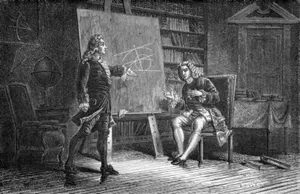
The Bernoulli brothers were great minds, but their collaboration was more of a fight than a symphony. They solve the same puzzles with the same intensity, but friction is inevitable. Let’s take the year 1691 as an example. They were fascinated by the shape of the sails when the ship was full of wind. Jacob discovered that the resulting curve was a catenary. He wrote a letter to John and boasted that he had solved the problem, but the problem was that he didn’t share the answer. He left his brother in the dark.
Johann took the bait. He solved it himself. When he published his discovery, he wasn’t just sharing the math. he threw a jab. He lamented that his brother had “apparently given up.” It was a low blow. Jacob writes down the solution and waits for an opportunity. This is not just an academic disagreement. This was the spark that ignited their personal war.
The Bet That Broke Them
If the sail dispute was a skirmish, the isoperimetric problem was the war to end it all. Challenge? Defines the shape of a closed plane curve of specified length that encloses the maximum area. It sounds abstract, but it is a battle for intellectual superiority.
In 1697, Jakob issued a direct challenge. He hoped John would solve the problem. Johann responded with a solution. He published it immediately and keeping the full derivation to himself. Jakob reviewed it and found it wanting. John’s answer is only partially correct.
Jacob doesn’t just argue. He bet.
He gambled that he could replicate Johann’s flawed derivation, point out all the errors, and offer a solution that was “actually” correct. The subsequent quarrel was vicious. It’s not just about math anymore. This is personal. This quarrel was the last break between the brothers.
Defending Leibniz and his last works
Johann was ardent in his friendships. He was equally keen in his resentments. Leibniz, like Isaac Newton and John, was unable to remain neutral when a dispute arose between G.W. Newton and John on the origin of calculus. He was a passionate defender of Leibniz. It was a partisan move, not an objective one.
Despite his turbulent personal life, his own contributions to mathematics were substantial He published his text on integral calculus in 1742. Soon after, he His work on differential calculus followed shortly after. It’s not all abstract theory. During his last years, he shifted focus. He mainly studied the principles of mechanics.
After his death, his works were collected under the name “Opera Johannis Bernoullii” and published in 1742 in four volumes. The math is still there. The bitterness has subsided. Although the brothers never spoke, their legacy lives on.