Roger Penrose didn’t just study black holes. He mapped them.
The British mathematician and relativist spent the 1960s calculating the basic features of these cosmic monsters. His work was so foundational that it earned him the 2020 Nobel Prize for Physics. He didn’t win it alone. He shared the honor with American astronomer Andrea Ghez and German astronomer Reinhard Genzel.
Penrose’s path to the top wasn’t linear. He earned his Ph.D. in algebraic geometry from the University of Cambridge in 1957. After that, he bounced around. Temporary posts took him to universities in England and the United States. By 1964, he settled at Birkbeck College in London as a reader, eventually becoming a professor of applied mathematics. In 1973, he moved to the University of Oxford to hold the Rouse-Ball Chair of Mathematics. He was knighted for his services to science in 1994.
The singularity and the map
In 1969, Penrose did something remarkable. Working with Stephen Hawking, he proved that all matter inside a black hole collapses to a singularity.
A singularity is a geometric point in space. Mass is compressed there to infinite density. Volume drops to zero. It’s a place where physics as we know it breaks down.
Penrose also developed a way to map the regions of space-time around a black hole. Space-time is a four-dimensional continuum. It has three dimensions of space and one of time. He called these maps Penrose diagrams.
A Penrose diagram allows one to visualize the effects of gravitation upon an entity approaching a black hole.
This visualization is key. It lets scientists see how gravity warps the journey of anything falling in.
Tiling and thinking
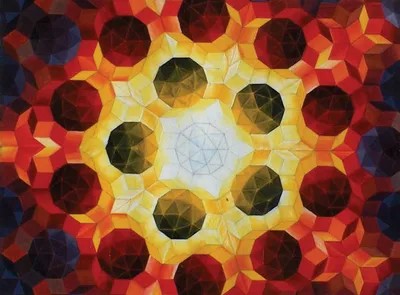
Penrose’s curiosity didn’t stop at cosmology. He discovered Penrose tiling. This is a set of shapes that can cover a plane. The trick is that it uses no repeating pattern. It’s aperiodic. It challenges our understanding of order and symmetry.
He also turned his gaze to the mind. How does consciousness work?
He argued that standard physics isn’t enough. Quantum mechanics is needed to explain the conscious mind. He laid this out in two books: The Emperor’s New Mind (1989) and Shadows of the Mind (1994).
His 2004 book, The Road to Reality, offers a massive overview of mathematics and physics. It’s an attempt to tie it all together.
Cycles of time
Penrose didn’t stop there. In 2010, he published Cycles of Time: An Extraordinary New View of the Universe. Here, he proposed conformal cyclic cosmology.
This theory frames the Big Bang not as a one-off event. It sees it as endlessly recurring. The universe expands, fades, and begins again.
The Royal Society recognized his broad impact long before the Nobel. They awarded him the Copley Medal in 2008. It’s one of the oldest and most prestigious scientific awards in the world.
Penrose keeps pushing boundaries. From tiling floors to the edge of the universe, he finds patterns where others see