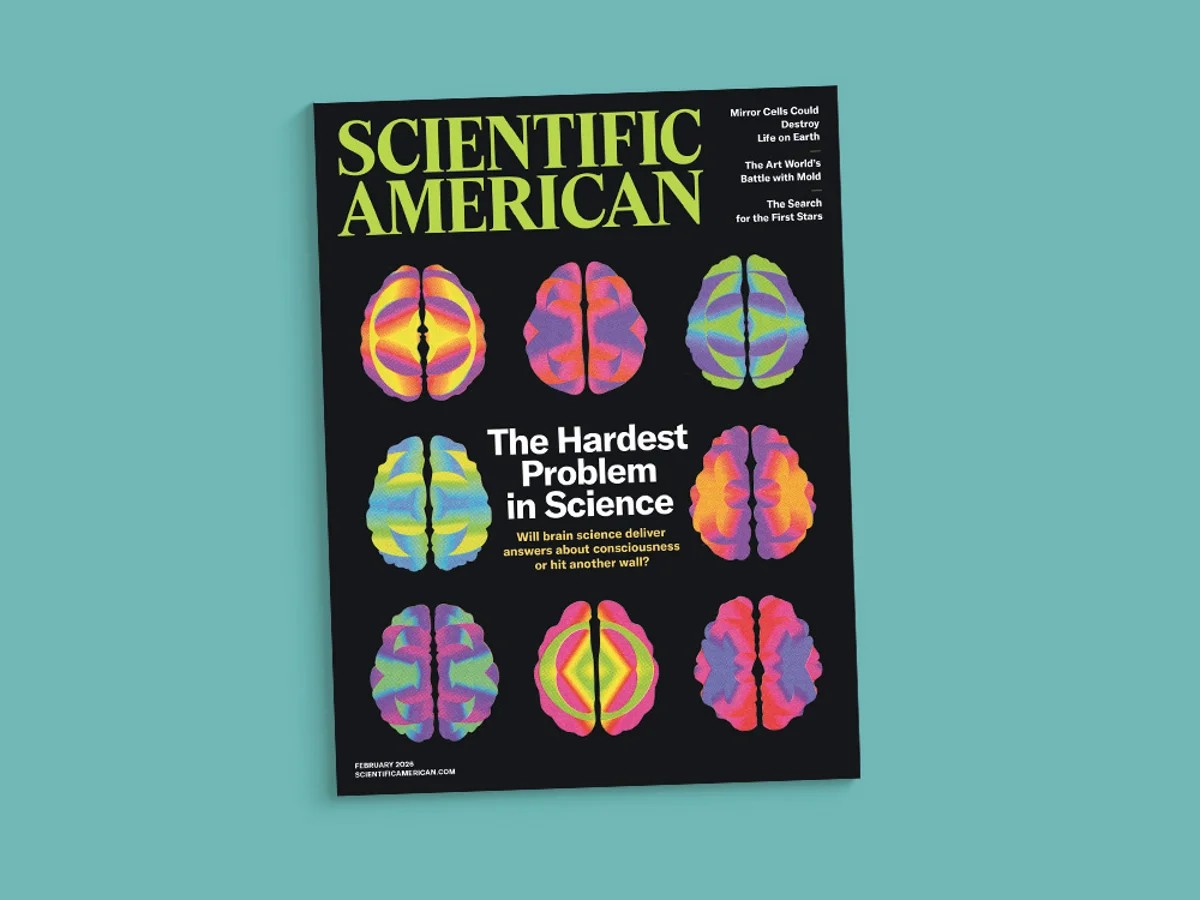
The February 2026 pile arrives. Readers are digging into the pages. Or at least their nightstands.
Lunar Archives and Cosmic Dangers
Daniel Spitzer found Peter Brannen’s piece on time capsules resting near a superstratum of CO2 literature. He’s got an idea. Put it on the Moon.
Calculations suggest Earth’s neighbor won’t leave our orbit until the sun swallows the system in about five billion years. That’s a long lease. Spitzer suggests parking our mixed legacy records near a lunar pole for whatever future civilization—or species—wants to judge us. Alternatively? He might offer up his own nightstand.
Then there is the mirror.
Vaughn S. Cooper’s “Deadly Mirror” laid out the bio-hazards of creating bacterium with inverted molecular structures. Ed Yalom sees a bigger problem waiting beyond Earth. Exploring the solar system means meeting things we didn’t pack. Extraterrestrial life might actually run on that mirror DNA. The deeper we go the higher the chance.
Frances Simison from Regina finds comfort in that very danger.
“I don’t think I have to worry… about nuclear waste… A mirror bacterium will be created… We will be wiped out pretty quickly.”
Her logic holds together in a specific way. Societal instability is coming. Improper nuclear waste storage is coming. Future generations will get sick. It’s inevitable. So why worry about the radiation if a synthetic apocalypse wipes us all out first? Life restarts. It becomes compatible with both threats. Less intelligent? Maybe. Simpler, perhaps.
Stars, Caustics, and Stress
Light bends. It’s how we see things that aren’t there.
José María Diego Rodríguez explained how galaxy clusters use gravitational lensing to show us the first stars. G. Richard Thompson wondered what actually allows us to estimate the dark matter hiding behind that effect. Is it the geometry? The focal lengths? The small, violent regions called caustics?
Rodriguez answers: curvature. Specifically the curvature produced by certain dark matter models acting as tiny microlenses. We find these near cluster caustics. Counting the lenses helps us keep or discard specific theories. It’s a census of the invisible.
Back on Earth the paradox is simpler to measure. Or harder to accept.
Anthony Vaccaro’s work on parenting suggests a split personality. Parents report more stress, lower moods, and daily depression. They also report greater life satisfaction. Anthony frames it as a contradiction. Jamal Bittar rejects the paradox entirely.
It’s not about conflicting feelings. It’s about bad metrics. Quick daily check-ins catch the exhaustion. They miss the pride. They ignore the love woven through the chaos. Sleep deprivation causes the stress. Money does. Lack of support does. Raising kids is tiring. It is also meaningful. You can be both.
Minds and Orbits
Consciousness isn’t a single thing. Kenneth Thomas notes that 40 years of neuroscience haven’t moved the needle on defining it. Allison Parshall’s article swaps “consciousness” and “awareness” like they’re synonyms. Thomas says they shouldn’t be.
He looks back. Way back. To Dogme and Hongzhi Zhengjue. Buddhist tradition suggests consciousness is mutable, impermanent, easily mistaken for “self.” Awareness? That is the constant. The fundamental layer. Science could use that distinction. It might actually work.
Space rocks crash harder than you think.
Phil Plait said asteroid collisions move faster than rifle bullets. Robert Masta questioned this. If two rocks are in the same belt aren’t they moving at the same speed? Relative velocity should be zero. Or close to it. Where does the bullet-speed come from?
Plait corrects him. Most orbit counterclockwise. True. But orbits aren’t circles. They’re ellipses. One asteroid might be slinging near the sun while another sits in a wider circle at the same moment. Speeds differ. Jupiter pulls at them, shifting their trajectories. The collision isn’t fast by choice. It’s fast by geometry.
These impacts don’t destroy the belt. They shatter individual rocks. Creating families from the debris.
An erratum waits in the wings.