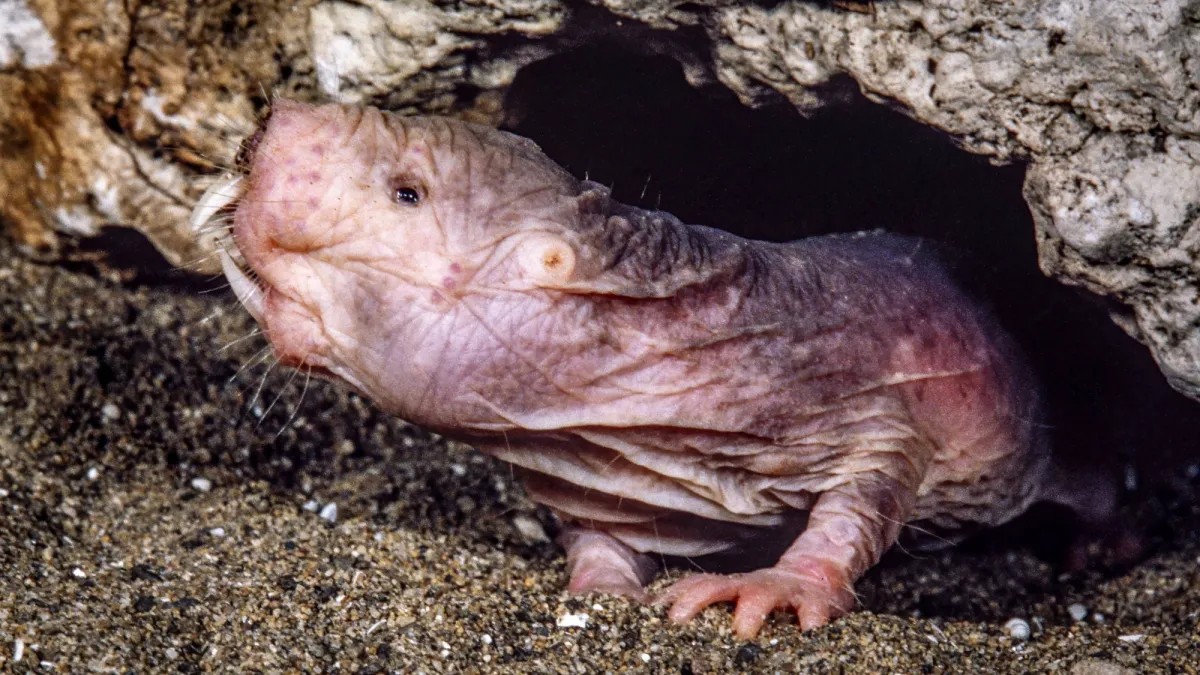
For decades, the social structure of the naked mole-rat (Heterocephalus glaber ) has been defined by a single, brutal concept: queen wars. In these underground colonies, where a single female reigns supreme as the sole breeder, the end of a queen’s reign has traditionally been viewed as a violent struggle for dominance.
However, new research published in Science Advances is challenging this long-held assumption. It turns out that these highly specialized rodents possess a “hidden” capacity for cooperation, allowing for peaceful successions when the colony faces environmental pressure.
The Eusocial Paradox
Naked mole-rats are among the very few mammals to exhibit eusociality —a social structure typically reserved for insects like bees and ants. In these societies, a strict hierarchy exists: one queen reproduces, while the rest of the colony functions as a collective workforce, maintaining tunnels, foraging for food, and nurturing the queen’s offspring.
This rigid system offers several biological advantages:
– Resource Efficiency: Energy is pooled to support a single litter at a time.
– Conflict Reduction: A singular reproductive focus minimizes infanticide within the group.
– Extreme Adaptations: These rodents are famously resilient, boasting long lifespans (up to 30 years), resistance to cancer, and an unusual lack of inflammatory pain.
While this stability works well in the wild, it creates a biological bottleneck. If the queen becomes infertile or dies, the colony’s survival is at risk, traditionally necessitating a violent takeover by subordinate females.
Stress as a Catalyst for Cooperation
To understand how these colonies handle disruption, researchers led by Janelle Ayres at the Salk Institute conducted a six-year study. Rather than focusing solely on the conflict, the team investigated resilience —the ability of a biological system to recover from stress.
The researchers introduced two specific environmental stressors to a lab colony:
1. Increased Population Density: Crowding the colony.
2. Relocation: Moving the colony to a new facility.
The results were unexpected. When the relocation compromised the queen’s ability to produce litters, the colony did not descend into a “bloody succession battle.” Instead, a subordinate female began a gradual transition to leadership.
“Our study reveals a ‘hidden’ side of reproductive organization in naked mole-rat colonies,” noted biologist Alexandria Schraibman.
Remarkably, the outgoing queen and the rising subordinate actually cooperated. They even maintained overlapping pregnancies to ensure the colony’s survival during the period of instability. Eventually, a second subordinate took over, and the former queen transitioned peacefully into a non-reproductive role.
Why This Matters
This discovery shifts our understanding of how social animals manage crisis. It suggests that naked mole-rats are not just slaves to a rigid, aggressive hierarchy, but possess a flexible social mechanism that prioritizes the survival of the group over individual dominance.
By studying how these rodents balance cooperation and competition, scientists hope to gain broader insights into biological resilience. Understanding how systems—whether social or cellular—recover from stress can provide vital clues into the fundamental principles of health and disease in all living organisms.
Conclusion: The discovery of peaceful succession proves that naked mole-rats can pivot from aggressive competition to cooperative survival when environmental stress threatens the colony’s stability.