


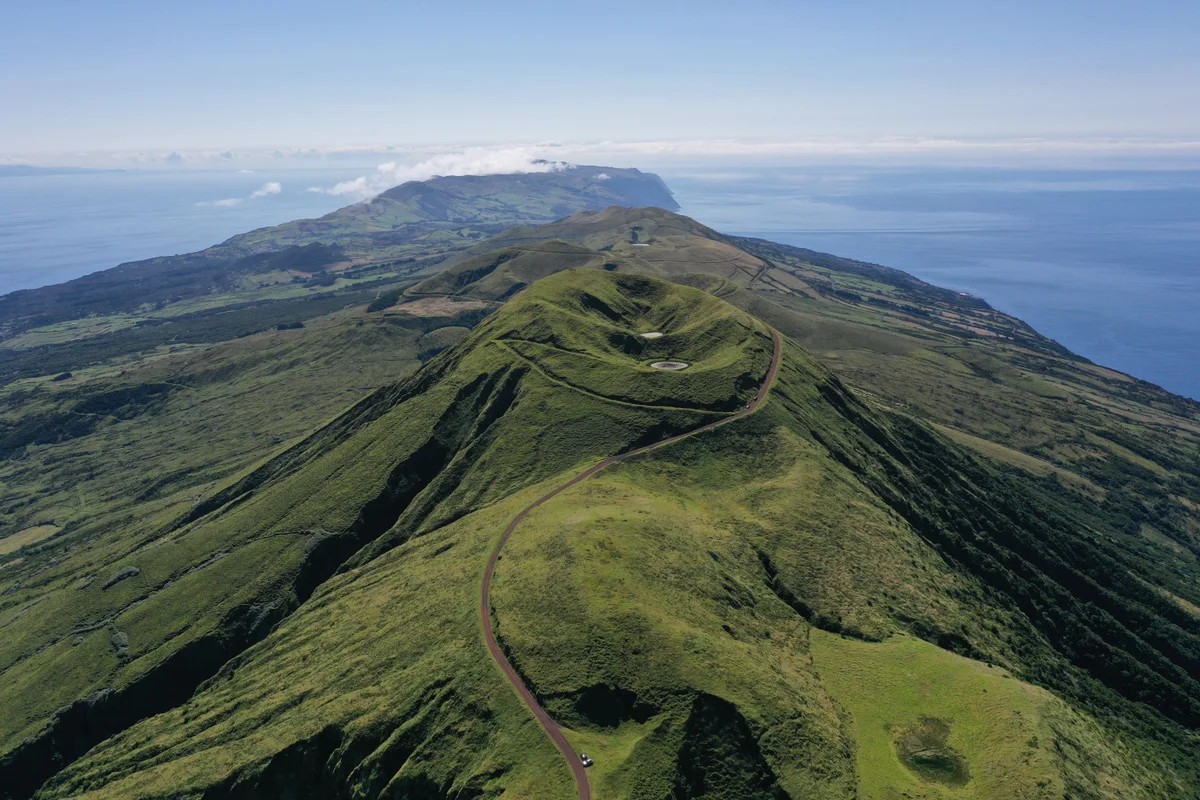
In March 2022, the residents of São Jorge Island in Portugal’s Azores archipelago were gripped by fear. A sudden swarm of thousands of tremors suggested that a massive earthquake or a violent volcanic eruption was imminent, triggering emergency evacuation plans. Yet, as quickly as the shaking began, it stopped. No eruption occurred, leaving scientists to wonder why such intense seismic activity had suddenly vanished.
A new study published in Nature Communications has finally provided an answer—one that serves as a sobering warning for volcanologists worldwide.
A “Failed Eruption” in Stealth Mode
The research reveals that the seismic activity was not the beginning of an eruption, but rather the final, gasping stages of a massive movement of molten rock that had already occurred in near-silence.
According to the study, a massive sheet of magma—equivalent to the volume of 32,000 Olympic-size swimming pools —raced from a depth of 12 miles to just one mile beneath the island’s surface in less than a day. Remarkably, this rapid ascent produced almost no large, rock-breaking earthquakes.
How did the magma move undetected?
The reason for this “stealth mode” lies in the island’s geology. Instead of forcing its way through solid, unbroken rock (which would have caused massive tremors), the magma utilized a preexisting fault network known as the Pico do Carvão system.
- The Path of Least Resistance: Fault lines are essentially labyrinths of fractures and permeable materials.
- The Result: The magma “tunneled” through these cracks rather than smashing through the crust, allowing it to ascend with incredible speed and minimal seismic noise.
The Mechanics of the Seismic Swarm
If the magma moved so quietly, why did the island eventually start shaking? The answer lies in what happened when the magma hit a dead end.
The upward surge was eventually halted by a rigid geological barrier near the surface. Once the magma stalled, its internal pressure changed; fluids and gases began leaking out of the magma into the surrounding fault cracks. This release of pressure and movement of fluids triggered the thousands of modest quakes that finally alerted authorities.
By the time the seismic swarm became detectable to humans, the magma was already dangerously close to the surface.
Why This Matters for Volcanic Forecasting
This discovery fundamentally challenges how scientists monitor volcanic threats. Traditionally, a buildup of large earthquakes is seen as a primary warning sign of an impending eruption. However, the São Jorge event proves that magma can reach the doorstep of the surface without providing those classic warnings.
“This is a bit of a wake-up call that these things could happen really quickly, and perhaps more quietly, than we anticipated,” warns Rebecca Williams, a volcanologist at the University of Hull.
The Azores islands are particularly vulnerable because they sit atop a “double engine”: a mantle plume of rising heat and the junction of three diverging tectonic plates. This combination makes volcanic activity a matter of “when,” not “if.”
Conclusion
The São Jorge event demonstrates that magma can exploit existing geological fractures to bypass traditional seismic warnings. This “stealth” movement suggests that current monitoring methods may need to rely more heavily on non-seismic data, such as GPS and satellite deformation, to detect eruptions before they become catastrophic.


