Game theory isn’t just abstract math. It is a tool for understanding real-life conflicts where your success depends on what other people do. Think of it as a framework for analyzing situations where parties have interests that are similar, opposed, or somewhere in between.
The field was born in 1944. Mathematician John von Neumann and economist Oscar Morgenstern published The Theory of Games and Economic Behavior. Their book laid the groundwork for a branch of applied mathematics dedicated to these interplays.
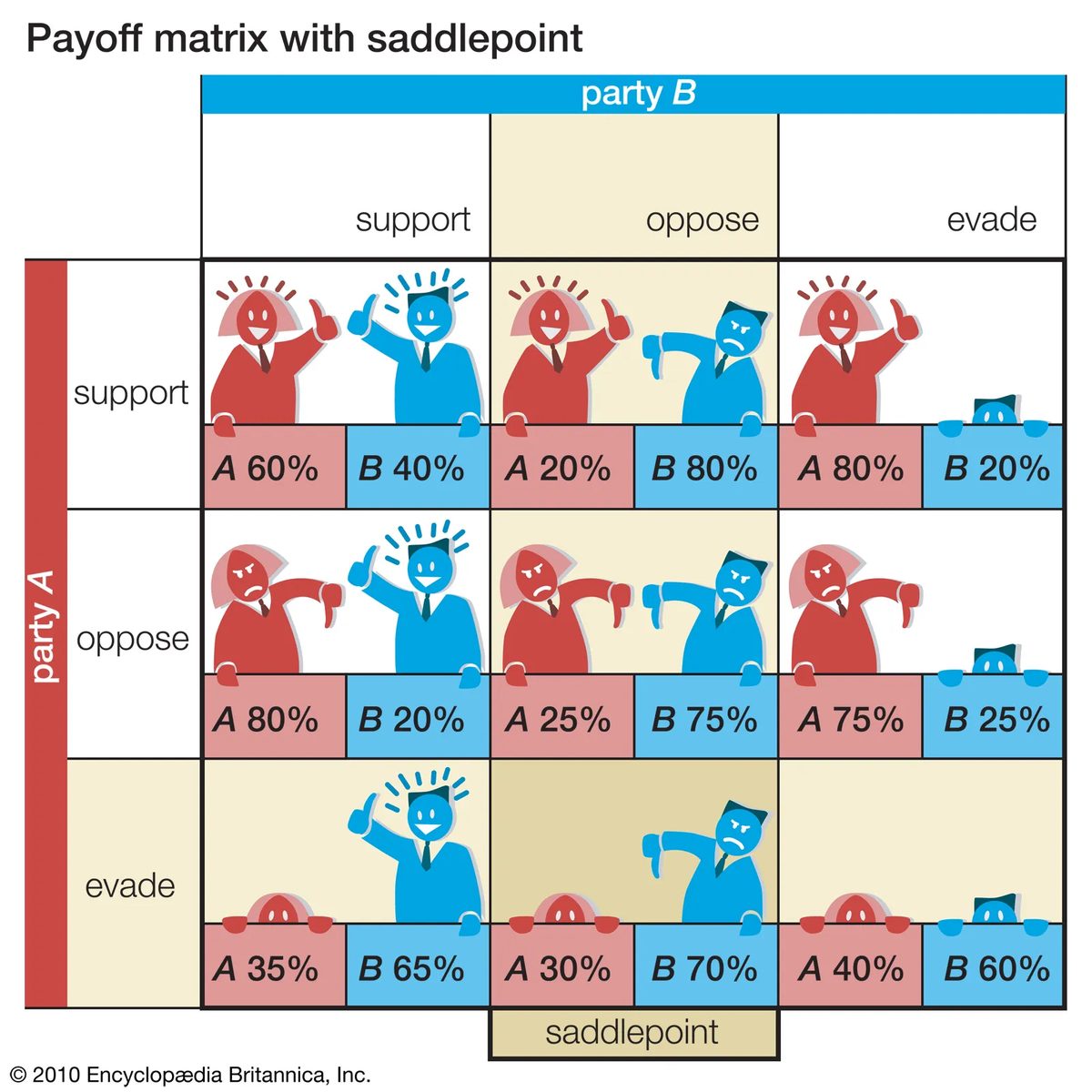
In a typical scenario, players follow fixed rules. They try to outsmart one another. This requires anticipating the moves of others before making your own. The goal is to find a solution. A solution prescribes the optimal strategy for each participant. It also predicts the average outcome.
For decades, experts believed every contest had at least one such solution. That belief held until 1967. A highly contrived counterexample proved otherwise. Some games simply don’t have a straightforward answer.
This concept ties closely to decision theory. It also includes famous models like the prisoner’s dilemma. These examples show how logic breaks down when human behavior enters the equation.
Why Your Best Move Depends on Others
Most people make decisions in a vacuum. They assume their choices don’t affect the outcome. Game theory rejects this. It argues that in competitive or cooperative settings, your best move is always a reaction to potential moves by others.
Consider a simple pricing war between two coffee shops. If Shop A lowers its price, Shop B must decide whether to match it or stay premium. The outcome for each depends entirely on the other’s choice. This is an interplay of mixed interests. One might want to steal market share. The other wants to maintain profit margins.
The mathematics behind this helps predict the expected result. It doesn’t guarantee you will win. It only shows what the optimal strategy looks like given the constraints.
The Limits of Predictability
Until the late 1960s, mathematicians thought they could solve any game. They assumed a stable equilibrium always existed. That changed in 1967. Researchers devised a counterexample that defied this rule.
This discovery was significant. It showed that some games have no solution in the traditional sense. You cannot always prescribe a single best strategy. Sometimes, the outcome remains unpredictable by design.
This doesn’t make the field useless. It just sets boundaries. Game theory works best when strategies are clear and players are rational. When those conditions fail, the model struggles.
Where Game Theory Matters Most
You encounter game theory applications daily. They appear in economics. They show up in biology. Even in computer science, algorithms use game-theoretic models to manage network traffic.
For students and lifelong learners, the core lesson is about anticipation. It teaches you to look beyond your own actions. You must consider the incentives of everyone else at the table.
Is it possible to outsmart everyone? Sometimes. But often, the best strategy is simply to understand the rules of the interaction. Knowing which side of the interplay you are on changes everything.
The field continues to evolve. New models emerge to handle more complex, real-world scenarios. The basic premise remains the same. Your move matters, but only because of what others do next.