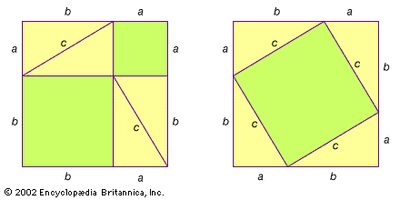
The equation a ² + b ² = c ² is likely the first thing most students encounter when they think of math. It is the rule that the sum of the squares of the two shorter sides of a right triangle equals the square of the longest side. We associate it with Pythagoras. The Greek philosopher and mathematician lived around 570 to 490 BCE. He gets the credit. But the history is messier. The theorem existed long before he was born.
Evidence shows that Babylonian scribes understood these relationships as early as 1900 BCE. Tablets from that era include accurate calculations for the square root of 2. That is the length of a hypotenuse when both legs are length 1. The same tablets list Pythagorean triples. These are integer sets that fit the rule. Take 3, 4, and 5. Square them. Add 9 and 16. You get 25. The math works. It was not new to Pythagoras. It was not even new to Euclid.
Ancient Origins and Misattributed Credit
People in ancient India knew this too. The Baudhayana Sulba-sutra, written between 800 and 400 BCE, mentions the relationship. It predates the Greek formalization by centuries. Yet, the name stuck to Pythagoras. Why? Probably because he started a school in Croton, Italy.
This was not a modern university. It was more like a monastery. Members took strict vows of secrecy. Any new mathematical result produced by the group was attributed to Pythagoras. This explains why we credit him. It does not mean he proved it. The first proof is lost to history. Some scholars think the standard geometric proof shown in textbooks might have been the original. Others suggest independent discovery in multiple cultures. The attribution is political, not just historical.
Euclid’s Windmill and the Problem of Numbers
Euclid formalized the theorem in Elements, Book I. It is proposition 47. The proof is famous. It is often called the “windmill” proof because the diagram looks like a windmill. Euclid placed it at the end of Book I. He used it as a capstone.
He likely invented this specific proof for a reason. At that point in Elements, Euclid had not yet established that line lengths could be manipulated like numbers. He deals with commensurable quantities—lengths that share a common measure. This changes in Book V. By saving the theorem for Book I, he used geometry to bypass the limitations of number theory at the time. A later proof in Book VI is easier. It uses similar triangles. The areas of similar triangles are proportional to the squares of their sides. But the windmill proof stands out. It is elegant. It is visual. It requires no algebra, just shapes.
Beyond Squares: Generalizing the Theorem
The theorem is not limited to squares. Euclid showed that any symmetrical regular figures drawn on the sides work. The area on the hypotenuse equals the sum of the areas on the legs. This applies to semicircles. It applies to triangles. It applies to hexagons.
Consider the lunes of Hippocrates of Chios. These are crescent-shaped figures formed by semicircles. They fit the rule. The area relationship holds. This generalization extends the theorem’s utility. It is not just about squares. It is about area relationships in right triangles. The core principle remains constant. The geometry shifts. The truth stays.
Why This Matters for Modern Learners
Students often memorize a ² + b ² = c ² without context. They treat it as a static rule. It is not. It is a historical artifact. It reflects knowledge passed down through Babylon, India, and Greece. Understanding the timeline changes how you see the math. You realize that proof is not always tied to a single genius. It is a collective effort.
When you study the windmill proof, you are looking at a solution to a specific problem Euclid faced. He needed to relate areas without relying on numerical ratios. The visual approach solved that. Later, the algebraic approach took over. Both are valid. Both are useful.
The theorem’s endurance is due to its simplicity. It connects shape and number. It bridges geometry and arithmetic. That connection is powerful. It allows engineers to calculate distances. It helps architects design stable structures. It gives programmers a way to measure spatial relationships. The applications are endless. The origin story is even more interesting.
Some might ask which version of the proof is best. The answer depends on what you need. Visual? Use Euclid. Algebraic? Use the equation. Abstract? Consider the generalization to any similar figures. Each perspective adds depth. None is superior. All are part of the same truth.
The story does not end with Euclid. Mathematicians have found hundreds of proofs. Some are elegant. Some are absurd. Some are wrong. The variety itself is the point. It shows that mathematics is not a single path. It is a landscape. You can approach it from many directions. The destination is the same. The journey is different.
This perspective helps students who struggle with the material.
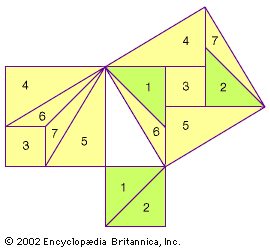
The Nine Chapters on the Mathematical Procedures, a foundational text from first-century China, didn’t just list right-triangle problems. It provided solutions for finding side lengths when two were already known. Centuries later, Liu Hui tackled the geometry in his Commentary. He offered a proof of the Pythagorean theorem that looked like a puzzle. The method involved cutting up the squares built on the triangle’s legs. Then, you rearranged the pieces. The goal was to make them fit perfectly into the square on the hypotenuse. Think of it as an ancient tangram. The original diagram is lost, so modern reconstructions try to capture that logic.
The theorem has held minds for nearly four millennia. We are not talking about a handful of explanations. There are over 300 distinct proofs documented today. The list of contributors reads like a history of human intellect.
Who proved the Pythagorean theorem?
You might expect the list to be dominated by Greeks. It is, but not exclusively. Pappus of Alexandria, who flourished around 320 CE, contributed his own geometric approach. The tradition didn’t stop at the Mediterranean. Thābit ibn Qurrah, an Arab mathematician and physician (836–901), added to the body of knowledge. His work bridged cultures and centuries.
Later, the Renaissance brought Leonardo da Vinci into the fold. The artist-inventor (1452–1519) didn’t just paint; he dissected the problem visually. His perspective showed that mathematical beauty could be aesthetic. Then came James Garfield. Yes, that Garfield. The twenty-second U.S. president (1831–1881) derived a proof using trapezoids. It was simple. It was elegant. It proved that you don’t need a degree in mathematics to understand the relationship between a right triangle’s sides.
Why does this matter now?
These aren’t just historical curiosities. They represent different ways of seeing the same truth. Liu Hui’s dissection method teaches spatial reasoning. Garfield’s algebraic approach teaches flexibility. Pappus’s work highlights the power of proportion.
When students ask how to remember the theorem, they are often looking for a trick. The real value lies in the variety of proofs. Each one offers a new lens. One person might grasp the concept through Liu Hui’s cutting. Another might click with Da Vinci’s symmetry. The existence of 300+ proofs suggests that the theorem is not a single fact. It is a gateway. It opens into geometry, algebra, trigonometry, and even physics.
The Nine Chapters solved practical problems. Land surveying? Construction? The math served a purpose. Today, we often strip the math of its utility. We treat it as abstract. But the Chinese approach reminds us that geometry began in the dirt. It began with measuring fields. It began with building things that stood up.
Liu Hui’s reconstruction, while not original, captures that spirit. It is tactile. You can imagine holding the pieces. Rearranging them. Watching the area stay constant while the shape changes. That is the core insight. Area is invariant. The Pythagorean relationship holds because the space under the squares is conserved.