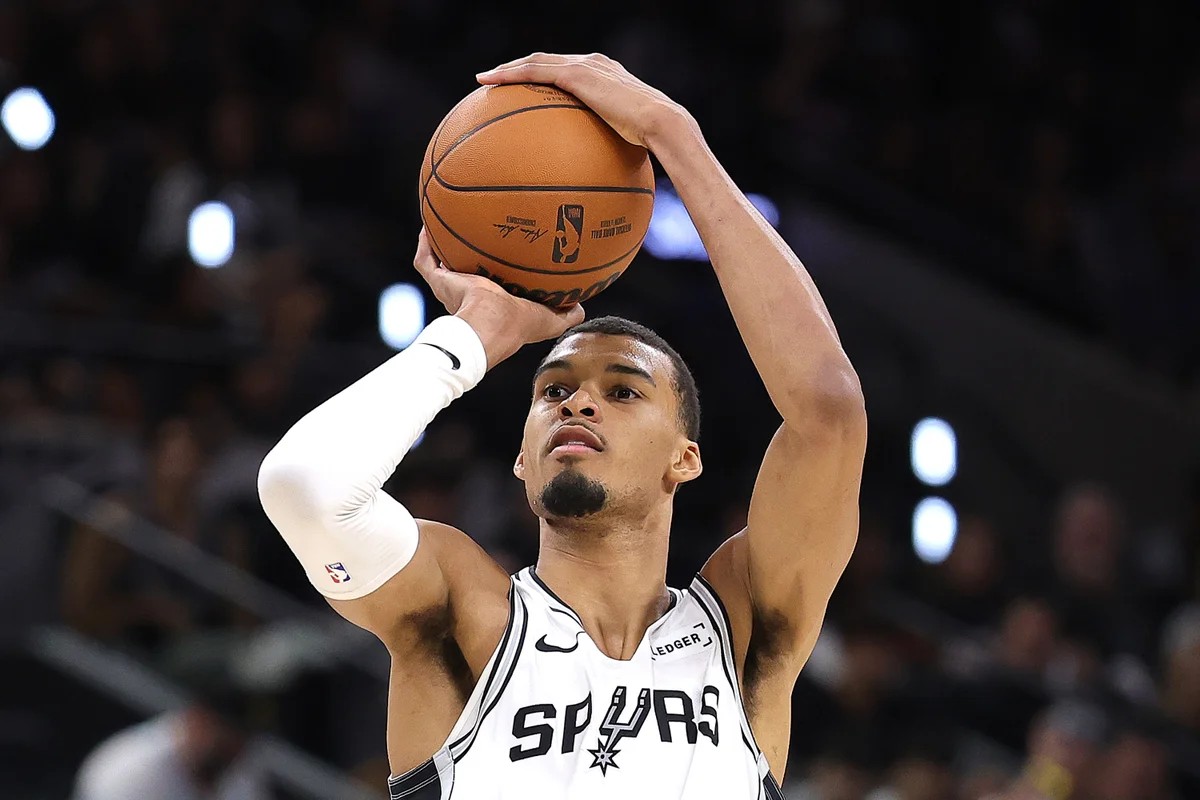
Science has answers. Most of the time. But then Victor Wembanyama exists, and suddenly the equations get weird.
Casual fans call him an Alien. That’s not just hyperbole. It’s a reasonable conclusion based on data. He’s seven-foot-four. Forwards don’t come like this. Centers who shoot deep threes on a routine basis are rare enough. Doing both while guarding the rim is a biological glitch in the system.
Look at Game 1 of the Western Conference Finals against OKC. Down the stretch, overtime, clock melting down. Wemby heaves a triple. Deep. Swish. Ties it. Spurs win in double OT. It felt inevitable in the moment, impossible on paper.
So why does it work? Scientific American asked physicists. And biomechanists. They wanted to know how the league’s tallest player keeps connecting on shots that defy logic.
“He’s just launching that thing.”
Larry Silverberg from North Carolina State says it like that. Flat. Disbelieving. Usually, big men stick to layups and hooks. Deep threes? That’s small-ball territory. Wemby blurs the lines.
Height should help. Simple math. The hoop is ten feet high. Wembanyama releases the ball way above that. Fewer defenders can touch the arc. Less air resistance to fight? Maybe. A 2008 Silverberg study noted higher release points improve accuracy, provided the launch remains consistent. Consistency is the kicker.
Theory breaks down in practice.
Dimitrije Cabarkapa from the University of Kansas sees it differently. Being tall isn’t a free pass for shooting mechanics. Big players often never develop the skill early. Why bother shooting threes when you can dunk on people? Then you grow into a shooter mold. It’s awkward. Long levers. Heavy limbs. Coordination suffers.
Amy Pope at Clemson puts it bluntly.
“Many tall players have difficulty because their long arms make the shooting motion harder to control.”
Wemby doesn’t care. He stands still. Vertical torso. Minimal forward momentum. Most shooters have to jump hard to clear defenders, which disrupts balance. Wembanyama doesn’t need that boost. His release point is sky-high already. A tiny vertical jump. A small wrist flick. Snap. The ball flies true.
Controlled. Balanced. Repeatable.
Then there’s the flexibility factor. You can’t just be long; you have to bend.
Cabarkapa insists on “bottom up” mechanics. Squat deep. Keep the core straight. Tuck the elbow. Hip flexion, knee flexion, ankle mobility. If your joints won’t bend, you can’t generate force. You’ll never get the rhythm right.
Wemby bends like rubber.
That’s the secret sauce, perhaps. Or just raw talent manifesting as physics defiance. Silverberg sees the strategy, though. Wemby knows defenders can’t bother him. He knows the range is too deep for most contesters. So he extends it further. Why not?
Is he playing basketball, or just breaking the sport’s design constraints?
It’s a creative gamble. Most players stick to what’s safe. Wembanyama looks at the three-point line and sees it as a suggestion. He works on the shots no one else touches. It’s neat, sure.
But also terrifying.
If this continues… if they hit New York in the Finals… the game might never be the same again. We’re watching a prototype. A beta version of what a player could be. And the patch notes aren’t looking good for the rest of the league.