


We trade secrets across wires every day.
That trade relies on one fragile thing. Randomness.
Encryption isn’t magic. It’s math wrapped in unpredictability.
If you can predict the next bit, you break the lock.
Most digital locks today use pseudorandom numbers. They look messy, sure, but they follow rules. Hidden, subtle, predictable rules.
Conventional computers are deterministic beasts. They crunch 1s and 0s through transistors that don’t know how to guess. They can’t toss a coin. Not really.
They just pretend to.
A quantum computer doesn’t blink at these fakes.
It spots the pattern instantly.
So we need something worse than noise. We need true chaos.
“It is very difficult for a computer… to generate a random value… everything that goes on in the scale of logic is basically completely predictable,” says Renato Renner from ETH Zurich.
Entangled uncertainty
Enter the qubit.
It doesn’t sit still.
A classical bit is either 0 or 1. A qubit? It holds infinite states simultaneously.
It exists in a blur.
Until you measure it. Then it collapses. Pop. A single result.
The new system uses this collapse to create randomness that no amount of computing power can reverse-engineer.
The researchers kept two qubits in a vacuum. Near absolute zero. At opposite ends of a thirty-meter tube.
Why so far apart?
To keep the world outside from sneaking in.
No hidden variables. No classical physics creeping into the result.
The qubits were entangled. Linked by the weird logic of quantum mechanics.
Measure one, and you know the other. Or you think you do.
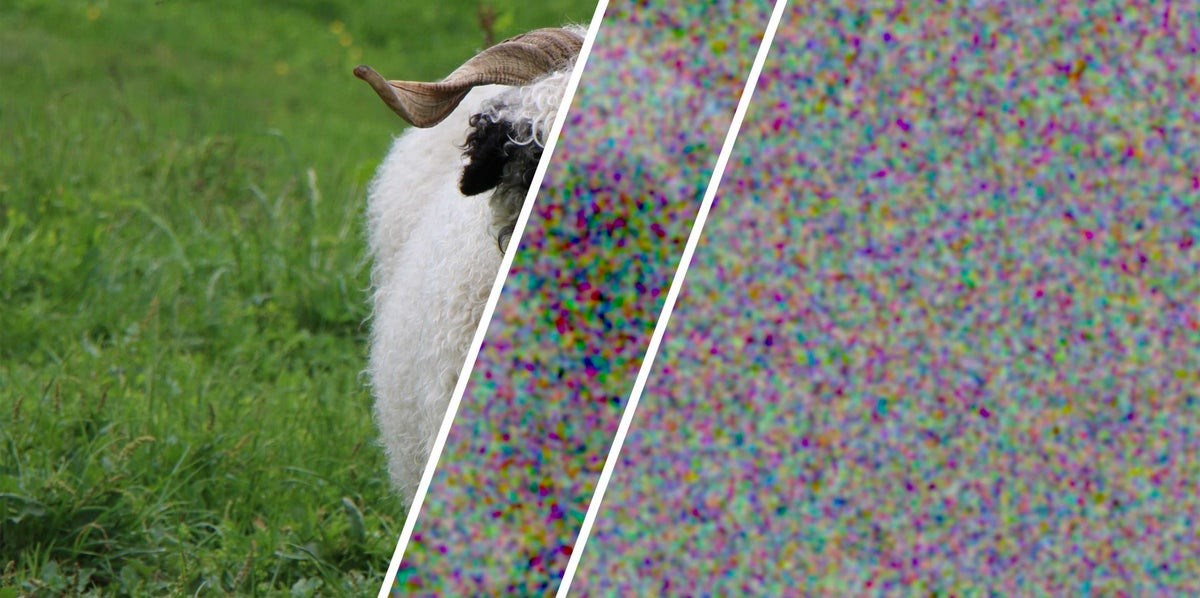
The setup was tested on a picture of a sheep.
Pixels became probabilities.
The output?
A scrambled mess of color and noise.
Impossible to unscramble.
Even for a quantum adversary.
Certifiable noise
Trust is the second ingredient in the security soup.
You can’t just take someone’s word for it that a number is random. You have to prove it.
The team ran a Bell test.
About one and a half billion of them.
This tests for “local realism”—basically checking if the particles are cheating by hiding a predetermined answer.
The test says they aren’t.
“Our setup is one that allows you to… run many Bell tests with good speed,” says co-author Andreas Wallraff.
The twist?
The second qubit acts as a verifier.
Previous attempts at quantum randomness usually trusted the device.
This method checks itself.
If the correlation fails, the number is discarded.
Only the unpredictable ones make the cut.
A problem without end
Quantum computers capable of cracking modern encryption are still mostly theoretical.
Far away, perhaps.
But bad randomness? That’s here now.
Wikipedia lists dozens of hacks caused by bad number generation.
Not theoretical.
Real money lost.
Real keys stolen.
This fix works for today. And for tomorrow.
Whether you are hiding from a supercomputer in 2025 or a quantum giant in 2050, you need unpredictability.
So is perfect randomness possible?
Maybe.
But until we build machines that think in probability, we’d better get good at trusting the quantum mess.
Because the pattern never lies.


