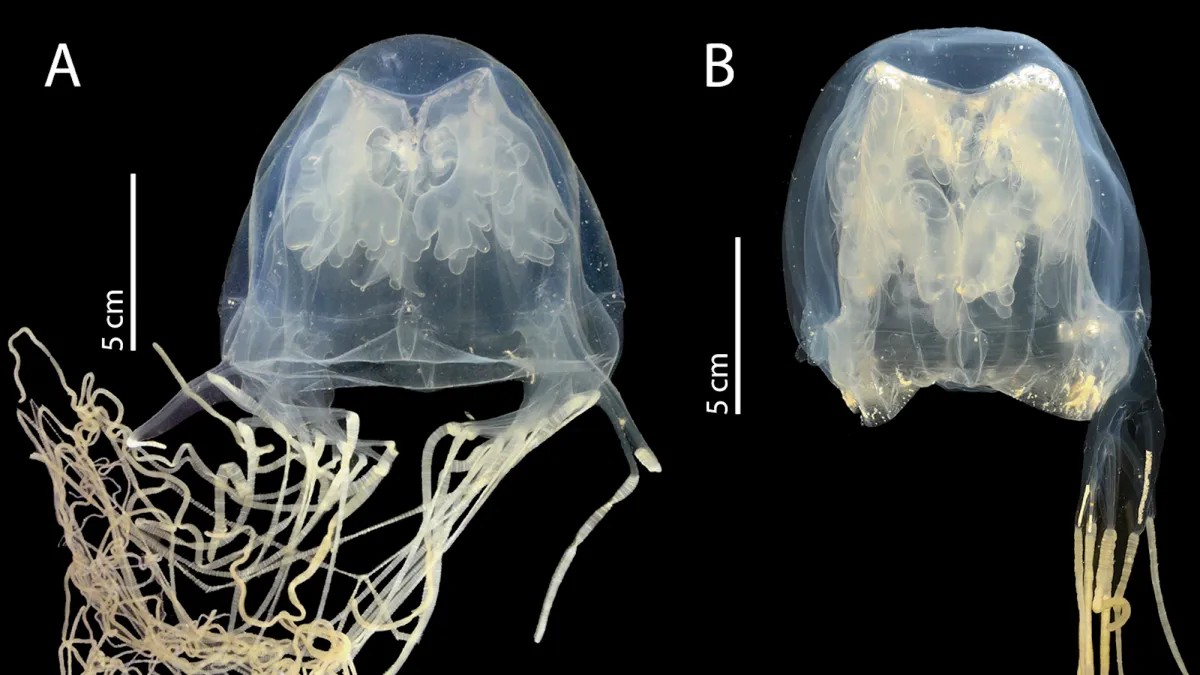
New box jellyfish named Chironex blakangmati is bad news. You don’t want to meet it. And you certainly don’t want to run into it from behind.
Look at the name. It’s Malay.
Translated, it means death from behind. Or, more broadly, the island where that kind of death happens.
Sentosa means peace. Historically though it was Pulau Klakang Mati. The Island of Death from Behind.
Cute contrast. Cheryl Ames from Tohoku University in Japan found this creature off Sentosa Island, Singapore. She thought she was just adding to her collection of Chironex yamaguchui. Common stuff, right?
No.
Genomic testing said otherwise.
She actually had to dig up an old yamaguchiui sample sitting in a freezer in Okinawa. Just to be sure.
“We realized they were completely distinct,” she said.
Fine. But what’s different?
Mostly it’s the perradial lappets. Those are the structures on the bottom of their square bell. They help the jellyfish swim. Yamaguchiui has pointy little canals on them. Blakangmati? None. Smooth edges.
Does it matter to you if you’re swimming?
Only insofar as it identifies the animal. Both species have complex eyes. Not those blind drifters floating with the tide. These guys see. They hunt.
They use those muscles, reinforced by those lappets, to power through the water toward their prey. Actively.
It’s impressive biology, really. Deadly biology, sure, but precise. They evolved eyes to lock onto targets. They built motors to close the gap.
And the old island name still fits.
Even if the modern maps say otherwise.
Peace and tranquility sounds nice, does it not? But the jellyfish remembers the old name. It waits in the clear water. And if you aren’t looking where you’re going?
Well. History tends to repeat itself. 🦑