David Harasti still sees that fish.
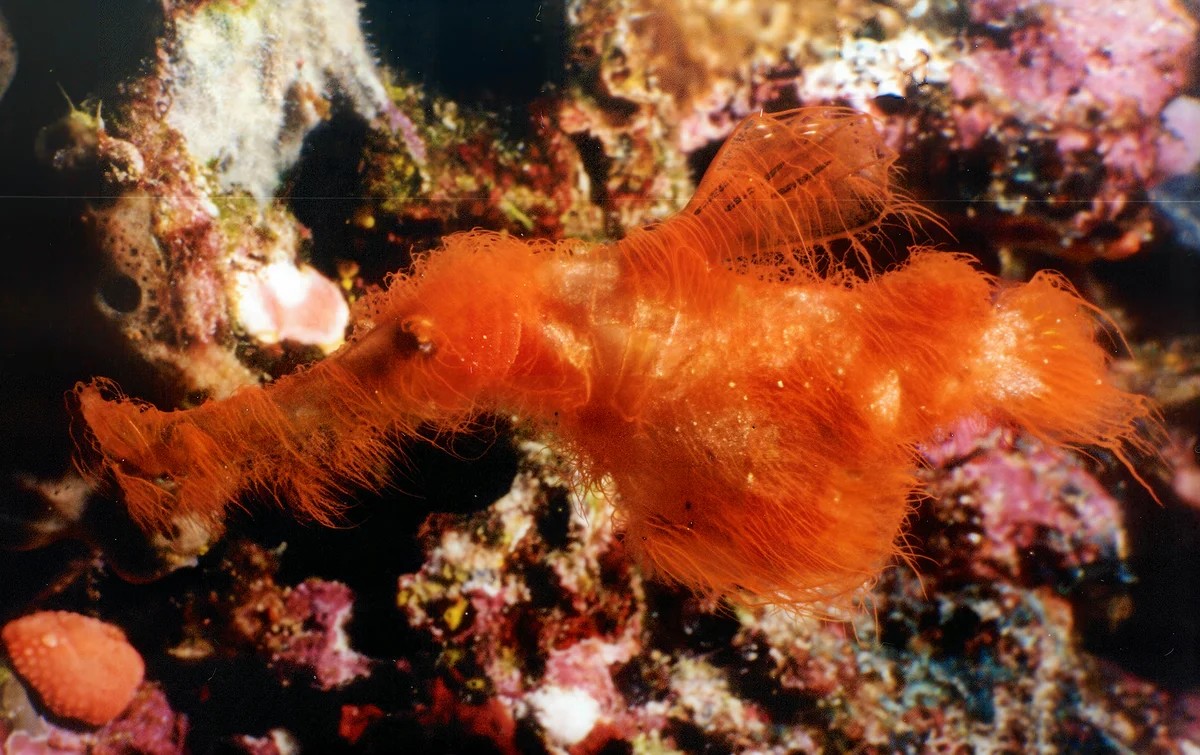
He saw it way back in 2003 while diving off the coast of Papua New Guinea. A flash of red. Shocking hairiness. It looked nothing like what marine biology usually produces. He knew immediately this wasn’t on the radar.
Then? Nothing.
Six more visits to that exact spot. Zero sightings. Doubt creeps in when you’re the only one who saw something. Did his brain conjure a hairy red phantom? To settle it, he turned to the Great Barrier Reef diving community. Then the archives of the Australian Museum. It turns out the fish wasn’t imaginary just waiting for confirmation.
Scientists finally nailed it. Solenostomus snuffleuparus. Yes, that is the real scientific name.
It’s a nod to Sesame Street’s shy monster friend.
“Yeah, this looks like Snuffles. It is scary,” says Graham Short. Short works at the California Academy of Sciences alongside the Australian Museum. He co-wrote the paper. The resemblance is almost identical, he notes, then adds. They actually emailed Sesame Street Australia about the naming choice. Maybe after a drink. The answer came next day. Approval granted.
A hairy disguise
The creature measures one to an inch and a half. Tiny. Found only in the southwest Pacific.
This discovery marks the seventh known ghost pipefish species. Ghost pipefish? They’re seahorse relatives. Camouflage is their superpower. Evolution did its thing here with dramatic flair.
They look like floating red algae. Divers walk right past them without thinking twice.
Most divers see red blobs in the current and keep swimming. That’s the point.
But don’t be fooled by the cuteness.
Ghost pipefishes are poorly understood. We know so much from dive logs, guesswork, and fragments of observation. Like their seahouse cousins, females grow larger while males brood the eggs.
They hunt too. CT scans reveal the truth inside their bellies. Skeletons of smaller fish sit digested in S. snuffleupagus guts. For something that adorable it’s a predator. Ruthless little thing.
Anatomy of the strange
How do you know it’s a new species? Not just a weird variant?
Science looks at bones and code. The new species packs more vertebrae than any known relatives. Then comes the mitochondrial DNA analysis. It shows a divergence of about eighteen million years ago. Long time ago to split from its nearest neighbor.
And the hair? That’s not mammalian. It’s filaments sprouting from hard bony plates. The fish lacks traditional skin so these plates form almost an exoskeleton. Other pipefish species have some hairiness, sure, usually just under the snout.
This one takes the aesthetic all the way.
It looks ridiculous.
Which is exactly why it survives. You keep looking at algae until it eats you. The ocean favors the strange, after all. What will we miss next