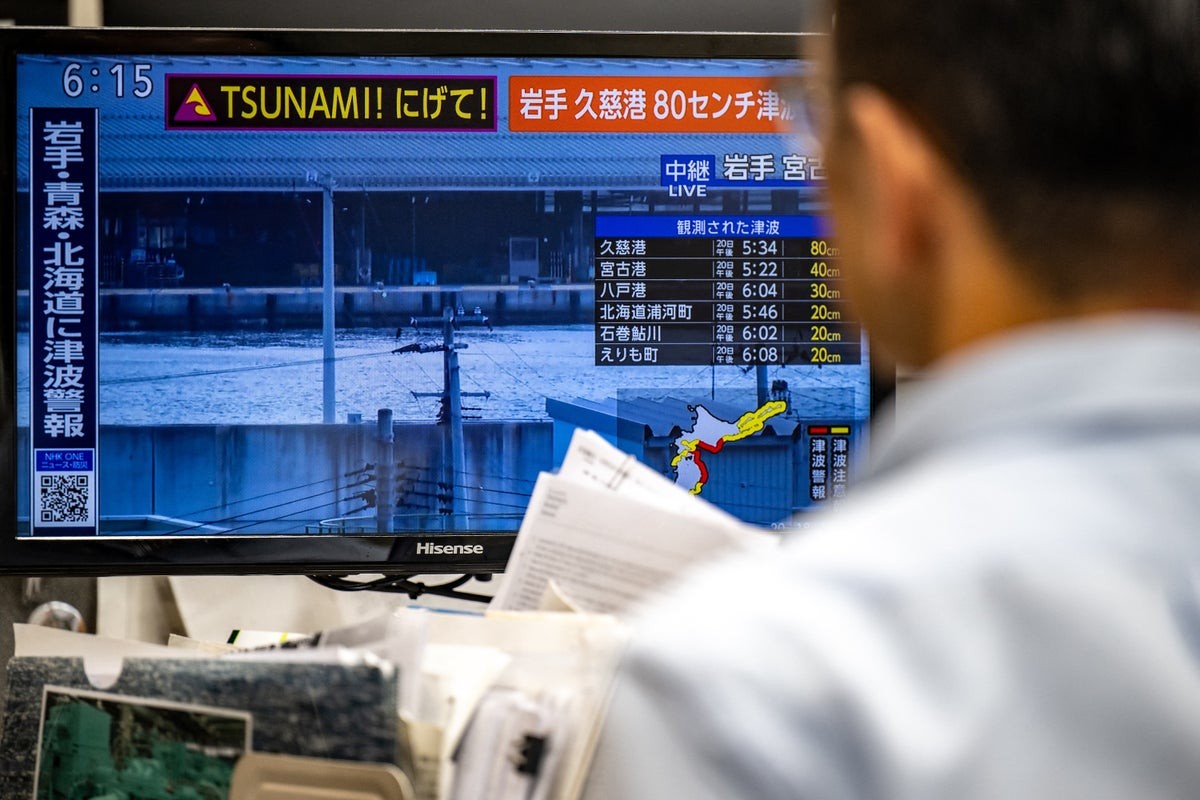
A powerful magnitude 7.7 earthquake struck off the northeastern coast of Honshu, Japan’s largest island, on Monday afternoon. While the immediate impact resulted in no reported deaths or major structural damage, the seismic event has triggered a heightened state of alert across the region.
The earthquake occurred at the Japan Trench, a subduction zone where the Pacific tectonic plate dives beneath the North American plate. This geological process is a primary driver of seismic activity in the region, making the area a constant focal point for earthquake monitoring.
The “Megaquake” Threat: Understanding the Risk
Following the tremor, the Japan Meteorological Agency (JMA) issued a tsunami warning and, more critically, a “megaquake advisory.” This advisory warns that the likelihood of a magnitude 8.0 or greater earthquake is currently significantly higher than usual.
To put the current risk into perspective:
* The Probability: Experts estimate a 1% chance of a megaquake occurring in the coming days.
* The Context: While 1% may sound low, scientist Amilcar Carrera-Cevallos notes that this is 10 times higher than the baseline risk.
* The Stakes: A magnitude 8.0 earthquake is exponentially more powerful than a 7.7 event and could trigger much more devastating tsunamis.
Why One Earthquake Can Trigger Another
In most seismic sequences, the largest event is the “main shock,” followed by a series of smaller “aftershocks.” However, seismologists warn that the relationship between earthquakes is complex.
When a major fault ruptures, it releases massive amounts of pent-up tectonic stress. This stress doesn’t just disappear; it is redistributed to surrounding faults. This can lead to two different scenarios:
1. Standard Sequence: The 7.7 quake was the main event, and the subsequent tremors are merely decreasing aftershocks.
2. The “Preshock” Scenario: The 7.7 quake was actually a precursor, and the true “main shock”—a massive megaquake—is still to come.
“Earthquakes make other earthquakes more likely,” explains earthquake geologist Wendy Bohon.
Preparedness and Public Response
The Japanese government’s use of a “megaquake advisory” is a relatively recent strategic shift in disaster management. Unlike a specific forecast, which predicts when and where an event will happen, an advisory serves as a call to readiness.
For the millions living along the coast, this means:
– Reviewing evacuation routes.
– Preparing emergency “go bags” with essential supplies.
– Remaining vigilant for tsunami warnings.
While history shows that many large earthquakes are not followed by even larger events, the current geological stress makes it impossible to rule out a worst-case scenario.
Conclusion
While the most likely outcome is that the seismic activity will continue to subside, the 10-fold increase in megaquake probability necessitates extreme caution. For now, Japan remains in a state of high alert, balancing scientific probability with the necessity of public readiness.