


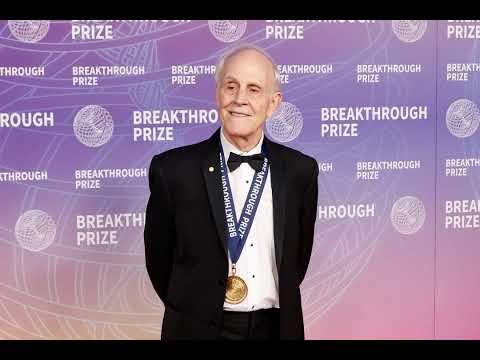
Theoretical physicist David Gross is a man of dualities. As a recipient of the Nobel Prize and the recent $3-million Special Breakthrough Prize in Fundamental Physics, he is an optimist regarding the laws of nature. He is certain that a “final theory”—a single mathematical framework that unifies all fundamental forces—exists.
However, he is a profound pessimist regarding humanity’s timeline. Gross warns that we are currently in a race against our own technology: the quest to understand the universe may be cut short by a nuclear catastrophe before we ever reach the finish line.
The Search for a Unified Theory
For decades, physics has been defined by a massive schism. We have mastered the “Standard Model,” which explains electromagnetism and the strong and weak nuclear forces. Gross himself played a pivotal role in this through the discovery of asymptotic freedom, a phenomenon where subatomic particles (quarks) behave differently depending on their distance from one another. This work earned him the Nobel Prize in 2004.
The “Holy Grail” remains the unification of these forces with gravity. While Gross has contributed significantly to string theory —a mathematical framework attempting this unification—the theory remains speculative and lacks experimental validation.
The “Logarithmic” Barrier to Discovery
Why hasn’t science bridged this gap yet? Gross points to a daunting mathematical and economic reality. To probe smaller distances and higher energies, we need more powerful machines, but the progress we gain is diminishing:
- The Physics Problem: As we try to probe smaller scales, the physical changes we observe occur only logarithmically. We have to go much, much further to see even tiny changes.
- The Economic Problem: The cost of reaching these higher energy scales increases exponentially (at least by the square of the energy).
Essentially, the deeper we want to look into the fabric of reality, the more “expensive” each new insight becomes. This creates a long-term timeline for discovery—stretching perhaps 30 to 60 years for a single leap—which makes the stability of our civilization a prerequisite for scientific progress.
The Mathematics of Nuclear Annihilation
Gross’s pivot from particle physics to nuclear advocacy is not a distraction; it is a matter of survival. He uses a chilling mathematical analogy to explain the threat: radioactive decay.
In the 20th century, experts estimated a 1% annual chance of nuclear war. While that sounds low, it implies a “mean lifetime” (the average time until the event occurs) of only 67 years for anyone born then.
Today, Gross argues, the situation is significantly more dangerous due to:
1. The collapse of international arms control treaties.
2. Increased nuclear proliferation.
3. Active conflicts involving nuclear-armed powers.
He conservatively estimates the annual risk has risen to 2%. In mathematical terms, this drops the expected “mean lifetime” of a child born today to just 35 years.
“It’s like the radioactive decay of an atom—it may be a low-probability extreme event, but the more time passes, the more likely such events are to occur. The probability accumulates.”
A Call to Action
Gross is not calling for total pacifism or the immediate abolition of all weapons, but rather for urgent, practical risk reduction. He is currently working with the Nobel Laureate Assembly for the Prevention of Nuclear War to push for global policy changes.
His goal is to reduce the annual risk from 2% to 0.1%. Such a reduction wouldn’t just prevent catastrophe; it would grant humanity the centuries of stability required to continue the scientific journey toward understanding the fundamental nature of existence.
Conclusion: For David Gross, the pursuit of ultimate scientific truth is inseparable from the pursuit of global security. If we cannot manage the existential risks we have created, the secrets of the universe will remain undiscovered, lost to a civilization that failed to survive its own ingenuity.


