


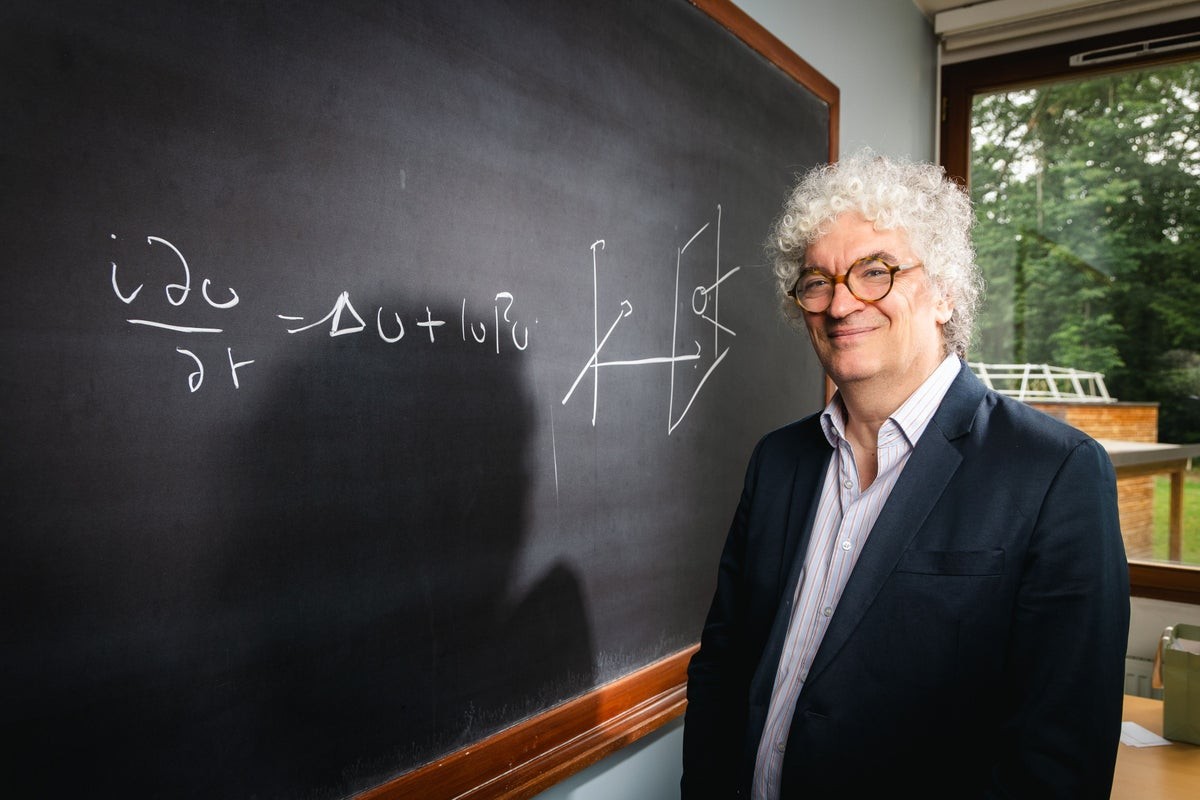
Mathematics often seeks to find predictable patterns, but the real world is frequently anything but predictable. From the sudden formation of a tornado to the intense focus of a laser beam, nature is governed by nonlinear systems —mathematical structures where a tiny change in input can lead to a massive, even infinite, change in output.
Mathematician Frank Merle has spent his career studying these “explosive” phenomena. His groundbreaking work on how these systems break down—a process known as “blowup”—has earned him the prestigious Breakthrough Prize in Mathematics, accompanied by a $3-million award.
The Challenge of the “Blowup”
In a simple, linear equation (like $y = 2x$), doubling the input always doubles the output. It is predictable and stable. However, in nonlinear equations, systems can experience a singularity or “blowup,” where values suddenly jump from zero toward infinity.
For decades, mathematicians approached these problems by starting with stable, linear models and making tiny adjustments to see how they might break. Merle took the opposite approach. Instead of treating nonlinearity as a nuisance to be managed, he embraced it as the fundamental reality of the universe.
“I see the world as a more catastrophic place to live,” Merle notes, reflecting his focus on the raw, unbridled power of nonlinear dynamics.
The Secret to Simplicity: Solitons
Despite the apparent mayhem of these systems, Merle discovered a hidden layer of order through the study of solitons.
A soliton is a specialized wave or structure that maintains its shape and energy even while moving through a highly turbulent or chaotic environment—much like a single, intact rogue wave traveling through a violent ocean. Merle’s work supports the “soliton resolution conjecture,” the idea that even the most complex, chaotic nonlinear systems eventually resolve into a predictable collection of these stable solitons.
By focusing on these structures, Merle has been able to transform problems involving infinite variables into much simpler problems with a finite, manageable number of parameters.
Real-World Impact: Lasers, Fluids, and Quantum Mechanics
Merle’s mathematical proofs are not merely theoretical exercises; they provide the framework for understanding physical limits in several critical fields:
- Laser Physics: In laser technology, “blowup” is actually a goal. Engineers want to focus light as intensely as possible. Merle proved the mathematical conditions under which laser equations lead to this extreme focus.
- Fluid Dynamics: In the study of fluids, blowups are often linked to turbulence. Merle investigated “compressible fluids” (governed by the Navier-Stokes equations) and proved that even when friction is present, it cannot stop the formation of a singularity. This provides vital context for how turbulence behaves in real-world environments.
- Quantum Mechanics: Merle challenged long-held beliefs regarding the nonlinear Schrödinger equation. While many scientists believed that quantum singularities would eventually disperse, Merle proved that in “super-critical” cases, they can indeed blow up.
Why This Matters
The ability to mathematically predict when and how a system will “break” is essential for modern science. Whether it is preventing catastrophic failure in fluid systems or maximizing the efficiency of high-energy lasers, understanding the boundary between stability and chaos is a fundamental requirement for technological progress.
By proving that chaos often hides a core of predictable structures, Merle has provided a roadmap for navigating the most unpredictable forces in physics.


