It was October 2024. I was at a Harvard workshop watching mathematicians talk AI. Not in panic, mind you, but in excitement. New tools, they said. New ways to see. During coffee, a group admitted they didn’t care if a human or a machine solved their hardest open problems. Just wanted the proof. Readable. Done.
So I asked the forbidden question.
Does it matter who solves the Riemann hypothesis? A human? Or some super-smart AI?
I thought I felt a chill. Smirks. That look. You know the one. Being a journalist in this room usually makes you feel slow. But then Andrew Sutherland, a MIT number theorist, laid it out cold.
“If that happens… mathematicians having jobs will be least of our problems,” he said. An AI capable of proving it would be one we’d not want to meet.
I hadn’t meant to be profound. Just tossing names. But now I wondered what this puzzle was that frightened people into thinking it required godlike intelligence to crack.
The Million Dollar Mystery
Bernhard Riemann published this in 1859. A guess about prime numbers. It sits at the top of every list of unsolved math mysteries. In 190 David Hilbert put it on his blueprint for the 20th century. Then the century ended, and the question was still there. Still stubborn. So in 2000, the Clay Mathematics Institute slapped a million dollars on it. One of the “Millennium Problems.” A challenge for our era.
Why such money? Because the math is gnarly. There’s a function where, for most inputs, no one knows the exact output. But when it does hit zero… well. That gives number theorists superpowers. Instantly. You could map every prime number along the infinite line. Precisely. No guessing. The ripple effects? Huge. Cryptography. Nuclear physics. Everything hinges on understanding the building blocks.
“The basic status is: nothing is happening, and don’t really expect anything to.”
That’s Alex Kontorovich from Rutgers. James Maynard from Oxford agrees. “Just don’t have any good idea of how get started,” he says. Nobody is really working on it right now. Or rather. The smart ones are trying everything except this.
Why?
Because primes are the atom of arithmetic. Brian Conrad from Stanford gets defensive about it. It’s like asking physicists why they care about forces. Primes are just… there.
Atomic Stones
Think back to Greeks. Counting. Stones. You can group fifteen stones in threes or fives. But seventeen? Nope. You have to count them one by one. Seventeen is fundamental. Indivisible.
Euclid knew there were infinitely many. Around 300 B.C. He proved it. But why are they where they are? That was the mystery. Maynard points out the weirdness. Primes act like random objects. But randomness is boring to mathematicians. We crave meaning. Order.
So they counted. Tedious, handwritten tables during Enlightenment. And a teenage Carl Friedrich Gauss started playing with them in late 1700. He found a pattern hidden in the noise.
Between 0 and 1 10? 25 primes.
Between 1000 and 1100? Only 16.
Higher numbers get sparser. Harder to be prime when you have more smaller numbers dividing you. Gauss watched the trend. Predictable as numbers got higher. He scrawled an equation for it. A rough prediction. He died without proving it. That job passed to his student.
Bernhard Riemann and the Musical Primes
His name Bernhard Riemann. Lapsed theologian. Number wizard. He couldn’t stomach the apparent randomness of primes. So he imagined a machine. A device to find every prime location exactly. It would walk the real line. Pick primes. Skip composites.
This machine’s soul was a function. The Riemann zeta function. It eats complex numbers. Complex meaning a mix of a “real” number plus an imaginary part. Times the square root of -1. Called i.
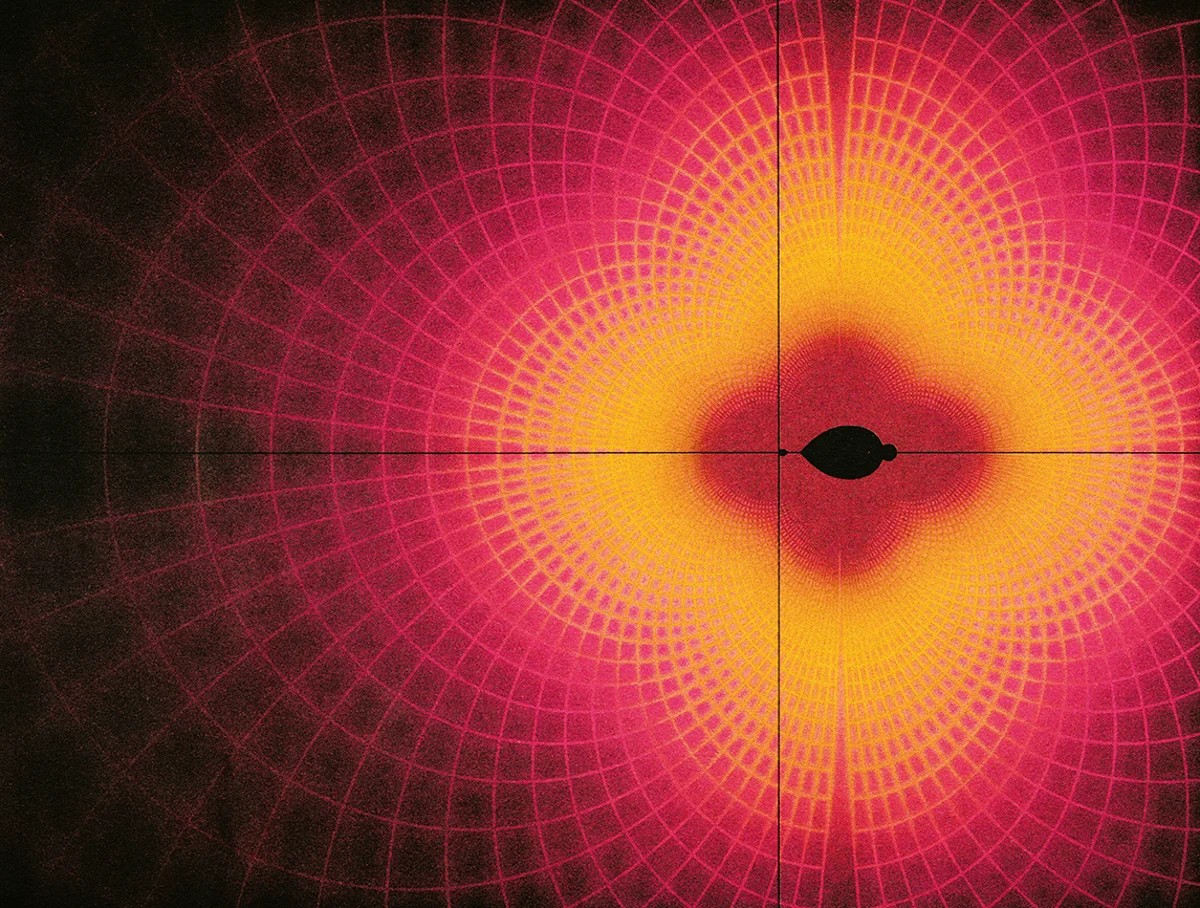
Mathematicians visualize this on a plane. X and Y axes. Every point feeds into the function. Output is another complex number. And sometimes? The output is zero.
Zeros matter.
Gauss’s rough prediction had errors. Gaps between where primes should be and where they are. Riemann found these gaps weren’t chaotic. They were musical. The errors broke into distinct pieces. Harmonics. Like notes in a chord.
Each zero of the zeta function determines a harmonic. Its imaginary part is frequency. Its real part is volume. Loudness. Add them up? You correct Gauss’s guess. You find the exact prime locations.
Riemann guessed a simplifying feature. A bet. He declared every zero’s real part was the same: exactly 1/2. Just different imaginations. They’d line up vertically on the complex plane. At x=1/2. The critical line.
This is the hypothesis.
Without it, the primes are a conductorless orchestra. Messy. Loud instruments, quiet ones, random pitches. Riemann said: every instrument plays at exact same volume. Kontorovich explains it. Simple. Elegant. Unproven.
You might ask why complex math ties into basic counting stones. Good question. It scares mathematicians too. Lauren Williams at Harvard loves it when unrelated things connect. Mystery. Wonder.
Ghosts in the Nuclear Physics
The hypothesis connects to the physical world, strangely.
- Physicist Freeman Dyson has tea with mathematician in Princeton. Mathematician notices strange patterns in zeta function statistics. Dyson says “I seen those. They match my atomic nucleus energy levels.”
Boom. Pure math helps solve nuclear physics. How? Nobody knows. Still obscure today. Zeros of zeta show up in random particle motion. Chaos theory. Even black hole theories.
Mathematicians use this anyway. Even without proof. Hundreds of papers exist. All starting with: “Assuming Riemann hypothesis…”. The music is ordered enough already. They’ve just been ignoring the volume levels for years.
Stuck at the Line
There’s whole family of these functions now. “L-functions” tied to other shapes or equations. All have their own critical lines. If their zeros lie on the line? Math gets cleaner. We call this generalized Riemann hypothesis. The prize isn’t just one problem solved. It unlocks massive chunks of understanding. We’re waiting on one piece to turn the key.
But the key won’t turn.
“Their good ideas over years none got nut of matter,” Andrew Granville says from Montreal. Steam runs out early. Always.
Then two years ago, hope flickered. James Maynard (Oxford) and Larry Guth (MIT). Breakthrough after decades of silence. No one could push boundary past certain point. Thought maybe stuck forever. Maybe intrinsic flaw.
Maynard and Guth invented new tricks in number theory. Squeezed the boundary tighter. Just barely.
“These are brilliant people, and they got marginal improvement,” Granville notes. No clear path forward from there.
“I don’t really view work as right direction,” Maynard admits. “I think our work…”
The sentence hangs. There isn’t a conclusion yet. Just silence, and millions of unsolved zeros.