Addition is one of those things we learn in kindergarten, but we rarely stop to think about it seriously. This is the basis of mathematics. You get a number. Add another number. You will get results. Pretty simple, right?
But when the numbers get big or you teach others, it helps to understand the mechanics behind the process.
How adding works
The essence of addition is combining quantities. When quantity A is added to quantity B, the result is C.
The formula is:
A + B = C
Let’s look at a basic example.
5+2=7
A combination of the numbers 5 and 2. The result is 7.
The symbol used in this function is the plus sign (+ ). between the numbers to be added.
For example:
2* * 3 = 5
More vocabulary
You may hear different terms used by teachers and textbooks. Knowing their meaning clarifies the concepts.
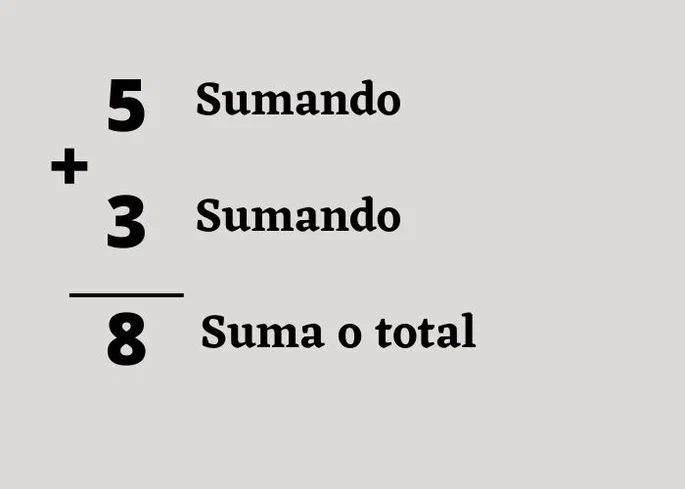
- Total: Each number being added. In the example above, 2 and 3 are both addends.
- Total: Final result. Sometimes called a sum.
Therefore, when solving addition problems, you must add the addends to get the sum.
This is not rocket science. But it’s important to get the basics right.
Addition is a basic operation that combines two or more numbers to find a sum. You run into this every day, whether you’re balancing your checkbook or counting the ingredients in a recipe. Works with almost any number system: natural numbers, whole numbers, decimals, fractions, real numbers, complex numbers, and even algebraic expressions. But understanding the mechanics is only half the battle. To truly master the execution of summation, you need to understand the rules that govern it and the exact steps involved in performing it.
Why extra features are important
Before we start working with numbers, it helps to understand why addition works the way it does. These characteristics or properties determine how the numbers interact during this process. Ignoring these can cause confusion later.
- Commutative property : The order of additions does not change the result. Whether you count 2 + 5 or 5 + 2, the result is 7. Changing the numbers makes it easier to count in your mind and is very convenient.
- Associative properties : The way you group the numbers in your head or on paper does not affect the total. The sum 1 + (3 + 4) gives the same result as (1 + 3) + 4. Both are 8. This gives you flexibility when working with complex equations.
- Closure property : When you add a number from a specific collection, the result stays in that collection. Adding two natural numbers always produces another natural number. This consistency makes the operation predictable and reliable.
“The closure property ensures that even if you start with integers, adding doesn’t remove you from the world of integers.”
How to run sum step by step
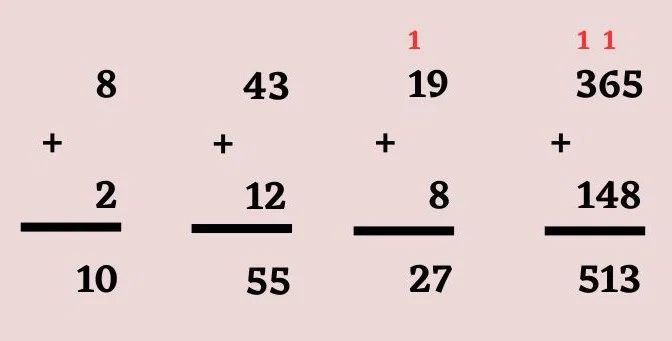
When you encounter multi-digit addition problems, the process builds. This is not just a guess. It’s all about targeting and carrying. This is the standard manual addition method.
-
Align numbers vertically
Enter the numbers you want to add above and below. This is where most mistakes happen. If the number has more than one number, you must pay special attention to the position of each number. Units should be with units, tens with tens and hundreds with hundreds. The main reason for inaccurate amounts is misalignment. -
Starting from the right (unit column)
Start adding the rightmost column called Unit Position. Move to the left tens, then hundreds and so on. This decimal system always starts at the right place.
The transfer (or acarreo) occurs when the sums of the columns exceed 9. The number to be transferred is the tens digit of the sum, which we move to the next column on the left. The unit part remains on the current line.
- Save results
Write the results of each column below the row. Place the numbers in their respective columns. After working through all the columns, draw a horizontal line below the numbers to separate the input from the final answer.
This systematic approach ensures accuracy. Break complex tasks into manageable chunks.
*See also Addition and Subtraction properties for related concepts. *
Why basic addition tables are important for early learners
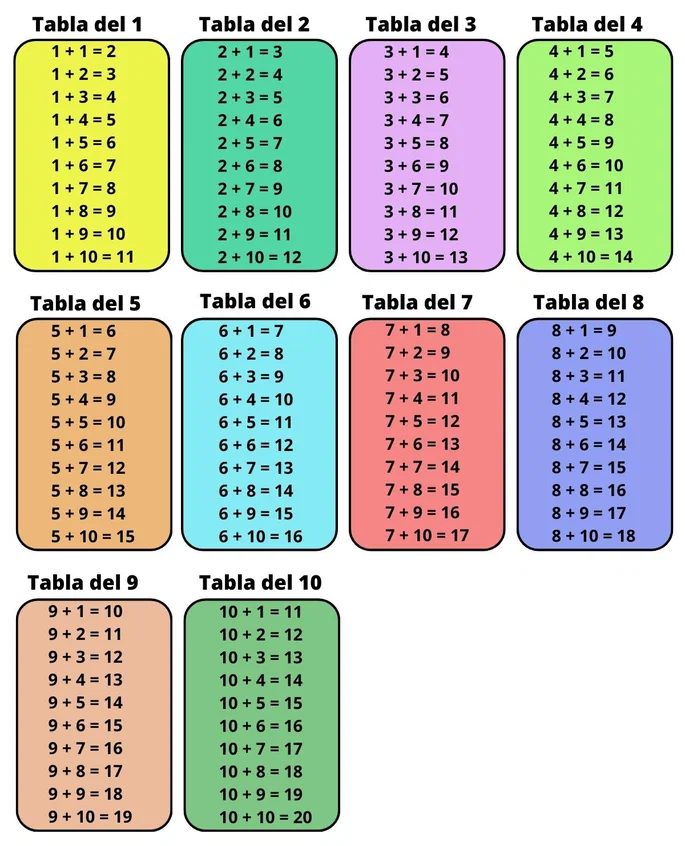
Relying on memory alone can be frustrating for parents who watch their children struggle with simple addition, or for students who just want to improve their mental math speed. Addition table works as a visual aid. These form a bridge between finger counting and sense of real numbers.
The most common starting point is an ordered list from 1 to 10. This diagram shows how to add all the natural numbers from 1 to 10 to all other numbers in the same range. It’s more than just a grid of numbers. This is a relationship chart.
“Consistency increases speed. When a pattern is clicked, it returns immediately.”
1-10 How the addition table works
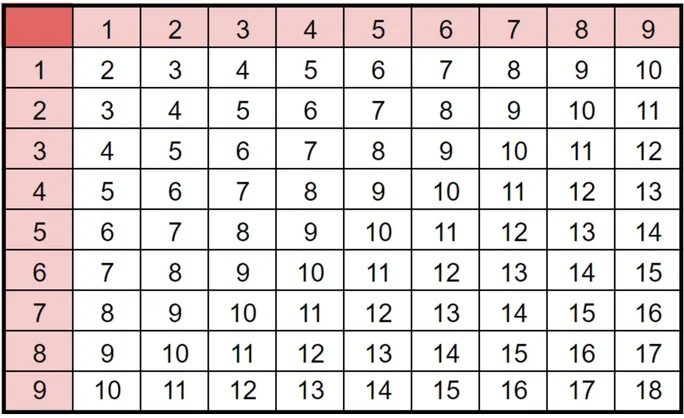
Imagine a network. The left column lists numbers 1-10. The same goes for the top line. You can find the sum where they intersect.
For example, if you need to solve 7 + 4:
1. Find 7 on the vertical axis.
2. Find 4 on the horizontal axis.
3. Locate this to find 11.
This method works with any combination in this range. Prove the commutative laws without verbal explanation. 7 + 4 is in the same position as 4 + 7 and has the same result. This visual symmetry helps kinesthetic learners and visual thinkers understand that order doesn’t change the whole thing.
Use these tables for active recall
Don’t just look at the table. Use it to test yourself. Cover the result column and try to predict the answer before it appears. This active engagement strengthens neural pathways more effectively than passive reading.
If you look at series 1-10, you will notice a pattern. Adding 1 adds one. Adding 0 doesn’t change anything. Adding 10 moves this number to the next decade. Recognizing these micropatterns can reduce cognitive load. Instead of looking at individual sums, you look at a patterns.
Beyond the basics
Tables 1-10 are good warm-ups, but students often have to work quickly. After sums 1-10 have been calculated automatically, the next logical step involves larger numbers or mixed operations. However, ignoring this foundation is a common mistake. The weaknesses of basic addition extend to subtraction, multiplication and finally fractions.
If you find the plain grid boring, try covering half the table. It forces the brain to fill in the blanks. This is where the real learning happens. Don’t guess, recall.
The hidden logic of the Cartesian summation grid
Most people looking at the grid see an empty box. You need to see the calculations happening on the other side of the wall.
A Cartesian table is more than just a graph. This is a two-dimensional grid. One axis extends horizontally. The other runs vertically. Each intersection is a calculated sum.
How to see the intersection
Let’s see how it works.
Enter the third line. Enter another line. Where do they intersect? The quantity is 5.
Why? Because 3 plus 2 is 5.
This is a key rule. The grid doesn’t guess. he said.
- Horizontal axis: Define the values of the rows.
- Vertical axis: Defines the column values.
- Cell: Sum of row and column headings.
Why is this important for learning mathematics?
You might think this is just an exercise. it is not. This is real-time pattern recognition.
Learning addition tables using Cartesian layout eliminates the need to remember individual facts. Relationships begin to emerge. The grid display increases by one to the right. Increases by 1 when moving down. The structure is predictable.
This is how visual learning tools work best. They make the abstract concrete.
Practical steps to use this grid
Would you like to practice using it? This is the process.
- Select the row number from above (or from the side).
- Select the column number on the side (or above).
- Find out where they intersect.
- Check the total.
For example, row 4 and column 5 intersect at point 9. It’s very simple. Quickly.
Add grid FAQ
Where can I get a printable Cartesian summation chart?
Search for “Empty Cartesian Addition Grid PDF”. Many training sites offer these as blank templates for practice.
Are linear arrays or rectangular grids better for children?
Cartesian grids show relationships better. Linear lists (1+1, 1+2, 1+3) hide symmetries. The grid shows that 3+2 is symmetric about the diagonal 2+3.
How do I explain this to struggling students?
Don’t start with the whole table. Let’s start with one line. Show how each number in a row increases by one, and then move to the columns. Show the same pattern. The brain focuses on patterns, not numbers.
“The intersection is not random. It is a promise of addition.”
Overall picture
This isn’t just for kids. Adults use similar logic when analyzing data. pivot tables. matrix. The concept is the same. There are two entrances. you get the output:
If you can read a Cartesian summation table, you can read many data structures.
Start small. Select a 5×5 grid. Please fill it in. Watch the numbers grow.
It is faster than I expected.
Math is easier when the denominators match
Adding fractions with the same denominator is easy. Leave the denominator as is. Just add a number to the beginning. It sounds too easy, but here are the rules.
Think of it this way: If you take three slices of pizza and cut them into eight equal parts, and then make two more pizzas, the size of the slices will stay the same. There is more.
The logic is formed as follows.
The denominator indicates the size of the fragment. If you don’t change it, your fraction will stay the same.
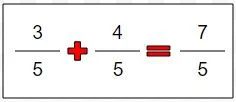
Let’s look at a concrete example. Suppose you want to add two fractions.
- 1/5 + 2/5
In both cases, the smaller number is 5, so no need to worry about it. Just touch the numerator (top number).
- Select 1 and 2.
- Add these: 1 + 2 = 3.
- Divide the sum by the original denominator.
The result is 3/5.
It is very beautiful. They don’t need anything in common because they already have the same denominator. No least common multiple was found. There is no need for complicated mutual multiplication. Just add it directly to the top line.
This rule applies regardless of whether the number is small or large. Do the fractions seem easy or difficult? If the denominators are the same, the numerators are combined.
Why does this work? It’s about the units. I count “one-fifth”. Add 1/5 and 2/5 to get 3/5. We don’t mix apples and oranges. You are mixing up a fifth and a fifth. The units remain the same throughout.
Remember this difference. Different denominators require different strategies. But when do they match? Just add the top. Leave the bottom. move forward.
Mutual multiplication hotkeys
Most people remember the “least common multiple” method for adding fractions of different bases. it works. But if you need an answer right away, that might be a bit much. There is a special trick to save yourself the trouble.
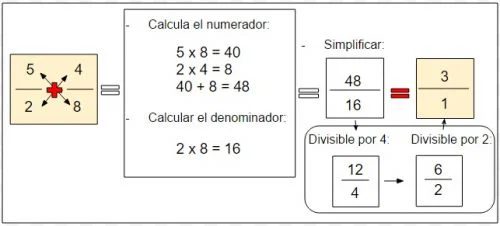
Multiply the number above the first fraction by the number below the second fraction. Then turn it over. Multiply the top edge of the second by the bottom edge of the first. Add these two products together. This is a new numerator.
Now let’s talk about the bottom. Give only two denominators. multiply. you have the answer.
expression:
a/b + c/d = (ad + bc) / bd
Let’s look at a concrete example. Let’s say you want to add 1/3 and 2/5.
- Cross product:
1×5=5
2×3=6 - Add the results.
- 5 + 6 = 11 (this is a new numerator)
- Multiply with the denominator.
- 3 x 5 = 15 (this is the new denominator)
The result is 11/15.
Why does simplification still matter?
It’s not over yet. Math gives you numbers, but math classes require the numbers to be clean. We need to reduce the fraction to its minimum. In the example above, 11/15 is already the simplest form because 11 is a prime number and not divisible by 15.
If you add 2/4 and 1/2 using this method:
Numerator: (2×2) + (1×4) = 4 + 4 = 8
* Denominator: 4×2 = 8
Result: 8/8
This simplifies to 1. Skipping the simplification step can leave an answer that looks correct at first glance, but is technically incomplete. Always check if there are common factors between the top and bottom.
When to use this method
This reciprocal multiplication technique is the fastest for simply adding or subtracting two fractions. Combining three or more fractions causes confusion. You are dealing with several pairs of numbers.
It also allows you to generate larger numbers quickly. Adding 13/17 and 24/31 as the denominator gives 527. Most students want to find the common denominator here to reduce the numbers. However, for simple brainstorming or single-pair questions, the crossover method is a reliable shortcut.
This is a tool. Use it if you want to save time. Skip it if it requires more work.
Actual costs of the degree
The price tag is the elephant in the room. In the United States, public tuition for a four-year degree costs an average of more than $27,000 per year. Private school? That figure rises to over $50,000. Add a room, board and books, and you’ll see six figures before you even hit the job market.
It’s more than just a number. For many, this is a life sentence.
US student loan debt has topped $1.7 trillion. That’s more than your credit card debt and car loan combined. The average borrower owes more than $30,000. It will take years to reveal. Some people never do this. This economic pressure is changing people’s lifestyle. They put off buying an apartment. They postpone retirement. They stay in jobs they hate because the only thing keeping them from drowning in debt is the paycheck.
Hidden course
Facts are taught in school. They test memory. They hardly teach you how to navigate the real world.
Think about it. When did you learn to file taxes? How do you negotiate your salary? How to build an emergency fund? How to read the contract? Almost none.
Instead, you spend years memorizing dates and formulas that can last until the week after finals. Then we forget them. At the same time, the really important skills in adulthood, such as financial literacy, emotional intelligence and the ability to solve real problems, are left on the cutting room floor.
This gap causes anxiety. Students graduate with a diploma, but without a compass. They know “what” to study, but they don’t know “how” to live.
Is this degree still worth it?
In some areas, yes. medicine. law. project. The barriers to entry are high, but so are the rewards. Degrees act as gatekeepers that filter out the candidates you really need.
to others? It’s very vague.
Many high-paying jobs now prioritize portfolios and skills over degrees. coding. design. digital marketing. Fields of sales. Boot camps and self-study programs are often more successful in these fields than traditional degrees. Faster ROI (Return on Investment). The debt burden is reduced.
But here’s the problem. This degree still opens a closed door to non-degree htodayers. HR algorithms often filter out resumes without a bachelor’s degree. Although work is not strictly required, the lack of it can lead to silent rejection. This is a structural bias that is difficult to overcome.
Options are evolving
It’s not all doom and gloom. Things are changing.
Community colleges offer the same general education credits at a fraction of the price. Transfer agreements with state universities make the transfer smoother and cheaper. Going to a two-year school can save you tens of thousands of dollars.
Apprenticeships are making a comeback. Paid training for trades such as plumbing, electrical and manufacturing. If you learn, you can earn. I have no debt. All that remains is skill and experience. These jobs are often well-paying and recession-proof.
Online certifications on platforms like Coursera and edX offer certifications from top universities. These aren’t necessarily considered “degrees,” but to a smart recruiter, they can demonstrate initiative and special abilities.
Conclusion
Education is moving from one-size-fits-all services to many options. today