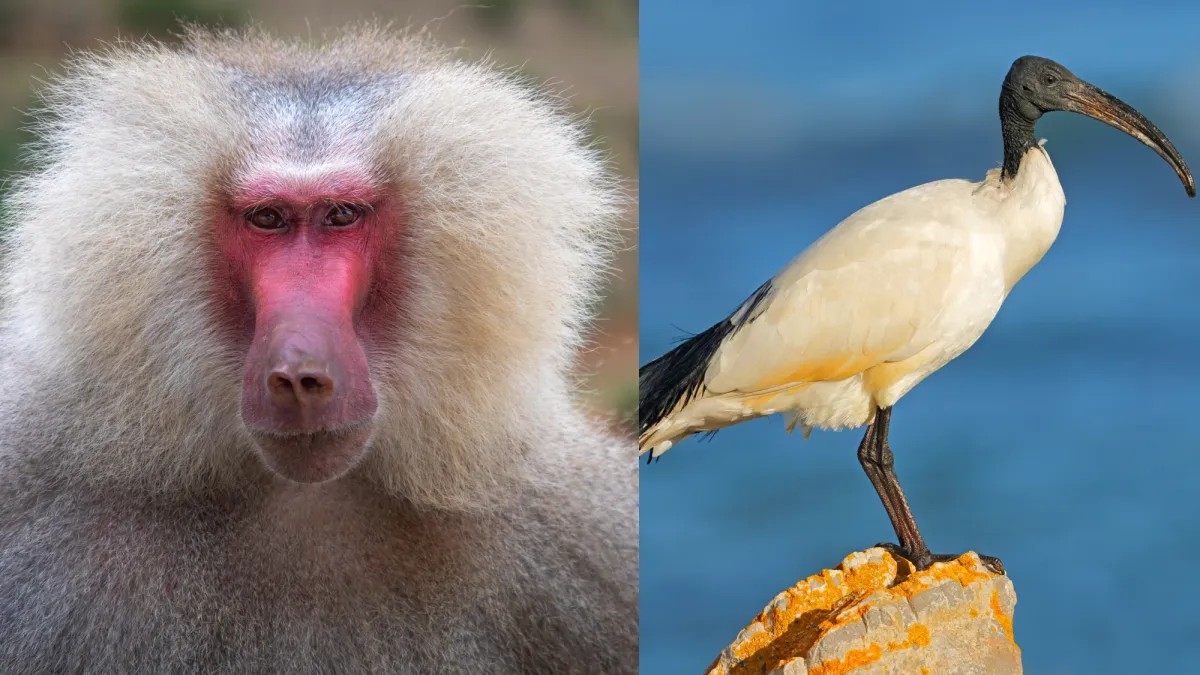
Thoth was busy. As the ancient Egyptian deity of magic, writing, and the moon, he didn’t have the luxury of sticking to one look. Sometimes he’s a baboon. Sometimes, he’s an ibis. A large bird with a long, curved bill. It’s confusing if you don’t know the history, but a new study finally answers the question of why these disparate creatures share such a high profile in the pantheon.
The answer isn’t mythology. It’s physics. And it’s bright white.
The Linguistic and Visual Link
To understand the symbolism, you have to look at the language. Recent scholarship has traced the roots of Thoth’s name back to North African linguistic terms meaning “bright” or “white thing.” It’s a subtle clue, but it points toward a visual association rather than just an abstract concept.
Egyptians were practical. They mummified sacred ibises in the thousands. These burials suggest a deep reverence, but why that bird? Among at least three species of ibises known to them, they consistently chose the white-feathered sacred ibis. They had two species of baboons available. They stuck with the hamadryas.
Both species share a specific trait that the other local primates and birds lacked. They reflect light. Specifically, moonlight.
Spectroscopy Confirms the Theory
Theoretical speculation is fun, but hard science is better. A team led by Catherine Hobaiter, a primatology researcher at the University of St Andrews, decided to stop guessing and start measuring. They looked at Papio anubis (olive baboons), Papio hamadryas (hamadryas baboons), and Threskiornis aethiopus (African sacred ibises).
The method? Spectroscopy. This technique measures the frequency of light waves reflected from an object’s surface. It removes the human eye from the equation. Human perception of color can be subjective; light frequencies are not.
The results were stark. The grizzled hair of the hamadryas baboon and the plumage of the sacred ibis have spectral profiles indistinguishable from the moon.
“So, sacred ibises and hamadmyas baboons are different in many ways but one thing that unites them their moon-like colour,” Hobaiter noted.
Other animals failed this test. The olive baboon? Different profile. The vervet monkey? Nothing like the lunar glow. The patas monkey? Irrelevant. The Egyptians didn’t pick these animals for their temperament or intelligence alone. They picked them because they glowed with the same light as the celestial body Thoth ruled.
Why Not Other Monkeys?
It’s worth noting that not all primates were welcome in ancient Egypt. Many African cultures today still regard baboons negatively, viewing them as agricultural pests that destroy crops. The olive baboon, for instance, is known for such behavior. Yet, Thoth was associated with the hamadryas instead.
Why the distinction? The hamadryas is silver-white. The olive baboon is brown. In the context of lunar worship, the difference is everything.
Thoth’s dual appearance isn’t a random artistic choice or a mythological mix-up. It’s a reflection of his domain. If you looked up at the night sky, the moon was the constant. If you looked at the animals that mirrored it, you found the ibis and the hamadryas. They were living mirrors.
The Symbolism of Reflection
Magic, wisdom, and writing all require light. You can’t see the past without a flashlight of sorts. You can’t read the stars if it’s cloudy. The moon provides the illumination for both navigation and night-time activity.
By choosing animals that reflect that specific spectrum, the Egyptians created a visual shorthand that transcended language. A priest sees a hamadryas, and he sees the moon. He sees Thoth. He doesn’t see just a monkey. The animal becomes a conduit.
The study, published in the journal Time and Mind, closes the loop on a centuries-old debate. It wasn’t just about the animals themselves. It was about the light they threw back at the heavens.
We still use symbols to represent abstract concepts today, though ours are usually more geometric. A dove for peace. A scale for justice. We don’t have many animal mascots for physics phenomena anymore. Maybe we should. There is something compelling about a deity that is literally made of the stuff of the night.