


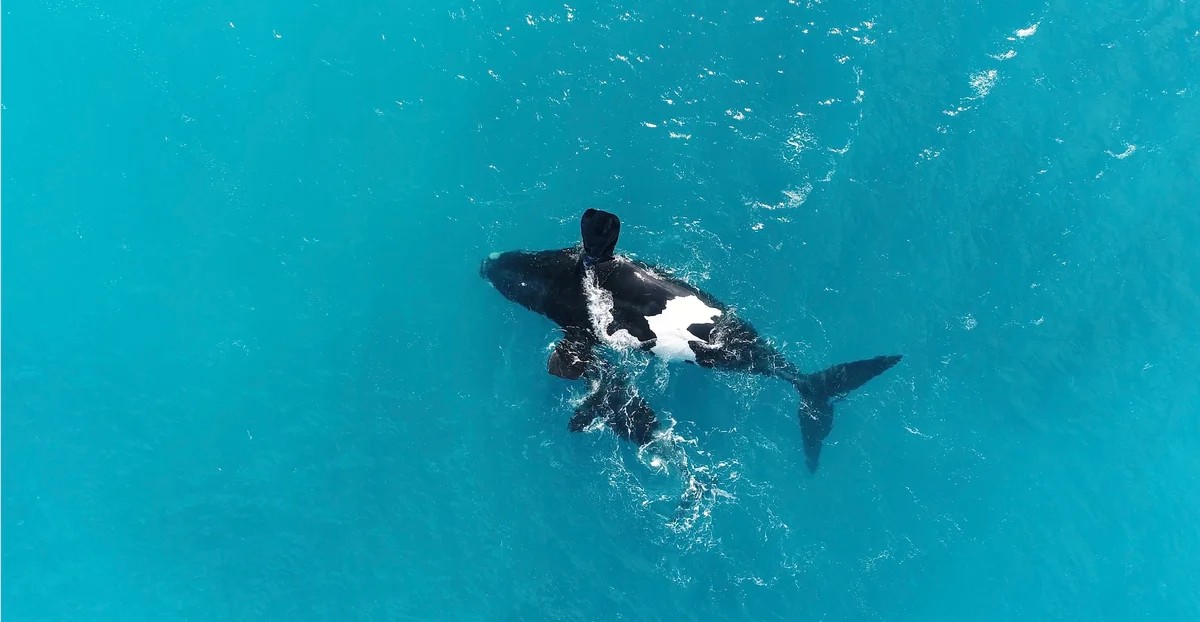
Whale moms are exhausted. They migrate thousands of miles without eating, then nurse their calves for months. It is a brutal cycle.
Southern right whales (Eubalaena australis ) do something no other whale species does. They flip upside down.
This behavior was observed at the Head of the Bight in South Australia. The location is critical. These waters are a calving ground, relatively safe from ship strikes. But why roll onto their backs?
The answer might be simple: control.
Resting Like a Mother
Renae van Noort from the University of Western Australia led the study. Her team used drones. They filmed 75 hours of footage. They watched 90 mother-calf pairs.
The results? Mothers spent an average of 33% of their time resting. Calves rested too, usually syncing with their mothers.
Most cetaceans float dorsal-side up. Sometimes underwater. Sometimes at the surface. But 25% of these mothers did something different. They rolled over.
This specific method of resting helps them manage their energy. And their milk supply.
“This is definitely an unusual behavior. It looks quite odd, especially when you see them with their pectoral fins in the air.” — Renae van Noort
The Upside-Down Strategy
How much time do they spend like this? Just 2%. Rarely. Both underwater and above.
Only lactating mothers were seen doing this. One pregnant whale was observed too.
Why? When a mother lies on her back, her calves can’t reach her mammary slits. The position acts as a barrier.
It forces the calf to wait.
This gives the mother agency. She decides when to feed. She decides when to rest. It is not just passive floating. It is active management.
Also, temperature regulation might play a role. The fresh air hitting their belly fins could cool them down.
Why Only Southern Right Whales?
You won’t see humpbacks or blue whales doing this. Malin Lilley, a psychologist at Texas A&M University who wasn’t part of the study, offers a theory.
Other species have different energy conservation methods. Or, perhaps, their habitats are too dangerous.
Rolling on your back makes you vulnerable. Ships strike backs.
The southern right whales at the Head of the Bight are in a protected area. Human disturbance is lower there. This safety might be the key. Without it, flipping upside down would be suicidal.
What We Still Don’t Know
The study, published in Mammalian Biology on July 6, answers some questions. Not all of them.
We don’t know why some mothers do this and others don’t. 25% engaged in the behavior. The rest did not.
Is it learned? Do calves watch their mothers? Do they learn through experience? Lilley suggests future research should look at how this habit is passed down.
For now, we just know that whale moms need a break. Even if that break involves being upside down in the ocean.


