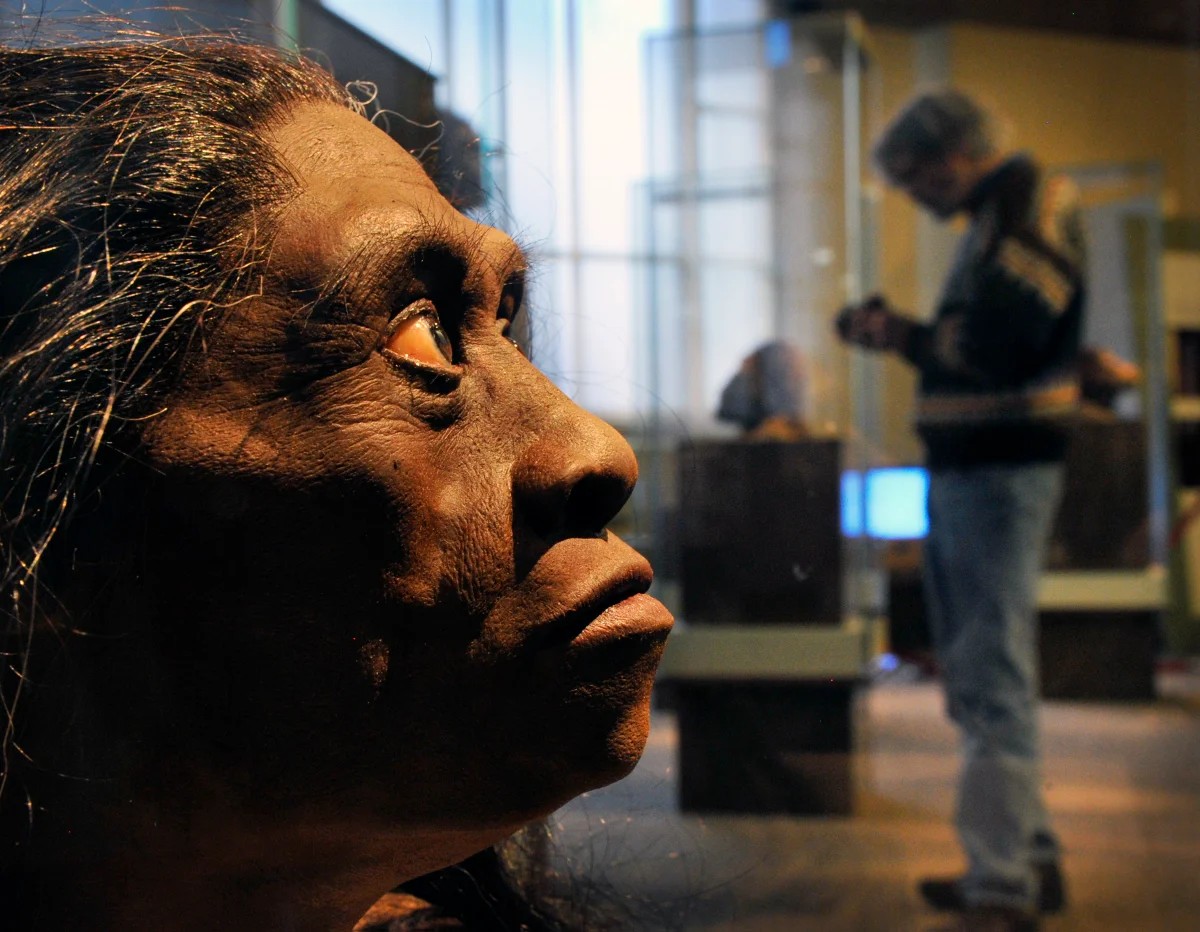
Old theories about Homo floresiensis are collapsing. Fast.
For two decades, the scientific community assumed these short, small-brained ancestors were apex hunters. They found bones of extinct Stegodons (elephant relatives) in Indonesian caves. They found burnt debris. The narrative was easy to digest: these “hobbits” killed big game, mastered fire, and dominated their ecosystem. It fit the progressive human evolution model. We like straight lines.
But a new study published today in Science Advances suggests they weren’t hunters. Not even close. They were scavengers. Feasting on what the Komodo dragons left behind.
Abrupt shift, right?
The authors argue the Stegodon bones weren’t butchered by human tools. The cuts? Bite marks. From dragons. To prove it, they didn’t dig up more bones. They went to the zoo. They fed goat carcasses to captive Komodo dragons and compared the damage to the ancient Stegodon fossils. The match was convincing. Briana Pobiner, a Smithsonian paleoanthropologist and co-author, calls this taphonomy the “smoking gun.”
“It’s a great example of going back to study a fossil… that hadn’t been studied with these taphonomic in more detail.”
So what about the fire evidence? Gone too. Or at least, misplaced. The researchers examined 4,500 tiny rodent bones from the cave. None were burnt. No charred wood. The so-called evidence of hobbit cooking likely belonged to Homo sapiens. Us. We arrived later. We made a mess. The ancient residents just got blamed.
Dean Falk at Florida State University says the paper makes a “dramatic claim.” She acknowledges it might not settle every debate. Could a hobbit have skinned a Stegodon without sawing through the bone? Maybe. But the burden of proof just shifted heavily.
This forces us to rethink the family tree.
We like to believe evolution is a ladder. Climb, improve, master fire, conquer nature. Linear progress. Pobiner disagrees.
“Our family tree was not a straight line.”
The hobbits lived alongside us in time, even if not in place. While Neanderthals milled about Europe and modern humans expanded, Homo floresiensis was picking at bones in Indonesia. They survived. They evolved. They did it without fire and without hunting the giant fauna.
Is that success or limitation?
The study overturns two decades of comfort. It leaves holes. It leaves questions about how a species so behaviorally limited persisted for so long.
And then it vanished. Around 50,00 years ago. Just as we showed up.
Was it competition? Disease? Climate? The dragon leftovers stopped arriving. Or perhaps we took their niche, too.