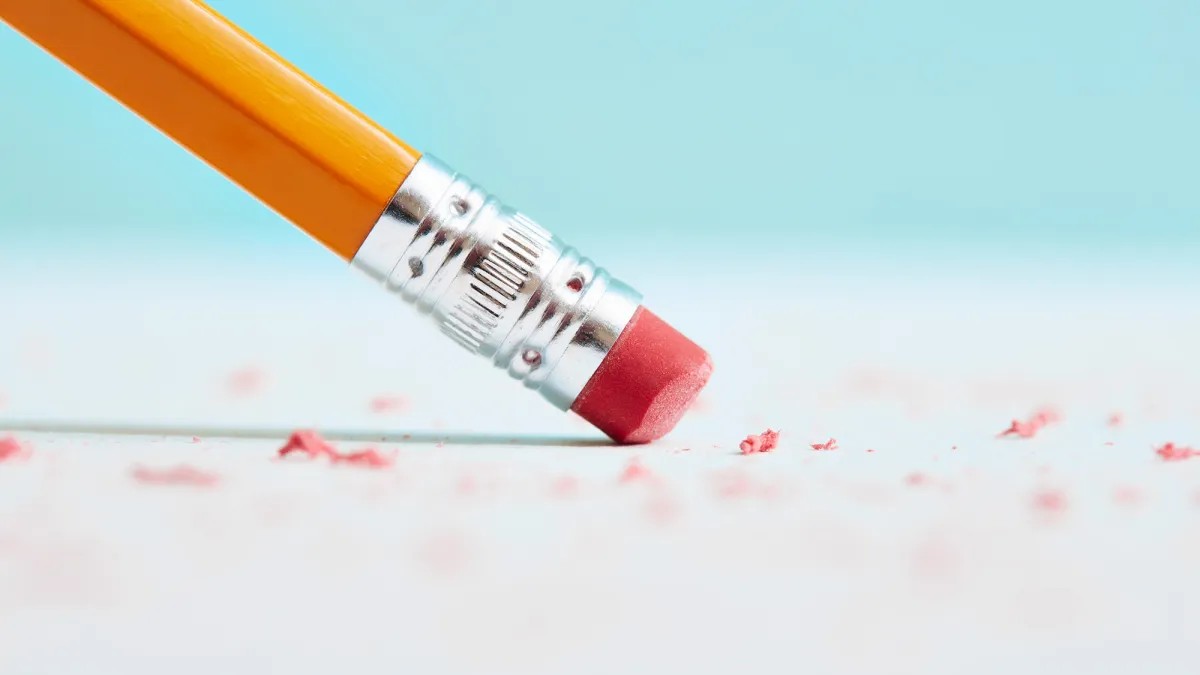
It works by stealing your graphite.
Simple physics, really. But also kind of gross when you think about the molecular warfare happening between your finger and a piece of tree pulp.
A brief history of rubbing things out
Long before backspaces existed, we were fixing typos the hard way. With bread. Or wax.
Then rubber came along in the 170s. Then plastic. Then electricity, apparently, in some weird experimental corner of stationery history.
But the mechanism hasn’t changed since ancient Mesoamerican artisans tapped rubber trees for latex thousands of years before anyone knew what “colonization” meant. They knew latex was useful. We just waited a while to realize it made a good eraser.
Whether you are using a squishy pink nubbin from the bottom of your junk drawer or a precision vinyl eraser costing more than a coffee, the principle is the same.
Graphite loves your eraser more than it loves paper.
“When you run a pencil over paper… that’s what leaves the pencil mark,” Dr. Joseph A. Schwarz says. He’s a chemist at McGill, and he knows this stuff. The mark isn’t ink soaking deep into the fibers. It is just dust. Tiny flakes of carbon sitting on top, held down by a “very small attraction.”
Your eraser is a thief.
The friction theft model
There’s greater adhesion to the rubber than the paper.
When you rub, the friction does the work. It’s not magic. It’s physics. Specifically, it’s a little abrasion. You are grinding the surface just enough to loosen the carbon, then the eraser snatches it away.
“There’s a greater adhesion… to rubber than to the paper… it removes them.”
That’s why hard erasers damage paper. They’re too eager. Soft erasers? They’re gentler. They lift without tearing. It’s a balance. Not a “perfect” one. Just a practical one.
Underneath it all? Van der Waals forces.
Sounds like a wizard spell. It’s actually just electrons being moody.
“On a molecular level… clouds of electrons,” says Dr. Justin Caram from UCLA. “They can randomly fluctuate… make one side positively charged… negative… binds things together.”
Positive seeks negative. Graphite sticks to paper weakly because of this jittery charge game. Erasers have their own jittery charges, but their handshake with graphite is firmer. So when you introduce heat via friction? The bond breaks. The graphite runs to the stronger hugger.
You are basically picking your fights with electrons.
When ink fights back
What if it’s not pencil?
Ink doesn’t play nice.
“Ink is carried by a liquid… into the fibers… it’s much more embedded… than graphite.”
Ink marries the paper. You can’t erase marriage that way. You can only paint over it. Which is exactly what Wite-Out did. What Egyptian scribes did with white paint on papyrus. Cover it up. Lie about it.
But then came thermochromic ink. The tricksters.
Brands like Pilot made ink that hides from heat. You rub fast? Friction makes heat. Heat (over 140°F) makes the color components split up. Poof. Blank paper.
It’s fake.
“The word ‘effectively’ is doing a whole lot of weight-lifting here.”
Because if you freeze that paper? The ink comes back. The colors recombine at -4°F. Your secrets aren’t safe. They’re just waiting for winter.
Humans and mistakes
We buy billions of pencils and erasers a year.
Screen time hasn’t killed the mistake. Autocorrect is a lie, after all. You still want to see what you wrote. You still mess up.
Tombow didn’t even sell an eraser for 26 years after they invented their pencil in 1913. Then WWII happened, rubber became scarce, they started mixing fats and oils into erasers like they were baking soap. Material shortages force creativity.
Or desperation.
Does it matter?
Probably not. Whether you are a monk in Egypt fixing a drawing of a jackal or a kid crossing out a math answer, you are engaging in the oldest human tradition after writing itself.
Fixing the thing you got wrong.
Some tools make the mess visible. Others hide it. Some even pretend it never existed until the temperature drops.
So keep the rubber. Keep the friction. Just know that you are fighting electrons with heat, and half the time, the ink is just watching from the freeze, waiting to show everyone you’re wrong.
Have something else you want to know?
Ask us.