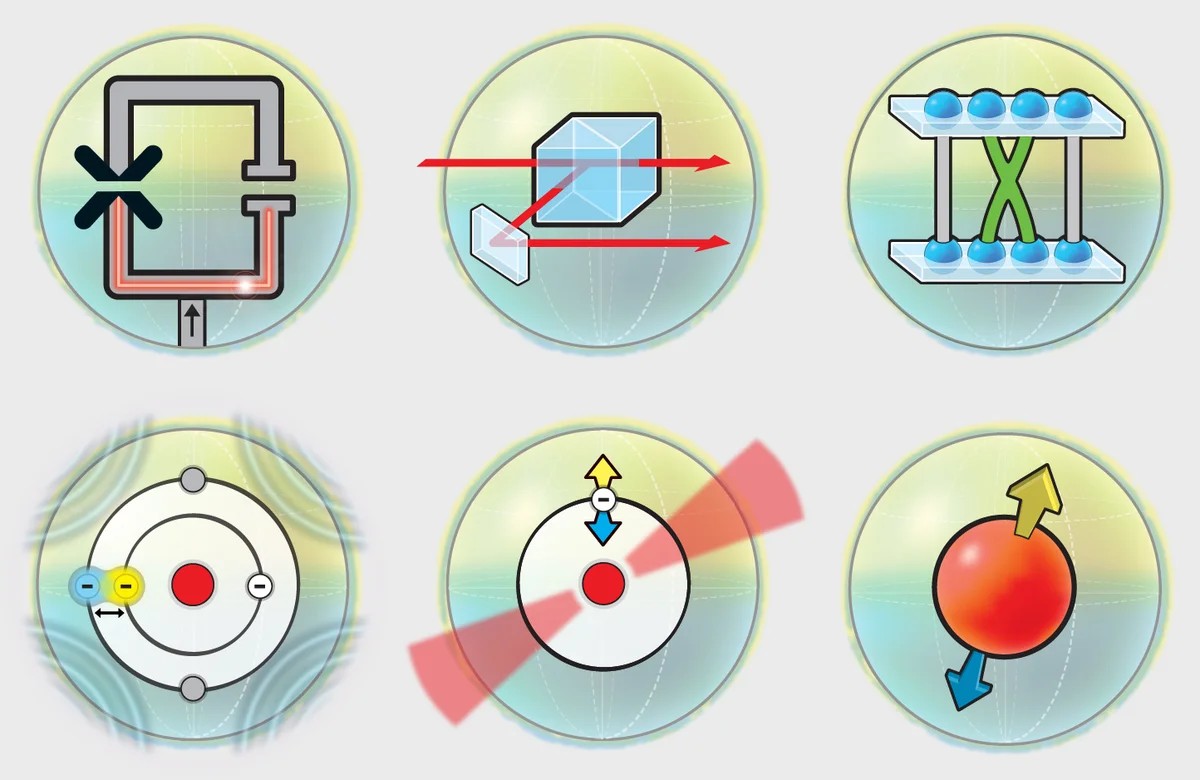
Scientists everywhere are building machines that cheat classical logic. They’re tapping into the weirdness of quantum mechanics to solve problems conventional computers just can’t touch. It sounds like magic, right? It isn’t, but it’s close.
The trick lies in qubits.
Classic bits are binary. Boring, even. A 0 or a 1. No gray areas. Qubits? They live in superposition. That means they are both 0 and 1 at the same time. Imagine a sphere with infinite points. That’s the potential of a qubit.
And there’s entanglement too. Connect two qubits, mess with one, and the other reacts. Instantly. Spooky, but true.
Think of a maze. A classical computer picks a path, hits a dead end, tries again. One by one. Slow. A quantum computer looks down from above. It sees every path at once. When you finally measure it? The fog lifts. The possibilities collapse. You get one answer.
So. What actually is a qubit?
Honestly? No one knows yet. It’s a wild west out there. Nathalie de Leon, who works at Princeton and Google Quantum AI, puts it bluntly: “It is a completely wide-open space.” She notes every platform has huge engineering risks. Still, labs are betting on different hardware.
Here is what’s on the table.
Superconducting Qubits
These rely on tiny circuits made of materials that conduct electricity without resistance—zero resistance. They need to be ultracold to work. When a circuit absorbs a microwave photon? Zap. The qubit jumps from state 0 to state 1. Scientists love these because they’re fast. Very fast.
Solid-State Spin Qubits
This approach looks at single particles. Specifically their spin. We’re talking electrons trapped in semiconductors, or defects in silicon chips, or electrons floating on liquid helium. The big selling point? Manufacturing. We can use existing semiconductor tech to build chips with them. We know how to do that part.
Neutral Atoms
Neutral means no net charge. Easy to trap with lasers, easy to move, easy to read. The state comes from electron or nuclear spin. Researchers fancy these because they scale nicely. You want a million qubits? Just add more atoms. It sounds simpler than wiring up superconductors.
Photonic Qubits
Made of light. Specifically, photons. Their state depends on which spatial rail they travel down. Light moves fast. Light doesn’t interact easily with noise. Proponents say these scale up like classical optical chips. No cooling to near-absolute zero required? Sounds like a win. Until it doesn’t.
Trapped Ions
Ions are charged atoms. Calcium. Magnesium. Beryllium. Electromagnetic fields hold them in midair. Lasers flip their spins. This method has historically shown the lowest error rates. Accuracy matters in a world prone to decoherence. It works, but holding individual atoms in a magnetic trap is finicky business.
Topological Qubits
The theoretical dreamers are chasing these. Instead of circuits or atoms, they use anyons. Quasiparticles. The idea is they are inherently protected against errors. Noise doesn’t matter as much. The problem? They’re mostly still theoretical. Scientists are still trying to prove they can actually make them.
The race isn’t about who builds the fastest qubit. It’s about which qubit survives long enough to do useful work.
Nobody has all the answers yet. We’re just picking tools for a job no one’s done before. 🚀