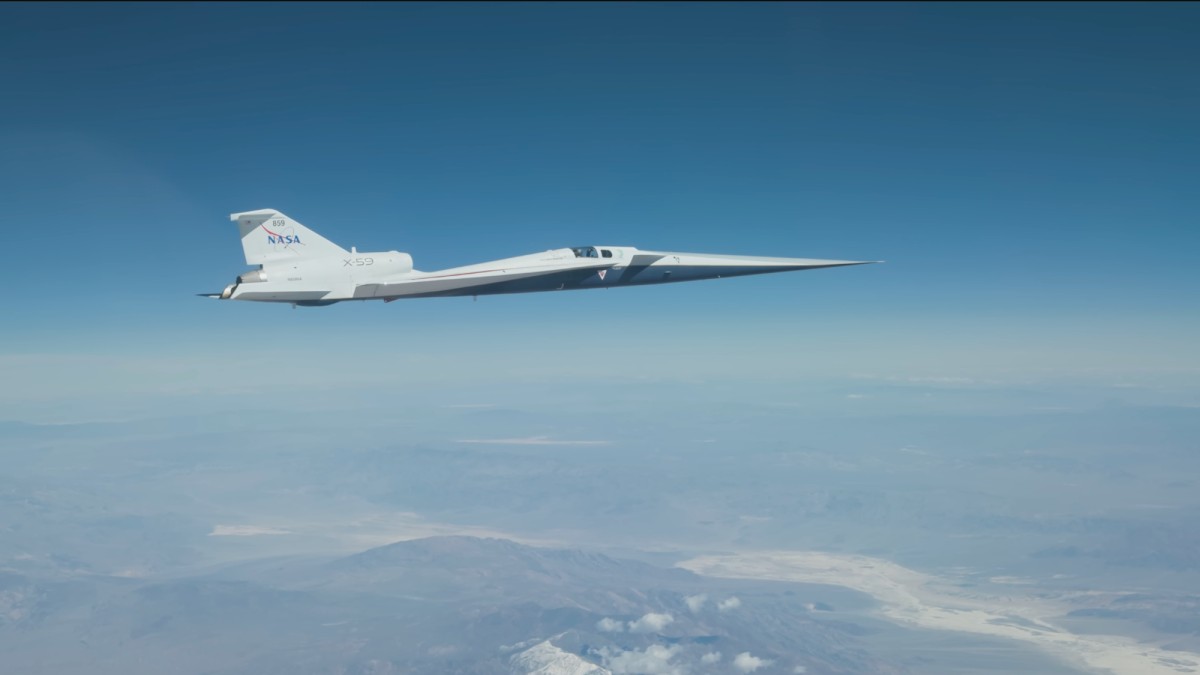
The era of supersonic aviation may be quietly returning, thanks to a sleek, needle-nosed aircraft that is redefining what is possible at high speeds. NASA and Lockheed Martin’s X-59 QueSST (Quiet SuperSonic Technology) recently showcased its agility and precision in a series of test flights over California’s Mojave Desert. While the plane has not yet broken the sound barrier in these specific maneuvers, the demonstrations mark a critical step toward eliminating the disruptive sonic boom that has grounded commercial supersonic travel for decades.
Precision Before Speed
The latest footage, released following a test flight on April 14, captures the X-59 executing complex aerobatic maneuvers that highlight its stability and control. The aircraft performed sharp ascensions and precise axial turns—movements that appear intense even from a safe distance. These exercises are not merely for show; they are essential for validating the plane’s handling characteristics across a wide range of flight conditions.
Although the X-59 did not reach supersonic velocity during this session, it achieved approximately 0.95 Mach (around 730 mph). This subsonic testing is a deliberate and necessary phase. Engineers must ensure the aircraft is stable and responsive at lower speeds before pushing it into the turbulent transonic and supersonic regimes.
“Moving forward, the X-59 will continue to test its performance at high and fast test points as well as low and slow test points,” Lockheed Martin stated. “From there, the joint Lockheed Martin and NASA team will move quickly into supersonic speeds.”
The Quest for a “Quiet” Boom
The primary mission of the X-59 is not just speed, but silence. Traditional supersonic aircraft, like the retired Concorde, generated loud sonic booms that disturbed communities below, leading to bans on overland supersonic flight. The X-59’s unique design—featuring an elongated nose and carefully shaped wings—is engineered to compress shockwaves into a softer, shorter acoustic signature.
When the aircraft eventually reaches its target operating conditions—55,000 feet altitude and Mach 1.42 (940 mph)—it aims to produce a “quiet supersonic thump.” This sound is projected to be roughly 16 times quieter than the booms of older jets, with a perceived loudness equivalent to a car door slamming inside a house. If successful, this breakthrough could pave the way for a new generation of supersonic commercial airliners that fly over land without violating noise regulations.
Military Applications and Future Steps
While NASA’s focus is on civilian aviation and regulatory change, the technology behind the X-59 holds significant interest for military applications. High-speed, low-signature aircraft offer strategic advantages in surveillance and rapid response. However, Lockheed Martin and NASA have not disclosed specific military plans, keeping the immediate focus on the scientific validation of quiet supersonic flight.
The X-59 program has faced delays, with public unveiling occurring in January 2025, but the pace of testing has accelerated since its first subsonic flight in October 2024. With nine additional flights completed since then, the team is closing in on the pivotal moment when the aircraft will first demonstrate its signature quiet boom.
Conclusion
The X-59’s recent display of agility confirms that the engineering challenges of quiet supersonic flight are being met with precision. As the aircraft prepares for its first true supersonic tests, it carries the potential to reshape air travel, turning the once-noisy realm of supersonic flight into a viable, quiet option for the future.