The Pentagon has officially released a new batch of government documents related to Unidentified Anomalous Phenomena (UAP), marking the first significant disclosure since President Donald Trump directed officials to declassify such materials earlier this year. The release includes FBI reports on unexplained sightings and NASA debriefings featuring astronauts who encountered unidentified objects during lunar missions.
While the administration frames this as a move toward transparency, experts suggest the opposite effect. According to Scientific American, specialists in the field argue that these files do not provide definitive answers. Instead, by highlighting mysterious images without clear explanations, the declassification may intensify public speculation rather than quell it.
Key Images and Incidents
The released materials span several decades and locations, ranging from modern military surveillance to archival footage from the Apollo era. Here is a breakdown of the primary visual evidence included in the release:
Recent Military Sightings
- Middle East (May 2022): A still image extracted from video footage shows a UAP crossing the screen of a U.S. military operator flying over the Middle East.
- Western U.S. (September 2025): A “black-hot” infrared image captures an unidentified object beneath a helicopter.
- Japan (2024): Personnel from the U.S. Indo-Pacific Command reported observing a football-shaped body near Japan.
- Unspecified Location (Late 2025): A monochrome screen capture shows a small, dark, and slightly irregular object located just below and to the right of the center reticle.
- Western U.S. (December 2025): Another black-hot infrared image depicts a dark dot over the western United States, with parts of the frame redacted for security reasons.
Archival Lunar Missions
The release also revisits historical data from NASA’s Apollo program, specifically highlighting anomalies found in photographs taken on the lunar surface:
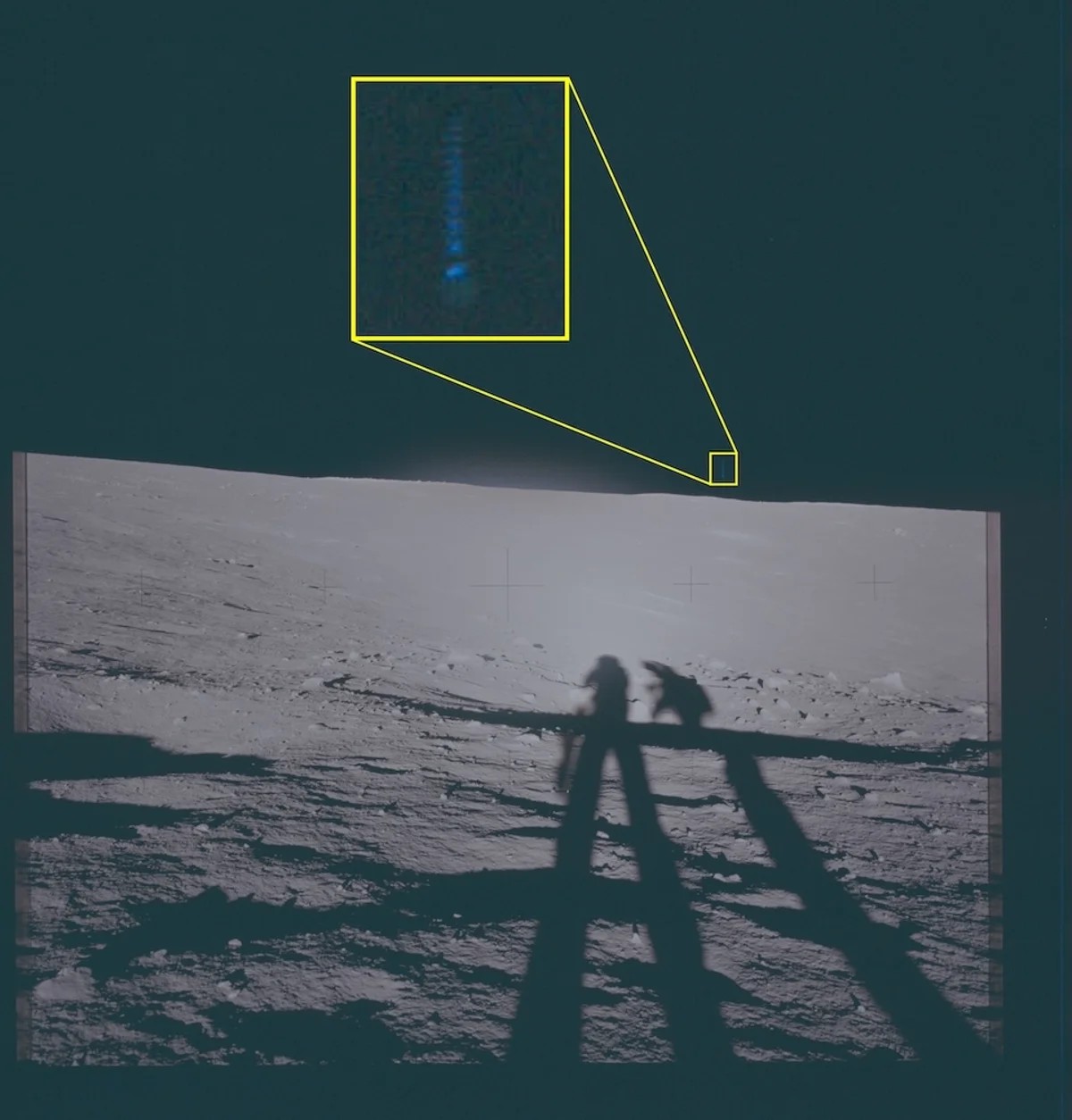
- Apollo 12 (November 1969): Multiple archival images from the mission’s landing site in the Oceanus Procellarum (Ocean of Storms) show unidentified phenomena.
- One image highlights a UAP slightly to the left of the vertical axis, hovering above the horizon.
- Two other areas, labeled “Area 1” and “Area 2,” appear to the right of the frame’s vertical axis.
- Another photo from the same mission shows a highlighted object near the right edge of the frame, above the horizon.
- Apollo 17 (December 1972): A previously released photograph shows three “dots” arranged in a triangular formation in the lower right quadrant of the lunar sky. These objects are more distinct in magnified insets of the original image.
Why This Matters
The timing and content of this release raise important questions about government transparency and public trust. By releasing images that are often ambiguous—such as dark dots in infrared footage or small anomalies in historical photos—the Pentagon is providing data without context.
This approach highlights a growing tension in how agencies handle UAP reports: balancing the public’s right to know with the need to maintain operational security and avoid confirming extraterrestrial hypotheses without proof. As experts note, the lack of conclusive evidence in these files may do more to stoke conspiracy theories than to clarify the nature of these phenomena.
The release underscores that while the government is willing to share raw data, it remains cautious about offering definitive interpretations, leaving much to the imagination of the public and the press.
In summary, the Pentagon’s latest disclosure serves as a reminder that while interest in UAPs has moved from fringe conspiracy to mainstream policy, the scientific and military communities still lack clear answers. The released files provide a glimpse into ongoing mysteries but stop short of providing resolution, ensuring that the debate over what these objects might be will continue.