


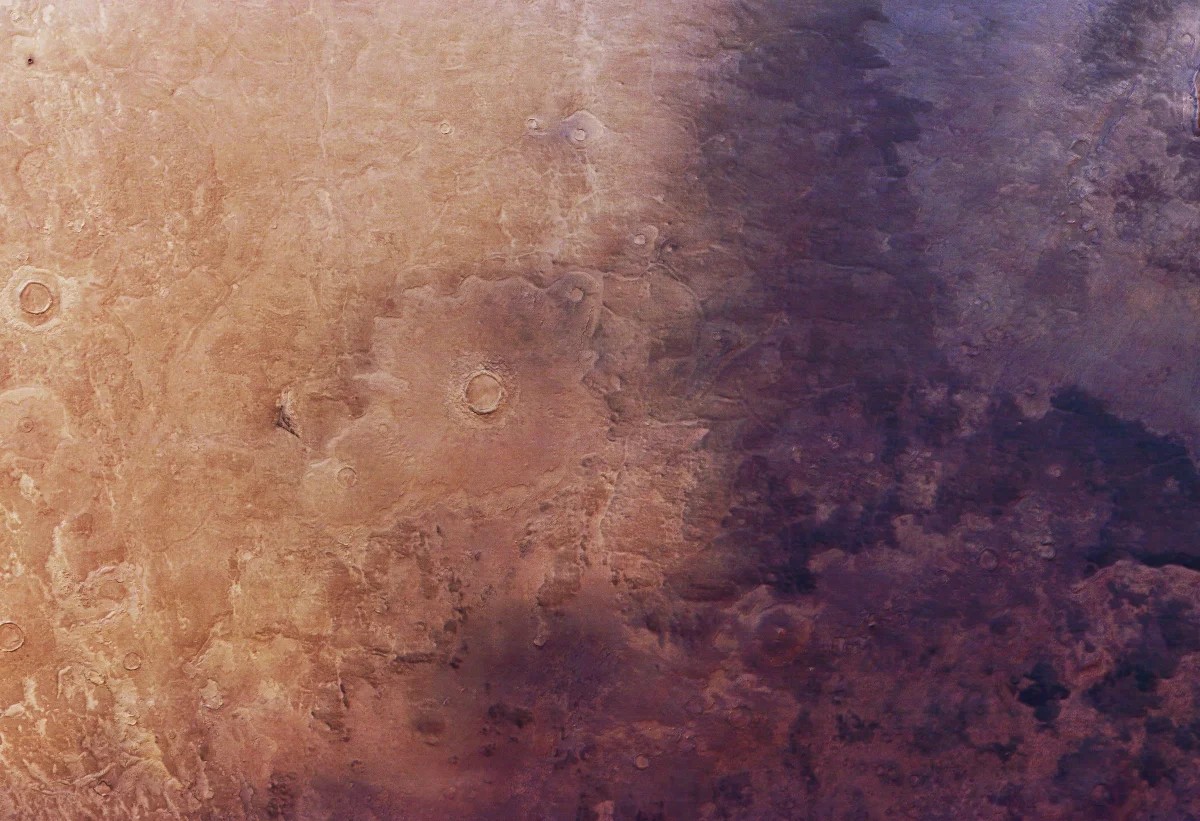
New orbital imagery from the European Space Agency (ESA) has revealed a striking transformation on the Martian surface. A “wave of darkness” is visibly spreading across the Utopia Planitia basin, a vast region believed to be the ancient site of a long-vanished sea.
A Contrast of Eras
The images, captured by the Mars Express mission’s High Resolution Stereo Camera (HRSC), present a sharp visual dichotomy. The landscape is split into two distinct zones:
– Light terrain: Composed of the planet’s familiar, rusted sands characteristic of modern Mars.
– Dark terrain: Composed of volcanic minerals dating back to the planet’s distant geological past.
This meeting of light and dark creates a “yin and yang” effect, marking a boundary between the contemporary Martian surface and much older geological layers.
Evidence of Rapid Change
What makes this discovery particularly significant is the speed of the transformation. When scientists compared these new images to data recorded by NASA’s Viking orbiters in 1976, the expansion of the dark regions was unmistakable.
In planetary science, surface changes are typically measured in millions of years. However, the visible shifts observed here have occurred over mere decades. This suggests that Mars is a much more dynamic and active world than its frozen, static appearance might suggest.
The Role of Martian Winds
While the dark material is composed of ancient volcanic minerals, its movement is driven by modern atmospheric forces. Scientists believe that strong Martian winds are the primary architects of this change. There are two leading theories for how this is happening:
1. Displacement: Winds may be lifting and spreading loose volcanic ash from ancient eruptions across the basin.
2. Erosion: Winds may be sweeping away lighter, overlying sediments, effectively “uncovering” the dark, igneous rock hidden beneath.
Hidden Resources and Geological Features
Beyond the shifting colors, the high-resolution imagery provides critical clues about the planet’s composition. The mission captured:
– Shadowy fractures and pits: These features suggest the presence of large volumes of water ice buried just beneath the surface.
– Impact craters: Numerous craters were identified, surrounded by the debris (ejecta) created during their formation.
The presence of subsurface ice is a vital piece of the puzzle for future Mars exploration, as it represents a potential resource for water and fuel.
The rapid expansion of dark volcanic material across Utopia Planitia highlights the power of Martian winds to reshape the planet’s surface in real-time, revealing ancient landscapes and hinting at the presence of subsurface ice.


