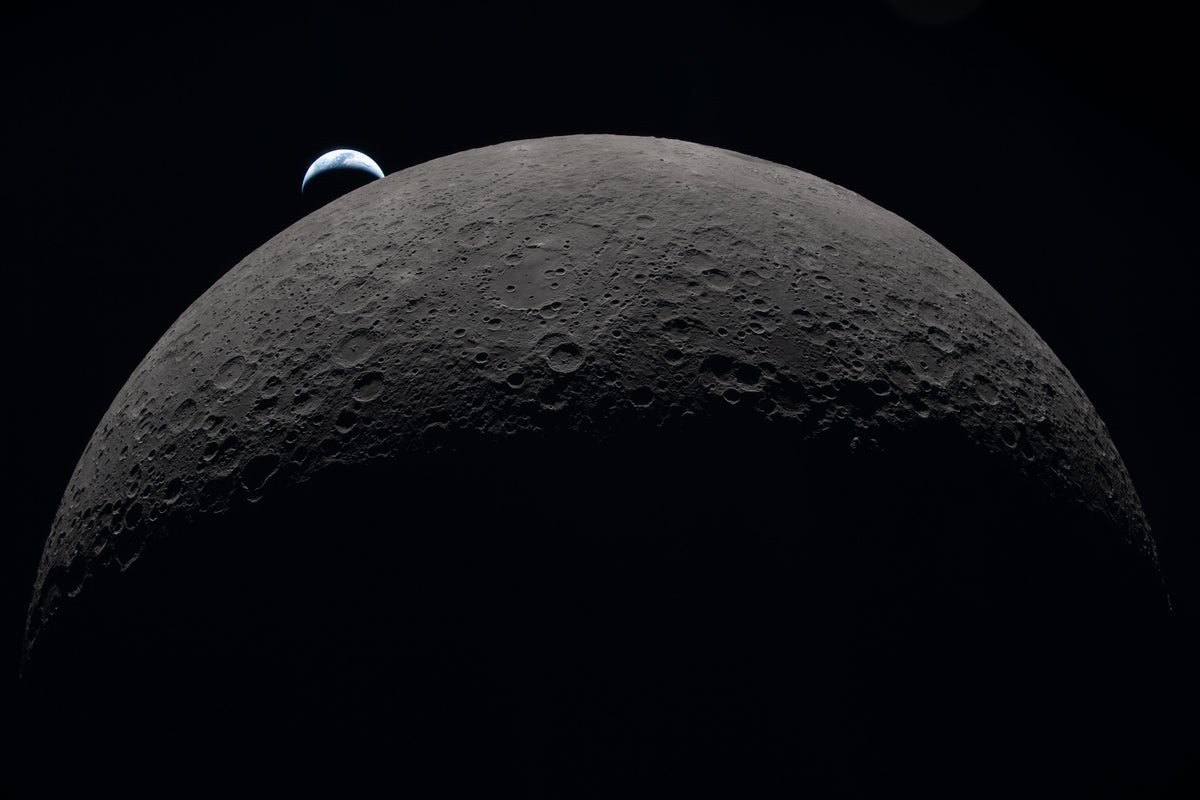
The Artemis II mission has concluded its 10-day voyage around the Moon, marking a historic milestone in human spaceflight. While the mission’s primary objective was to test the limits of deep-space travel, its legacy will be defined by the breathtaking visuals beamed back to Earth.
Through a cutting-edge laser-based communications system, the Orion spacecraft transmitted high-resolution imagery that captured everything from the sheer scale of the lunar landscape to the fragile beauty of our home planet. The crew—Reid Wiseman, Victor Glover, Christina Koch, and Jeremy Hansen —did more than just navigate a spacecraft; they provided a new visual vocabulary for our relationship with the cosmos.
From Launch to Deep Space
The mission began on April 1 at Florida’s Space Coast, marking the first crewed lunar mission since the Apollo era ended in 1972. The journey transitioned quickly from the roar of the launchpad to the silent, vast expanse of space.
- The Departure: After a smooth launch, the crew entered Earth orbit, preparing for the massive burn required to break free of our planet’s gravity.
- Leaving Earth Behind: On April 2, the Orion spacecraft consumed 6,700 pounds of fuel to propel itself toward the Moon, offering the crew a final, shrinking view of “Spaceship Earth.”
The Lunar Perspective: Shadows and Basins
As the spacecraft approached the Moon, the scientific value of the mission became apparent. Human eyes can perceive nuances in color and topography that even our most advanced satellites sometimes miss.
Observing the Terminator
One of the most striking phenomena captured was the “Terminator” —the moving line that divides the lunar day from the lunar night. This boundary of light and shadow provides a dramatic sense of the Moon’s rugged, uneven surface.
The Orientale Basin
A major scientific highlight was the view of the Orientale Basin. This massive impact crater is a cornerstone of planetary science, helping researchers understand how asteroid impacts shape solar systems. Seeing this feature through human eyes provides context that data alone cannot replicate.
A New Visual Legacy: Earthrise and Beyond
For decades, the “Earthrise” photo from the Apollo 8 mission served as a profound reminder of Earth’s isolation in the void. Artemis II has provided a modern successor to that legacy.
“The mission’s core goal was an unrequited success, thanks to their diligence.”
- Earthset and “A New View”: Rather than just an Earthrise, the crew captured a stunning “Earthset” and a viral image titled “A New View of Earth,” which depicted both the Moon and Earth shrouded in shadow.
- The Scale of Distance: Exterior camera shots from the far side of the Moon provided a sobering perspective: the Moon appearing massive in the foreground, while Earth appeared as nothing more than a tiny, fragile crescent.
Celestial Wonders and the Return Home
The mission was not limited to lunar observations; the crew witnessed rare celestial alignments that are seldom seen from a terrestrial vantage point.
A Cosmic Eclipse
During a solar eclipse viewed from space, the sudden darkness allowed the astronauts to see planets—including Saturn, Mars, Mercury, and Venus —alongside a sea of stars that are usually drowned out by sunlight. They also captured “Earthshine,” the phenomenon where light reflected from Earth illuminates the dark side of the Moon.
The Successful Return
The mission concluded on Friday at 8:07 P.M. EDT with a precise splashdown. After being retrieved by Navy divers and brought aboard the USS John P. Murtha, the crew’s safe return was met with global celebration.
Conclusion
The Artemis II mission successfully bridged the gap between decades of lunar dormancy and a new era of deep-space exploration. By combining groundbreaking science with unprecedented visual documentation, NASA has not only proven the viability of crewed lunar transit but has also re-inspired a global fascination with the heavens.