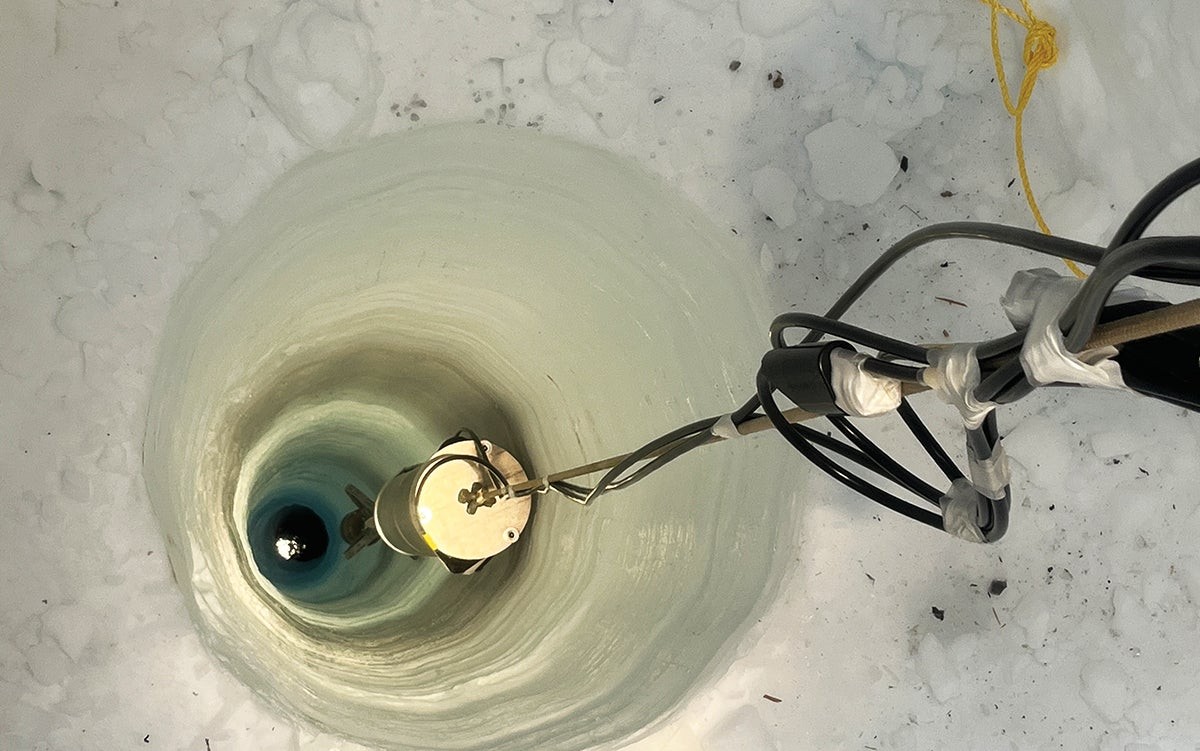
While the Antarctic ice sheet looks motionless from the surface, the ground beneath it is constantly moving. To capture these subtle movements, scientists have successfully deployed the world’s deepest seismic sensors, buried 8,000 feet beneath the ice at the South Pole.
This ambitious project, a collaboration between the U.S. Geological Survey (USGS) and the IceCube Neutrino Observatory, aims to turn Antarctica into a premier listening post for global tectonic activity.
A Silent Vantage Point
The South Pole offers a unique advantage for seismic research: it is one of the quietest places on Earth. Unlike many other locations, the region lacks heavy human infrastructure and significant “noise” caused by the Earth’s rotation, which often distorts sensitive data.
By placing sensors deep within the ice, researchers achieve two critical goals:
– Noise Reduction: The massive ice sheet acts as a buffer against atmospheric pressure changes that can interfere with surface-level readings.
– Global Coverage: The station fills a massive geographical gap in the Global Seismographic Network, providing a perspective on tectonic shifts that other stations cannot reach.
Engineering the Impossible
Reaching a depth of 8,000 feet required extreme engineering. To create access, teams used a specialized “hot water drill” that channels energy comparable to a powerful steam locomotive through a tiny opening.
The deployment process is a race against time and physics:
1. Melting the Path: The drill melts through the ice at a rate of approximately three feet per minute.
2. Rapid Deployment: Once a hole is completed (roughly 50 hours of drilling), engineers have a 50-hour window to lower the instruments before the ice refreezes.
3. Extreme Durability: To survive the immense pressure at those depths, the seismometers are housed in stainless steel vessels capable of withstanding 10,000 pounds per square inch.
How the Sensors “Hear” the Earth
The technology inside these vessels is highly sophisticated. Each sensor utilizes a small pendulum suspended within a magnetic field. When a seismic vibration occurs, a resistor measures the change in magnetic strength required to keep the pendulum steady.
This method allows scientists to detect low-frequency ground motions, ranging from massive earthquakes to “Earth tides”—the subtle stretching of the planet caused by the gravitational pull of the sun, moon, and Earth itself.
Why Long-Period Waves Matter
The new sensors are specifically designed to capture long-period seismic waves produced by major earthquakes (magnitude 7 or greater).
“Imagine hitting a bell. It’s going to sit there and ring until the energy completely dies down,” explains David Wilson, director of the Global Seismographic Network.
Unlike surface shakes that pass quickly, these deep-reaching waves can vibrate through the Earth for months. By capturing these “ringing” waves, scientists can:
– Characterize Fault Movements: Understand exactly how a fault shifted during an event.
– Tsunami Prediction: Better determine if a specific seismic movement has the potential to trigger a tsunami.
– Map the Interior: Use the way waves travel through the planet to reveal new details about Earth’s deep internal structure.
Conclusion
By burying advanced sensors deep within the Antarctic ice, scientists have established a high-precision window into the Earth’s core. These instruments will provide unprecedented data on global earthquakes and the fundamental mechanics of our planet’s interior.