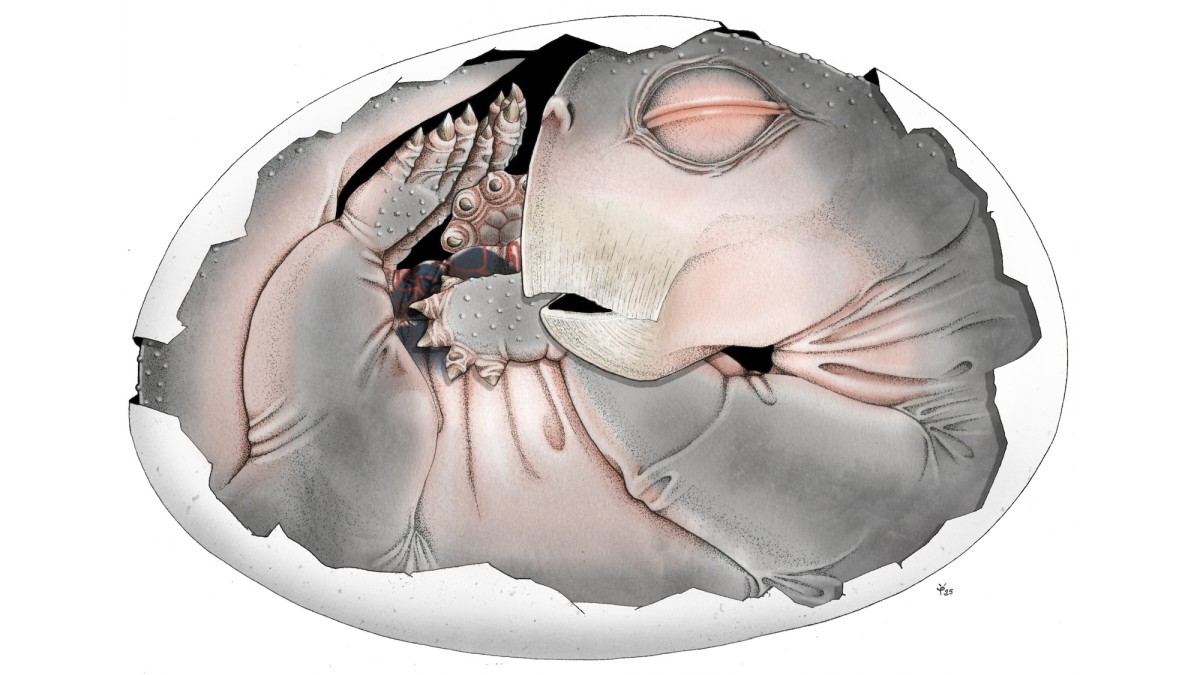
For decades, evolutionary biologists have grappled with a fundamental question regarding the origins of mammals: Did our earliest ancestors reproduce via live birth, or did they lay eggs like modern monotremes (such as the platypus)?
A new study published in the journal PLOS One provides a definitive answer. By utilizing cutting-edge imaging technology to examine a 250-million-year-old fossil, researchers have confirmed that proto-mammals laid eggs, marking a major milestone in our understanding of mammalian evolution.
The Discovery: A 17-Year Journey
The breakthrough centers on a specimen discovered nearly two decades ago in South Africa’s Karoo Basin. While the region is a renowned fossil hotspot, this particular find was not immediately understood.
What initially appeared to be a small nodule containing mere flecks of bone was eventually revealed to be the remains of a Lystrosaurus hatchling. Lystrosaurus was a crucial herbivorous species that emerged in the wake of the End-Permian Mass Extinction—a catastrophic event triggered by massive volcanic activity that wiped out much of the Earth’s life. While many species perished, Lystrosaurus managed to thrive in a volatile, drought-prone world.
Technology Bridges the Gap
Although the fossil was found in 2008, scientists lacked the tools to prove it was an egg at the time. The turning point came with the use of synchrotron X-ray CT scanning at the European Synchrotron Radiation Facility in France.
This advanced imaging allowed paleontologists to look inside the fossil without destroying it. The team identified a critical anatomical detail: an incomplete mandibular symphysis (the lower jaw).
“The fact that this fusion had not yet occurred shows that the individual would have been incapable of feeding itself,” explained paleobiologist Julien Benoit.
Because the jaw had not yet fused, the animal was still in a pre-feeding developmental stage. Its curled position within the nodule confirmed that it had died while still inside its egg.
Evolutionary Advantages of the Egg
The study suggests that Lystrosaurus likely laid soft-shelled eggs. This explains why fossilized evidence of such eggs is incredibly rare; unlike hard calcium shells, soft shells do not fossilize easily.
The size and nature of these eggs provided several evolutionary advantages that helped the species survive a period of extreme climate instability:
– Nutrient Density: The relatively large size of the egg compared to the body suggests a high yolk content, providing the embryo with all necessary nutrients for development.
– Desiccation Resistance: Larger eggs are more resistant to drying out, a vital trait during the frequent droughts of the post-extinction era.
– Rapid Independence: The evidence suggests these animals were highly developed upon hatching, allowing them to evade predators and begin reproducing quickly.
Why This Matters Today
This discovery does more than just fill a gap in the prehistoric record; it provides a “deep-time” blueprint for biological resilience. By studying how Lystrosaurus adapted to a rapidly changing and chaotic ecosystem 250 million years ago, scientists can gain valuable insights into how modern biodiversity might respond to current global climate crises.
Conclusion
The confirmation that proto-mammals laid eggs redefines our understanding of mammalian development and highlights how specific reproductive strategies can drive survival during periods of intense ecological upheaval.