While NASA’s Artemis II mission has captured the world’s attention with its successful circumlunar flight, the narrative of American lunar dominance may be premature. Beneath the high-profile headlines of the U.S. space program, China is executing a methodical, highly disciplined campaign to put its own astronauts on the lunar surface.
As NASA works to re-establish a human presence on the Moon for the first time in over five decades, a different strategic model is emerging from the East—one that could see Chinese footprints appearing on the Moon before the decade is out.
China’s Stealth Milestones: Testing the Hardware
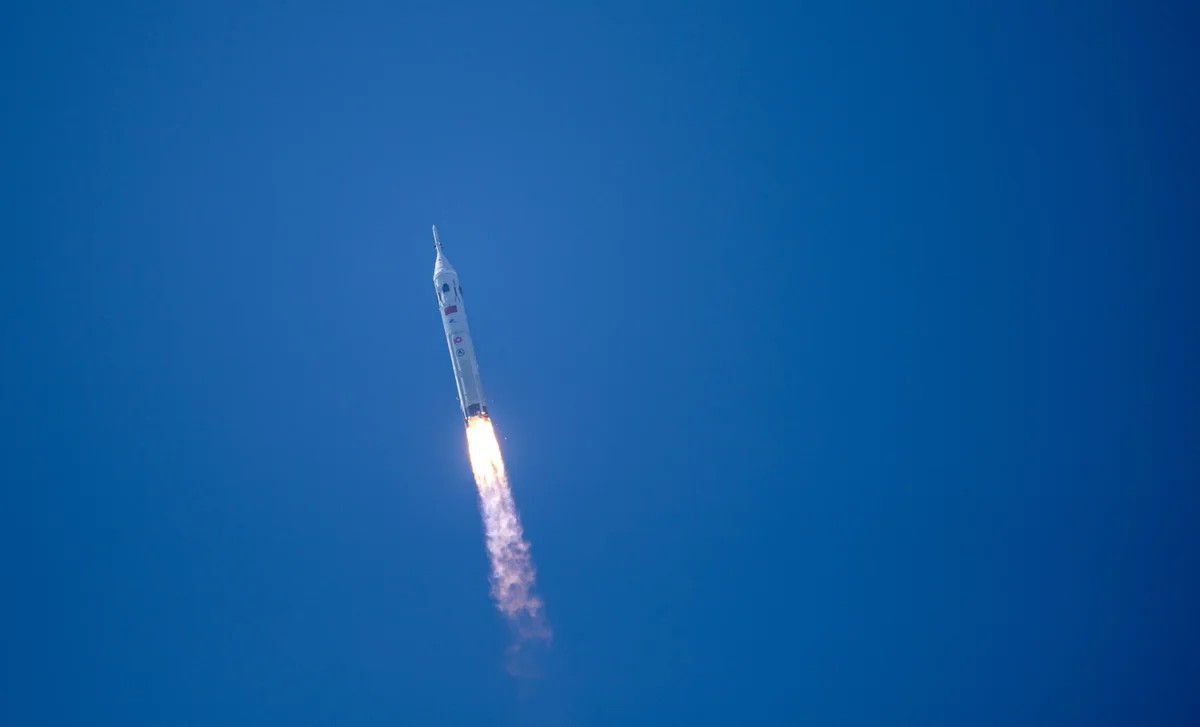
Unlike the highly publicized Artemis missions, China’s recent progress has been characterized by technical tests designed to prove reliability rather than garner media attention. A recent successful test of the Long March 10 rocket and the Mengzhou spacecraft highlights several key technological advantages:
- Advanced Abort Systems: During a recent test, mission controllers successfully triggered a solid rocket system to pull the Mengzhou spacecraft away from the launcher during ascent. This “in-flight abort” capability is critical for crew safety.
- Propulsive Recovery: The Long March 10 stage demonstrated a “boost-back burn” followed by a controlled, propulsive splashdown. This capability for precise, powered landings is a feat that NASA’s current Space Launch System (SLS) is not currently designed to match.
- Modular Rocket Design: China is moving toward a multi-core booster configuration—similar to the architecture of the SpaceX Falcon Heavy—to provide the massive lift required for deep-space missions.
The Strategic Divergence: Centralization vs. Collaboration
The most significant difference between the two programs lies in their organizational structures. This distinction creates a unique set of advantages and risks for both nations.
The American Model: A Distributed Network
NASA’s Artemis program relies on a complex, decentralized web of international partners and private commercial entities, including SpaceX and Blue Origin. While this fosters innovation and cost-sharing, it also introduces complexity. The U.S. must manage various stakeholders, each with different timelines and technical standards, which can lead to programmatic shifts and delays.
The Chinese Model: A Unified Command
In contrast, China’s lunar program is driven by a centralized, state-led approach, primarily managed by the China Aerospace Science and Technology Corporation. This allows for a singular, concentrated effort.
“If the Chinese can maintain a single concentrated effort, they will retain an advantage,” notes Bleddyn Bowen, co-director of the Space Research Center at Durham University. “Today China’s effort resembles the 1960s U.S. Apollo moon program more, while the U.S. Artemis program resembles the Soviet Union’s competing design bureaus of the late 1960s.”
The Roadmap to the Moon
China has set a clear, ambitious goal: a crewed lunar landing before 2030. Their planned mission architecture is already taking shape:
- Launch: Two Long March 10 rockets will be used.
- Transport: One rocket will carry the Mengzhou spacecraft (the crew module), while the other carries the Lanyue lunar lander.
- Rendezvous: The two craft will meet in low lunar orbit, where astronauts will transfer from the Mengzhou to the Lanyue for the final descent to the surface.
While the U.S. aims for a landing by 2028 via Artemis IV, China’s progress on landing hardware—having already tested the Lanyue lander in simulated lunar gravity—suggests they are closing the gap rapidly.
Beyond the Race: A Question of Permanence
While the “race” is often framed as a sprint to be the first to touch the surface, experts suggest the real competition may be about long-term presence. Some analysts believe that while the U.S. might reach the Moon first, China may have a better chance of establishing a permanent, crewed lunar station due to its integrated development approach.
Regardless of who arrives first, the increasing density of lunar activity raises a critical question: How will these two superpowers manage the Moon? As both nations push toward the lunar south pole, the need for international norms and shared understanding regarding lunar exploration becomes more urgent than ever.
Conclusion: While NASA currently leads in public visibility and mission complexity, China’s centralized, hardware-focused approach poses a legitimate threat to American lunar primacy, potentially making the 2030s a decade defined by Chinese lunar presence.