After a landmark 10-day journey around the Moon, the Artemis II crew is entering the final, most critical phase of their mission. The Orion spacecraft, affectionately nicknamed Integrity by the astronauts, is currently on course to splash down in the Pacific Ocean off the coast of San Diego, California, tonight.
The Final Countdown to Reentry
The return to Earth is a high-stakes technical feat that requires precision at every stage. The mission timeline for this evening is as follows:
- 7:33 P.M. EDT: The Orion capsule will separate from its service module, which provides the essential fuel, oxygen, and water used during the lunar orbit.
- Trajectory Correction: A final “raise burn” will be executed to refine the spacecraft’s path toward the splashdown site.
- 7:53 P.M. EDT: Orion will officially hit the Earth’s atmosphere.
- 8:07 P.M. EDT: Projected splashdown in the Pacific Ocean.
The “13 Minutes of Terror”
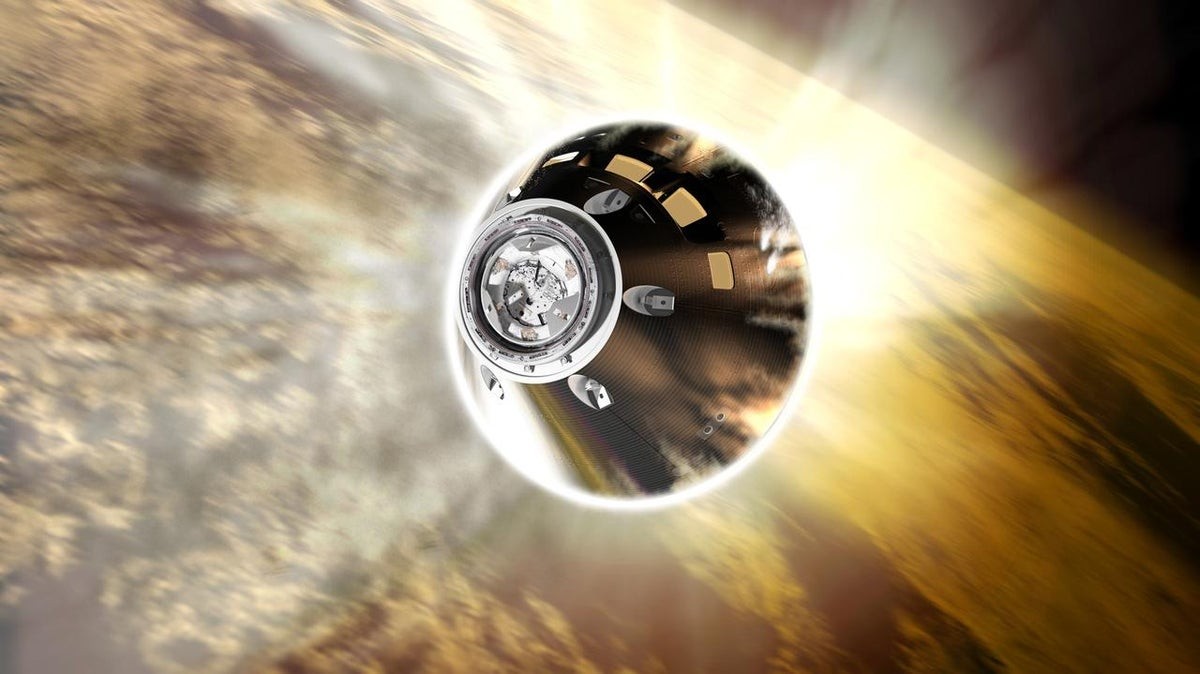
The reentry process is arguably the most dangerous part of the mission. As the capsule plummets toward Earth at speeds approaching 24,000 miles per hour, it will encounter extreme friction with the atmosphere.
“It’s 13 minutes of things that have to go right,” noted Artemis II flight director Jeff Radigan.
During this window, temperatures are expected to soar to approximately 5,000 degrees Fahrenheit (2,760 degrees Celsius). This intense heat creates a sheath of superhot plasma around the craft, which will result in a six-minute communications blackout, leaving Mission Control in Houston temporarily unable to speak with the crew.
Once the craft slows below 35,000 feet, a sequence of parachutes will deploy to decelerate the capsule from orbital speeds to less than 20 miles per hour, ensuring a safe impact with the water.
Recovery and Reunion
NASA has prepared an extensive recovery operation involving both civilian and military assets. Once the splashdown is confirmed:
1. Helicopter Retrieval: Recovery teams will pick up the astronauts from the water.
2. Naval Transport: The crew will be transported to the USS John P. Murtha.
3. Order of Egress: NASA officials expect Christina Koch to be the first to exit the capsule, followed by Victor Glover, Jeremy Hansen, and finally Reid Wiseman.
Following their recovery, the crew—comprising NASA astronauts Reid Wiseman, Christina Koch, and Victor Glover, alongside Canadian Space Agency astronaut Jeremy Hansen—will fly to the Johnson Space Center in Houston to reunite with their families.
Why This Mission Matters
The successful return of the Artemis II crew marks a pivotal moment in modern space exploration. This mission is not merely a flight; it is a stress test for the systems and human endurance required for NASA’s broader goal: returning humans to the lunar surface and eventually reaching Mars. By successfully navigating the extreme thermal and communication challenges of reentry, NASA validates the technology that will support much longer, more complex deep-space journeys in the coming decade.
Conclusion: As the Artemis II crew prepares for their high-speed descent, the world watches a critical test of human ingenuity and spacecraft resilience that paves the way for the next era of lunar exploration.