


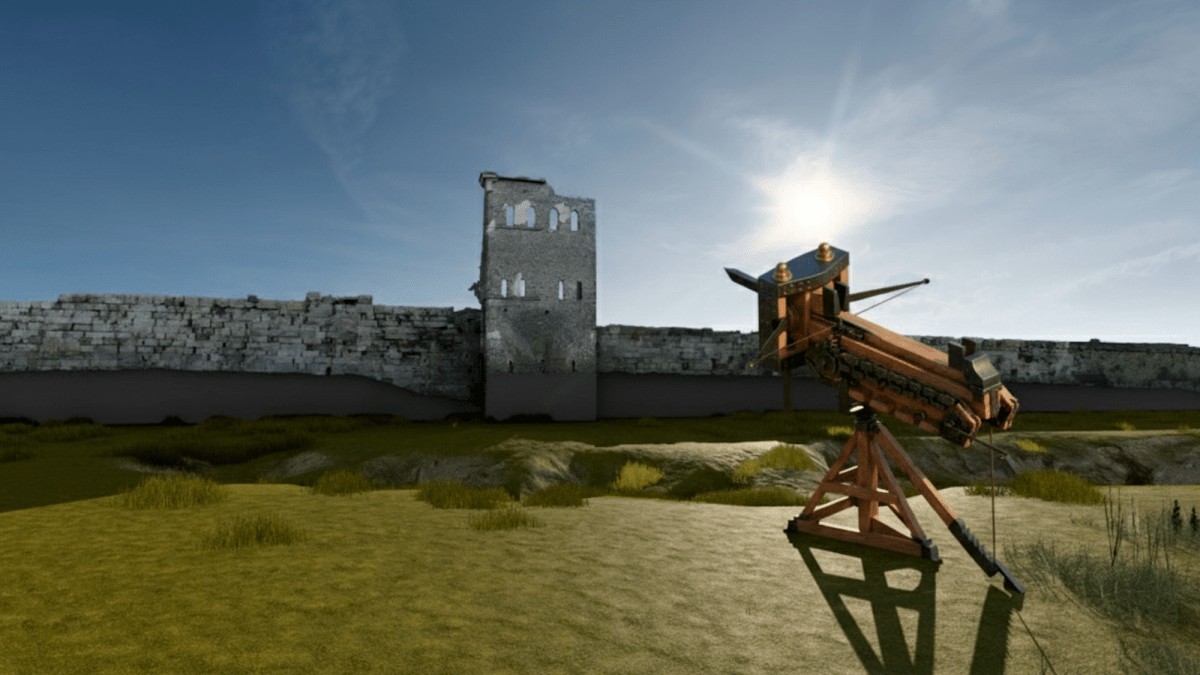
Archaeologists have long relied on ancient texts to understand the evolution of warfare, but physical evidence of certain legendary weapons has remained elusive. Now, a study published in the journal Heritage suggests that researchers may have finally found the “fingerprints” of a mechanical marvel: the polybolos.
Located on the battle-scarred walls of Pompeii, these marks provide the first tangible evidence of a repeating weapon that predates modern machine guns by two millennia.
The Siege of 89 BCE
While Pompeii is most famous for its destruction by Mount Vesuvius in 79 CE, its fortifications tell a much older story of conflict. Nearly 170 years prior to the volcanic eruption, the city was a target during the Social Wars (91–87 BCE).
During this period, Roman forces led by General Lucius Cornelius Sulla laid siege to the city. To break Pompeii’s resistance, Roman troops targeted the northern walls near the Herculaneum and Vesuvio gates with heavy artillery. While the city eventually surrendered and was annexed into the Roman Empire, the scars of that battle remain etched in the stone.
Distinguishing Ballistae from the Polybolos
For years, researchers attributed much of the wall damage to ballistae —massive, torsion-powered engines that functioned like oversized crossbows. These weapons typically left large, circular dents and chips in the fortifications caused by heavy stone projectiles.
However, using high-resolution laser scans, 3D modeling, and detailed imaging, researchers from the University of Campania identified a different pattern of destruction:
- The Marks: Instead of large craters, certain sections of the wall feature small, four-sided pits.
- The Pattern: These pits are grouped closely together in fan-shaped clusters.
- The Impact: The shallow depth of the indentations (only a few centimeters) suggests they were caused by metal-tipped bolts rather than heavy stones.
This specific distribution—regular, tight, and repetitive—is the hallmark of a weapon capable of rapid, successive fire.
A Mechanical Marvel: The Polybolos
The polybolos was a revolutionary design credited to the Greek engineer Dionysius of Alexandria in the 3rd century BCE. Unlike the ballista, which relied on the tension of twisted ropes, the polybolos utilized a sophisticated system of mechanical chains and gears.
This mechanism allowed for a “magazine” of ammunition, enabling operators to fire multiple bolts in quick succession. Ancient writers like Philo of Byzantium described it as a “repeating catapult,” a concept so advanced that similar rapid-fire technology would not reappear in warfare for nearly 2,000 years.
Why This Discovery Matters
This finding bridges the gap between historical literature and archaeological reality. For centuries, the polybolos existed only in the writings of ancient engineers; now, its destructive impact is physically documented.
The presence of this weapon in Pompeii also sheds light on Roman military strategy. General Sulla was known to have integrated advanced technological breakthroughs from the Eastern Mediterranean into his campaigns. This suggests that the Roman military was not just a force of brute strength, but a highly sophisticated machine capable of adopting and deploying cutting-edge Greek engineering to secure dominance.
This discovery confirms that the ancient world possessed mechanical complexities far more advanced than previously proven by physical evidence alone.
In summary, the discovery of polybolos impact sites at Pompeii provides the first physical proof of ancient repeating weaponry, illustrating a sophisticated level of military technology that would not be seen again for centuries.


