


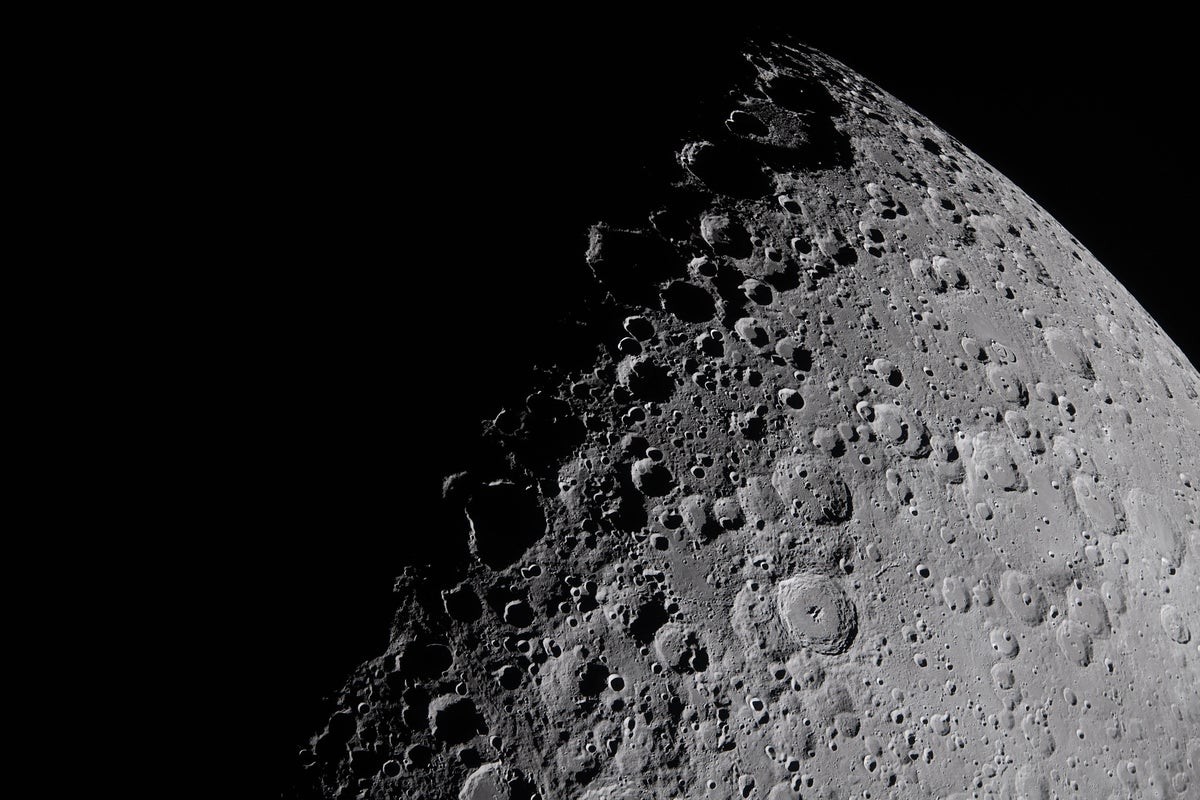
NASA’s Artemis II mission has reached a monumental milestone, successfully completing a lunar flyby that marks the first time humans have ventured into the vicinity of the Moon in over half a century. The mission, crewed by NASA’s Reid Wiseman, Victor Glover, and Christina Koch, alongside the Canadian Space Agency’s Jeremy Hansen, has provided humanity with a fresh, unprecedented look at our celestial neighbor.
A Record-Breaking Journey
On its sixth day, the crew officially became the farthest humans from Earth in history, breaking a record that had stood since the Apollo 13 mission in 1970.
As the Orion spacecraft soared just 4,067 miles above the lunar surface, the astronauts documented landscapes never before seen by human eyes. Using intensive training to interpret the Moon’s “albedo”—the way light reflects off different minerals and terrains—the crew described a surreal landscape through their viewports:
– Topography: Features described as “healing wounds” on the lunar skin and frozen lava streaks as smooth as “paved roads.”
– Craters: Bright, sharp features compared to “pinpricks in a lampshade.”
– Celestial Phenomena: The crew witnessed a total solar eclipse and observed “earthshine”—the dim, bluish glow on the Moon caused by sunlight reflecting off Earth’s oceans and clouds.
“No matter how long we look at this, our brains are not processing this image in front of us. It is absolutely spectacular, surreal,” remarked mission commander Reid Wiseman.
Political Tensions and Budgetary Shadows
While the scientific achievements were historic, the mission also served as a backdrop for political friction. During a call on Monday, President Donald Trump—whose administration initiated the Artemis program—congratulated the crew but also addressed the precarious future of space exploration.
The President noted the pivotal decision he faced during his first term regarding whether to revive or close NASA. This conversation comes at a critical juncture: the White House’s latest budget proposal for fiscal year 2027 suggests a 23% cut to NASA’s overall funding and a staggering 47% reduction in the science budget. If enacted, these cuts would result in NASA’s smallest budget adjusted for inflation since 1961.
The call was marked by a moment of technical awkwardness; after a lighthearted comparison between crew member Jeremy Hansen and hockey legend Wayne Gretzky, a minute-long communication silence left the astronauts uncertain if the connection had been lost.
The Road Home
The mission is now transitioning from observation to reentry. Having completed their lunar flyby, the Orion spacecraft is currently on a trajectory back toward Earth.
Key upcoming milestones include:
– April 7: The spacecraft will exit the Moon’s sphere of influence and enter Earth’s gravitational dominion.
– April 10: The crew is scheduled to splash down in the Pacific Ocean, near San Diego, California.
Before their return, the crew will engage in scientific debriefings regarding their lunar observations and hold a scheduled communication with astronauts currently stationed on the International Space Station (ISS).
Conclusion
The Artemis II mission has successfully bridged the gap between the Apollo era and the future of deep-space exploration, providing invaluable scientific data and breathtaking imagery. However, the mission’s long-term legacy may ultimately depend on whether NASA can maintain its momentum in the face of significant proposed federal budget cuts.


