


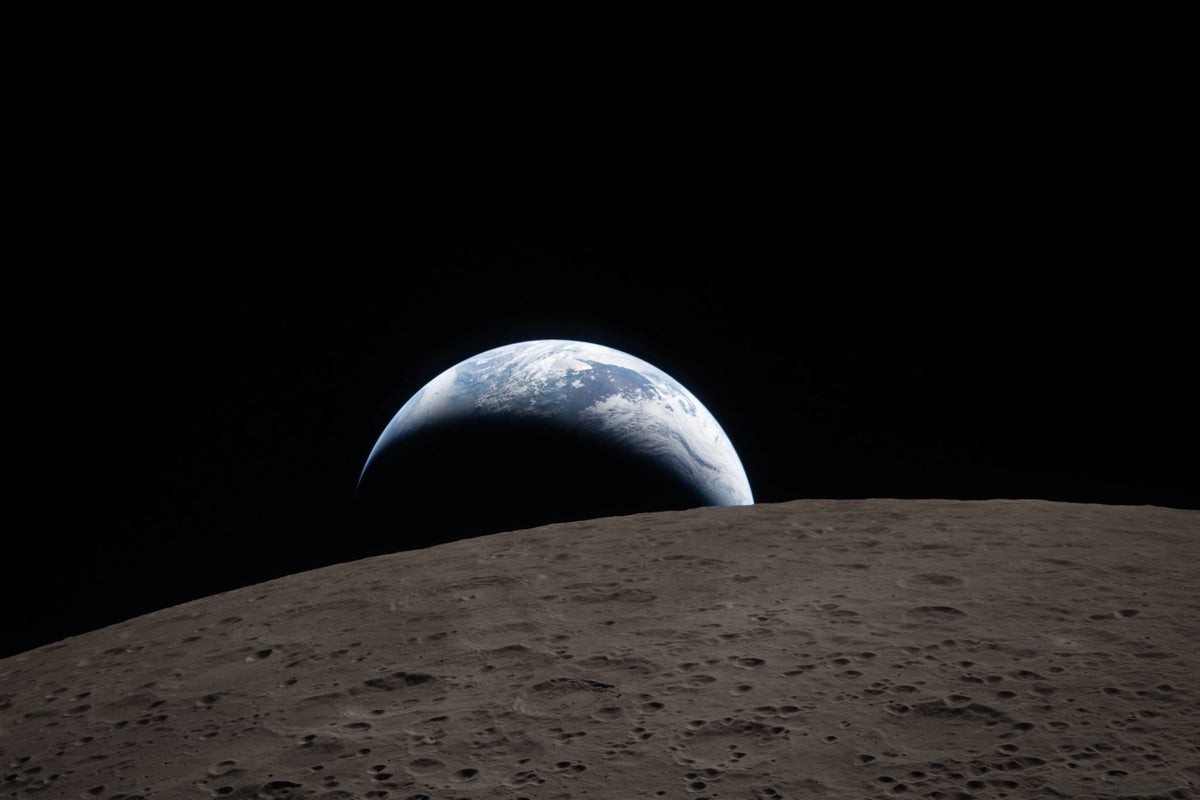
The crew of NASA’s Artemis II mission has reached a historic milestone, venturing further into deep space than any human in history. As the Orion spacecraft rounded the far side of the moon on Monday, the astronauts captured two breathtaking celestial events: an “Earthrise” and an “Earthset.”
These moments serve as a modern echo of one of the most significant visual achievements in space exploration history.
Recreating a Moment of History
The “Earthrise” captured by the Artemis II crew is a spiritual successor to the legendary photograph taken by astronaut William Anders during the Apollo 8 mission on December 24, 1968. That original image, which showed our home planet peeking over the lunar horizon, became a cultural touchstone. It provided a profound visual realization of Earth’s isolation in the void, famously helping to ignite the global environmental movement.
While the visual similarities are striking, the technical context of these two missions differs significantly:
– Apollo 8: The crew orbited the moon 10 times, with the original “Earthrise” captured during their fourth orbit.
– Artemis II: The mission is focused on a flyby rather than a long-term orbit; the Orion spacecraft will not be staying to circle the moon.
The View from the Far Side
The sequence of events unfolded with dramatic timing. Less than an hour before witnessing the Earth rising, the crew observed an “Earthset,” watching our planet disappear behind the lunar limb.
During the interval between these two views, the crew experienced a period of isolation. As the Orion spacecraft rounded the far side of the moon, the astronauts—Reid Wiseman, Victor Glover, Christina Koch, and Jeremy Hansen —lost all communication with Houston Ground Control for approximately 40 minutes. This “blackout” is a standard consequence of lunar geometry, as the moon itself acts as a physical barrier to radio signals between the spacecraft and Earth.
A Message to the World
When communication was finally restored, the crew shared their awe with mission control and the public. At the time of the sighting, much of the Earth’s eastern hemisphere—including Asia, Africa, and Oceania —was visible to the astronauts.
“To Asia, Africa and Oceania: We are looking back at you,” Christina Koch remarked once the signal was regained. “We hear you can look up and see the moon right now. We see you too.”
This connection highlights the unique psychological aspect of deep-space travel: even as humans push further into the unknown, the perspective remains tethered to the home planet they left behind.
Conclusion
By capturing these views, the Artemis II crew has not only documented a technical success but has also provided a modern visual reminder of Earth’s place in the cosmos, bridging the gap between the Apollo era and the next chapter of lunar exploration.


