


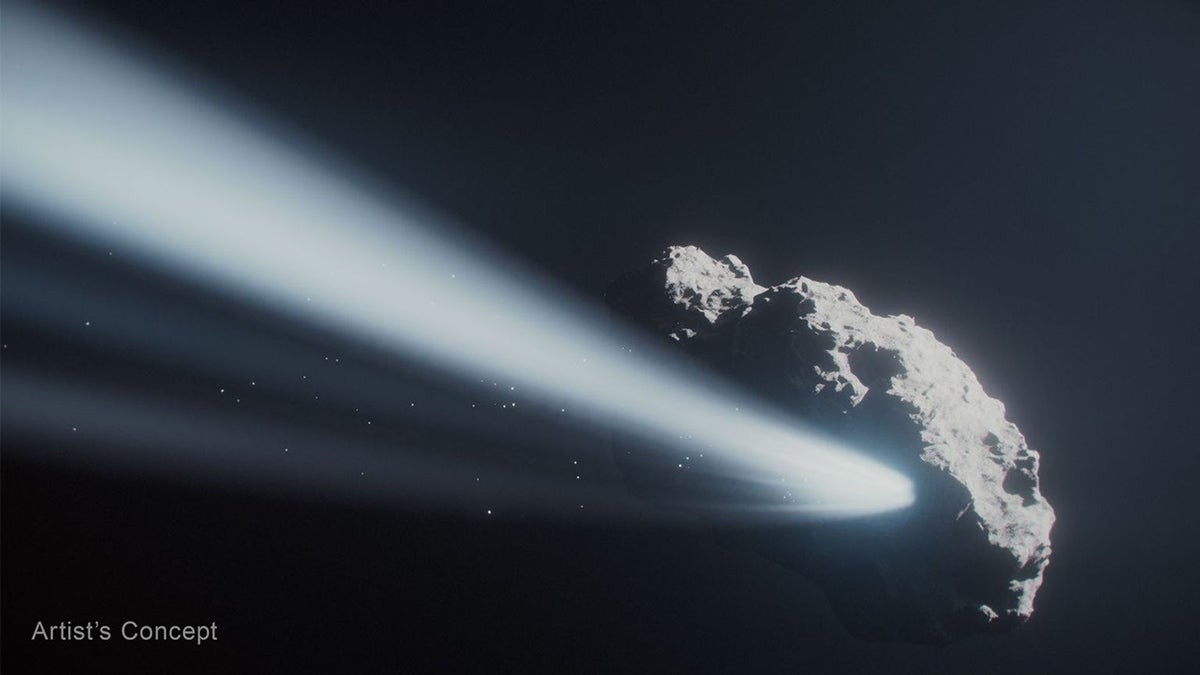
Astronomers have witnessed a comet dramatically reversing its rotation – a phenomenon never before documented. Using the Hubble Space Telescope, scientists observed this bizarre behavior in Comet 41P/Tuttle-Giacobini-Kresák (41P) after its close approach to the sun in 2017.
Rapid Shift in Rotation
Data initially captured by NASA’s Neil Gehrels Swift Observatory revealed a significant slowdown in the comet’s spin between March and May 2017. The object’s rotation rate decreased threefold within just two months. What followed was even more unusual: instead of remaining slow, the comet accelerated its spin in the opposite direction. Researchers hypothesize the comet almost stopped entirely before volatile gases propelled it into a reverse rotation.
The Role of Outgassing Jets
The key to this reversal lies in the comet’s outgassing jets. As 41P neared the sun, heat caused frozen ices to vaporize, creating jets of gas. These jets acted as thrusters, unevenly distributed across the comet’s surface.
“If those jets are unevenly distributed, they can dramatically change how a comet, especially a small one, rotates,” explains David Jewitt of UCLA, co-author of the study published in the Astronomical Journal.
This uneven thrust effectively slowed the comet down, eventually flipping its direction of spin – akin to pushing against a merry-go-round to reverse its motion.
A Rare, Fast-Paced Event
This observation is remarkable because such dramatic rotational changes typically occur over centuries, not months. Comet 41P’s rapid evolution provides a rare opportunity to study these processes in real-time. The comet originated in the distant Kuiper Belt before being drawn inward by Jupiter’s gravity. It has maintained its current orbit for approximately 1,500 years, but is rapidly losing mass.
Scientists believe this mass loss will eventually lead to the comet’s disintegration, making this spin reversal a fleeting moment in its cosmic life cycle.
This discovery highlights the dynamic and unpredictable nature of comets, and how even seemingly stable celestial bodies can undergo radical transformations due to simple physical forces.


