For the past several years, schools have faced a surge of discussion around generative AI tools like ChatGPT. While some tout them as transformative, and others warn of potential harm, many teachers remain hesitant to fully adopt them. This isn’t necessarily resistance to innovation, but a pragmatic evaluation: does this tool solve a real problem in the classroom?
Recent research, including conversations with 17 teachers worldwide, reveals a surprising trend: teachers aren’t rejecting AI, but they aren’t reorganizing classrooms around it either. Instead, they’re adopting a measured approach, leveraging AI for productivity while maintaining boundaries around core learning tasks. This isn’t indifference, but professional judgment.
The Productivity Gap: Where AI Has Immediate Value
The most immediate use case for AI in education isn’t student learning—it’s teacher workload. Educators juggle grading, lesson planning, parent communication, and administrative tasks. In this environment, AI tools excel at drafting, summarizing, and generating text. One New Jersey engineering teacher noted using AI to compress routine tasks, saying it genuinely helps lighten the administrative burden. RAND’s American Educator Panels confirm this pattern: teachers are adopting AI primarily as a productivity tool, not a core instructional technology.
This mirrors how professionals across fields use AI: it solves the immediate problem of time pressure and administrative demands. But instructional use cases require more careful consideration.
The Unclear Instructional Role: What Learning Problems Does AI Solve?
When it comes to direct classroom instruction, teachers ask a fundamental question: what learning problem does this tool solve? Many remain unconvinced, even after years of exposure. Some experiment with AI as a revision partner in writing, while others design lessons around the technology itself, encouraging critical analysis rather than blind reliance. A science teacher from Guam said they use AI as a starting point, but not a source of authoritative knowledge.
Learning science suggests students benefit most when technology supports reflection and revision, not by replacing critical thinking. This means AI is more valuable as a tool to analyze rather than as a shortcut to answers.
AI Literacy: A Practical Entry Point
The most promising instructional opportunity lies in AI literacy itself. UNESCO and the OECD increasingly frame it as a foundational skill, encouraging schools to teach students how algorithmic systems generate information—and where they fail. Students already navigate environments shaped by algorithms; generative AI is just another layer.
Teachers are focusing on helping students understand how these systems produce information, including their biases and limitations. One New York elementary teacher described illustrating how AI systems work—and where they break down. This approach treats AI as a case study in how digital systems shape knowledge, rather than a productivity tool.
Bias, Hallucinations, and Trust: Addressing the Risks
Teachers consistently raise concerns about the reliability of AI outputs. A New York library media specialist noted that AI often “hallucinates” facts, while others point to real-world examples of algorithmic bias. One high school teacher in New Jersey expressed concerns about how AI might reinforce existing inequities, particularly for students from marginalized communities.
These issues aren’t just theoretical; they’re practical concerns about trust and accuracy. AI becomes less a tool for answering questions and more a demonstration of how technological systems shape information.
Pragmatic Indifference: The Default Stance
Teachers aren’t necessarily rejecting AI, but they aren’t rushing to integrate it into core learning tasks. Many adopt a posture of pragmatic indifference: using it for lesson planning but not necessarily for the lessons themselves. They discourage students from relying on AI for research.
Schools exist to foster complex cognitive work: deep reading, methodical writing, reasoning, and evidence evaluation. If a tool primarily reduces the need for this work, teachers question whether it advances or undermines learning.
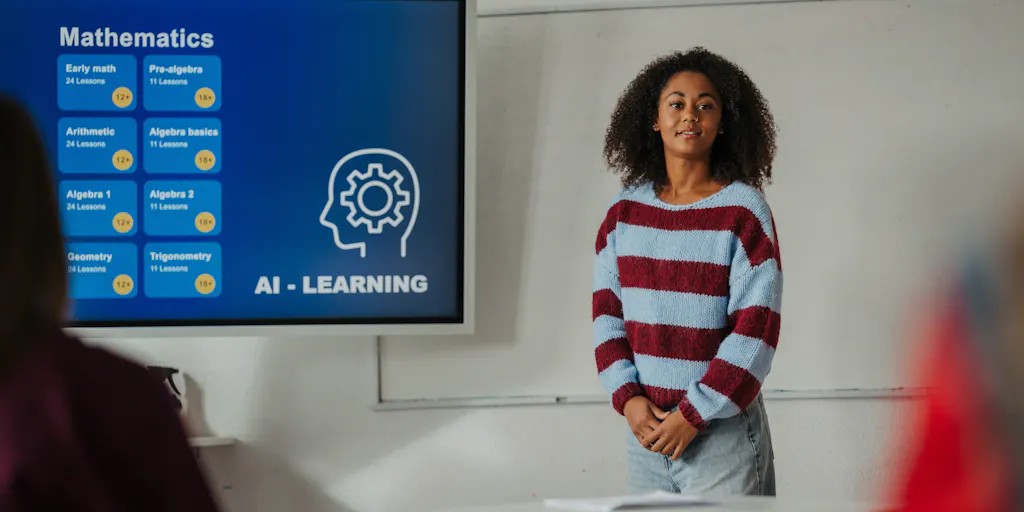
Ultimately, the fourth-grade teacher’s question remains: what can AI actually do for fourth-grade math? Until the instructional use case is clear, the conversation must shift to the skills that remain valuable—critical thinking, problem-solving, and rigorous analysis.