


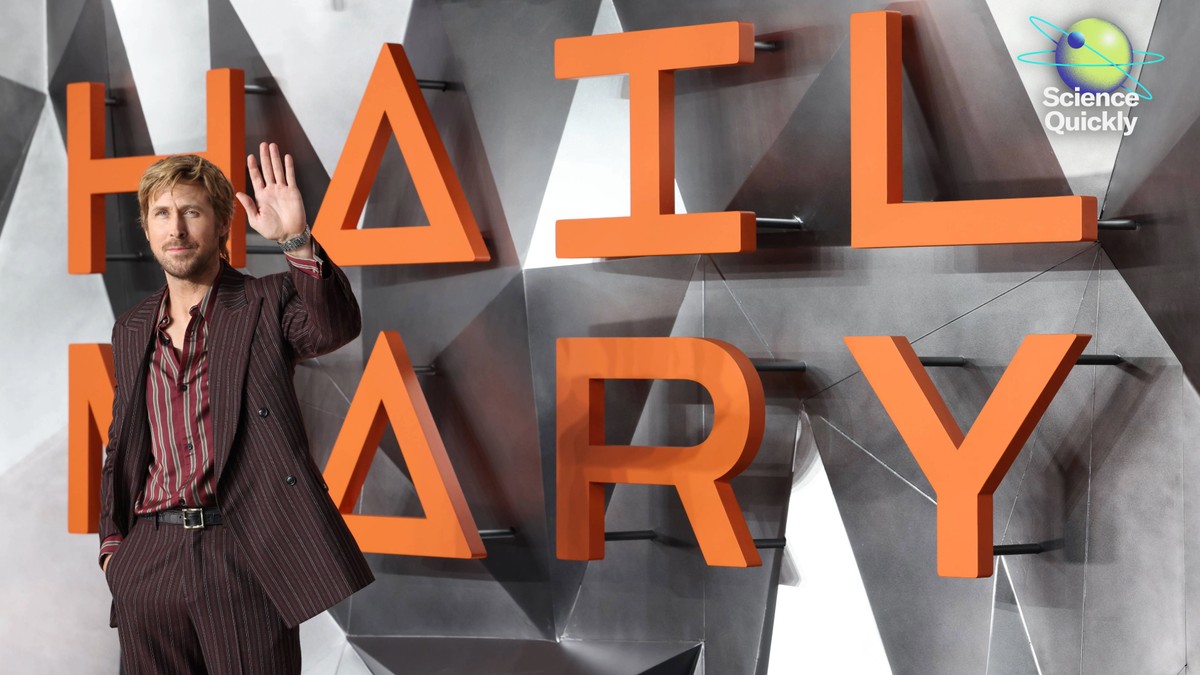
Ryan Gosling stars in the new sci-fi film Project Hail Mary, where a science teacher wakes up in deep space with no memory of how he got there. The movie, based on Andy Weir’s novel, blends real science with imaginative world-building. To discuss the film’s creation, Scientific American ‘s Bri Kane spoke with Weir, who also served as a producer this time, unlike his previous collaboration with Matt Damon on The Martian. Weir explains his unique approach: he wasn’t given money to leave, but stayed involved every step of the way.
Building a Believable Alien World
Weir’s process begins with grounding the fantastical in reality. For Project Hail Mary, he started with the exoplanet 40 Eridani Ab, eight times Earth’s mass, orbiting its star in just 46 days. To create a habitable environment, Weir considered the physics of extreme conditions: high atmospheric pressure to retain liquid water, and a powerful magnetic field to prevent atmospheric erosion.
This led to a world where dense, ammonia-rich atmosphere blocks sunlight, eliminating the need for vision. Life evolved in layers, with organisms absorbing light at the top and others feeding below, much like deep-sea ecosystems on Earth. The surface gravity would be 2.1 g’s, meaning the alien lifeforms would be exceptionally strong. Weir imagined Eridians as mobile, beehive-like structures, mostly inorganic with a small core of biological matter.
The Importance of Empathy
The film emphasizes empathy and collaboration, themes central to Weir’s character development. He argues that intelligence, pack instincts, and language are prerequisites for interstellar cooperation. These elements inevitably lead to empathy, as seen in social animals like wolves, where mutual care ensures survival. For the alien Rocky, Weir designed a species capable of understanding collective survival and compassion.
Visualizing the Impossible
Weir admits his imagination is not visually strong, describing his mental images as “blobs.” He relies on lists of features rather than detailed visions. This makes adapting his work to film seamless: the screen version becomes canon in his mind, filling the gaps in his own visualization. If he thinks of Ryland Grace, he now automatically pictures Ryan Gosling.
Balancing Science and Fiction
The science in Project Hail Mary is mostly grounded in established physics, though Weir acknowledges bending rules at the quantum level. He cites the fictional manipulation of neutrinos as an example of where speculation overrides current understanding.
Weir’s characters are often based on his own personality, like Mark Watney in The Martian. However, Ryland Grace is the first character he created without direct self-projection, making him conflict-averse, naive, and slightly fearful.
The Inspiration Behind the Story
Weir draws inspiration from science fiction classics, like Enemy Mine, where adversaries forced to cooperate for survival. He also notes cultural differences in technological development: Eastern cultures excelled in delicate ceramics, while Western advancements in optics stemmed from glassmaking. His goal is not to portray one species as superior but to highlight unique strengths that emerge through collaboration.
Would Weir Go to Space?
No. Despite writing about brave explorers, Weir admits his anxiety would prevent him from volunteering for a space mission. He relies on fictional characters to fulfill his adventurous spirit, preferring to stay grounded in reality.
If he could meet Rocky, he’d ask for the secret behind xenonite production, a fictional material central to the story. Weir doesn’t define it explicitly, leaving room for further exploration.
Ultimately, Project Hail Mary blends scientific rigor with imaginative storytelling, creating a compelling narrative about collaboration, empathy, and the boundaries of human (and alien) ingenuity.


