


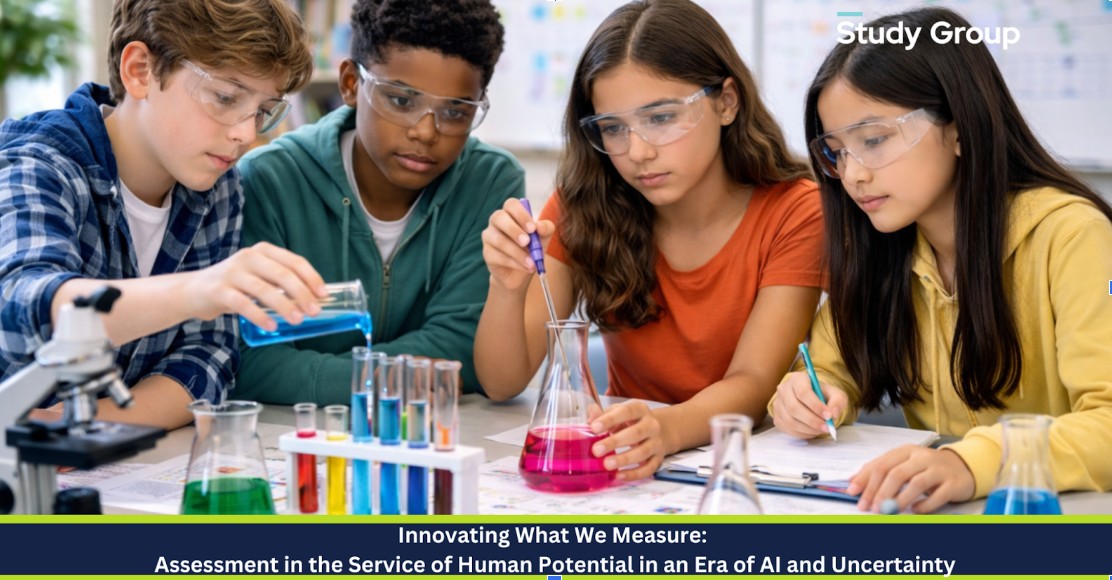
For too long, education has prioritized measuring the easy instead of what truly matters. The current reliance on standardized tests – designed to assess rote memorization and procedural skills – has inadvertently stunted the very innovation it should foster. In a world defined by accelerating change and deep uncertainty, this approach fails to prepare students for the demands of the 21st century.
The Problem with Traditional Assessment
Standardized tests act as powerful signals, but those signals often reward the wrong behaviors: regurgitating facts instead of applying knowledge. They ignore the essential skills needed in a rapidly evolving landscape, such as creativity, collaboration, and digital literacy. Today, an educated person isn’t defined by how much they know, but by their ability to learn, adapt, and solve novel problems. Traditional tests are merely snapshots of past learning, failing to capture the dynamic process of how understanding actually unfolds.
To unlock human potential, education must move beyond “assessment of learning” to “assessment for learning.” This means transforming measurement into a tool that actively improves teaching and learning, rather than just grading performance.
Beyond IQ: Holistic Development and Human Variance
True growth isn’t just academic. It’s about developing the whole student: socially, emotionally, and culturally. Learning doesn’t occur in isolation, and neither should assessment. As research increasingly shows, intelligence isn’t fixed; it’s a malleable trait shaped by biology, identity, culture, and experience.
The key is recognizing human variance not as “noise” but as a strength. Asset-based assessments leverage this diversity, measuring a holistic profile of agency and resilience developed within a student’s communities.
Measuring the Invisible: Processes Over Outcomes
The obsession with “correct answers” obscures the real mechanisms of learning. To truly understand how students develop, we must measure the underlying processes : self-regulation, motivation, attention, and engagement.
Emerging tools, like real-time classroom climate surveys, provide actionable feedback on these invisible factors. A student’s response to failure is just as revealing as their success. Tracking metacognition and “productive failure” – learning from mistakes – reveals how students adapt when faced with challenges.
Instead of waiting for end-of-year reports, educators are embedding low-burden indicators directly into daily workflows, ensuring immediate “validity-in-use” to drive continuous improvement.
Cultivating Future-Proof Skills
The skills that matter most aren’t captured by multiple-choice tests. Collaboration, communication, critical thinking, perseverance, and AI literacy are essential for thriving in a dynamic world. Above all, intellective competence – the ability to apply knowledge strategically – must be prioritized.
This requires recognizing competencies developed outside the classroom: in workplaces, communities, and real-world experiences. The future of assessment lies in immersive, AI-driven simulations that seamlessly measure these complex traits. Game-Based Assessment, like those developed within environments such as Roblox, analyzes continuous telemetry to assess teamwork and systems thinking without interrupting the learning flow.
Reimagining Core Subjects
Even foundational subjects must evolve. Next-generation assessments in math and language arts are abandoning abstract exercises in favor of authentic, real-world scenarios that measure deep “knowledge-in-use.” By mapping a learner’s cognitive journey from novice to expert before designing tasks, educators can create performance-based assessments that measure conceptual transfer and interdisciplinary literacy.
The bottom line: by redefining what we measure, we unlock human potential. The tools and infrastructure to build a modern, dynamic assessment ecosystem are already maturing. Now, leaders must shift investments away from outdated compliance models and toward a future where assessment fuels growth, innovation, and true preparedness.


