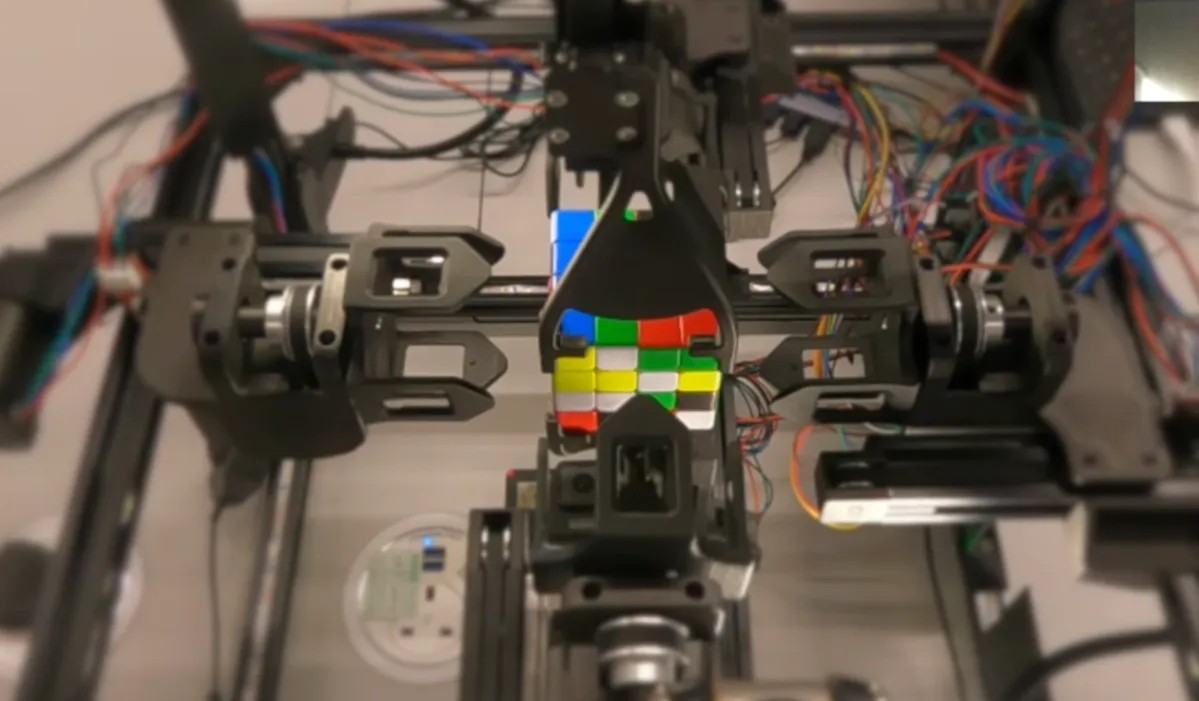
Two British brothers, Matthew and Thomas Pidden, have set a new Guinness World Record for the fastest time solving a 4×4 Rubik’s Cube with a robot. Their creation, dubbed “The Revenger,” completed the puzzle in a blistering 45.3 seconds – over 30 seconds faster than the previous robotic record. This also improves on the 55-second time the same robot achieved in earlier tests.
The Revenger: How it Works
The Pidden brothers, both undergraduate students, spent 15 weeks building The Revenger at the University of Bristol. The robot utilizes a two-part system: a mechanical body and a software “brain.”
- Vision: Dual webcams scan the cube to identify the color arrangement.
- Manipulation: Custom-built robotic arms physically grab and rotate the cube’s faces.
- Algorithm: A laptop runs a specialized algorithm that analyzes the webcam data and calculates the optimal sequence of moves.
To ensure fairness, plastic shutters blocked the webcams until the timer started, preventing any pre-scan advantages.
Record-Breaking Attempts and Context
The record attempts took place last year but were only recently certified by Guinness World Records. The robot successfully solved the cube six times during testing, with its third attempt already beating the previous record. The current record of 45.3 seconds was achieved on its sixth try, witnessed by a cheering crowd as the cube’s faces aligned to single colors.
Why this matters: This achievement demonstrates rapid progress in robotics and machine learning. The ability to solve complex mechanical puzzles with such speed highlights the increasing precision and efficiency of automated systems. It’s not just about beating a record; it pushes boundaries in computer vision, algorithm optimization, and robotic dexterity.
Robots vs. Humans: The Speed Race
While 45.3 seconds is impressive, robots have solved the standard 3×3 Rubik’s Cube even faster. The current robotic record for the 3×3 is just 0.103 seconds – faster than a blink of an eye, achieved by a team at Purdue University.
Humans still hold a respectable position in the competition, with the fastest human solve (2.76 seconds) achieved by a nine-year-old. This shows that while robots can surpass mechanical speed, human dexterity and pattern recognition remain competitive.
The Pidden brothers’ project combines childhood passion with advanced computer science, proving that complex problems can be tackled with creativity and determination.
The rapid advancements in automated puzzle-solving raise questions about the future of robotics in fields beyond recreation, from manufacturing to surgery.