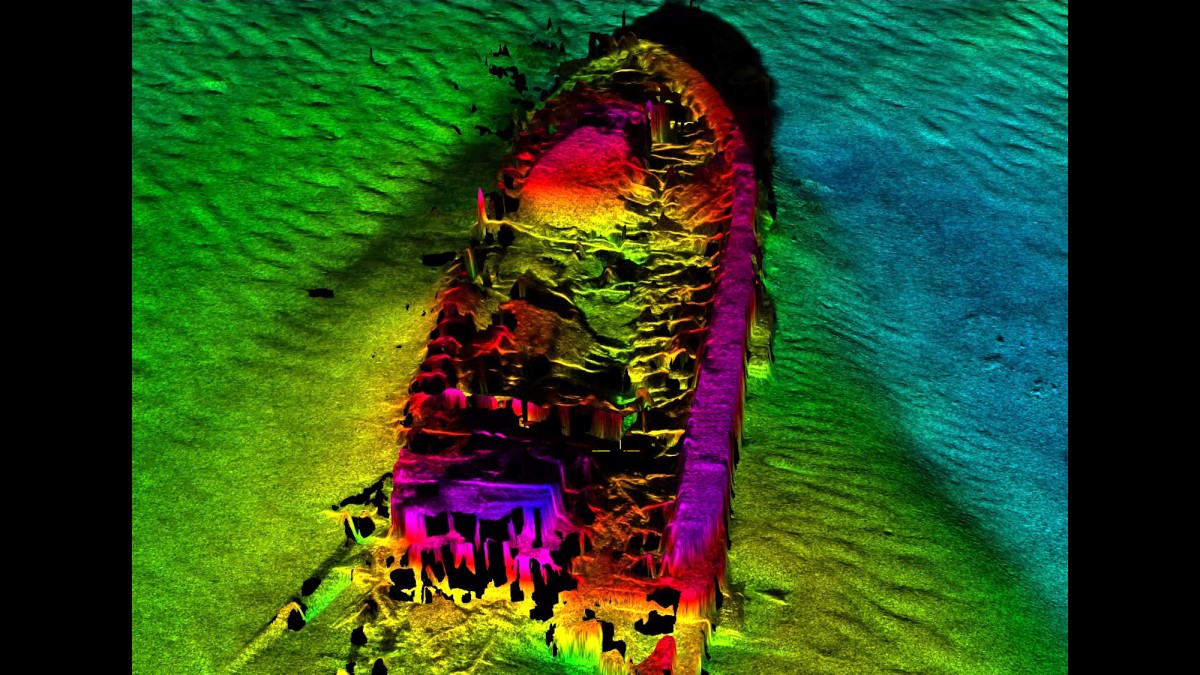
The wreck of the USS Monitor, a pivotal ironclad warship from the American Civil War, has been remarkably well-preserved on the Atlantic seabed, according to new high-resolution scans released by the National Oceanic and Atmospheric Administration (NOAA). This discovery provides unprecedented detail about a vessel that dramatically altered naval warfare in the 19th century.
The Monitor : A Technological Revolution
The Monitor was built in just 102 days in 1862 to counter the Confederate ironclad CSS Virginia. Its low profile, revolving turret armed with two massive 280 mm Dahlgren guns, and steam-powered propulsion made it a radical departure from wooden warships. Though mocked by some contemporaries as the “Yankee cheesebox,” the Monitor represented a major naval advancement. Its design influenced U.S. Navy ship construction for decades.
The Monitor participated in only two battles, including the famous clash at Hampton Roads in March 1862, which resulted in a tactical draw against the CSS Virginia. This duel marked the first time ironclad warships engaged each other, effectively rendering traditional wooden fleets obsolete. However, its service was short-lived.
Sinking and Rediscovery
On December 31, 1862, the Monitor foundered in a storm off North Carolina while en route to assist in a blockade of Charleston, South Carolina. Sixteen sailors died in the sinking, though most of the crew survived. The exact location of the wreck remained unknown for over a century. In 1973, a joint expedition by Duke University, the National Geographic Society, and the National Science Foundation located the wreckage, leading to its designation as a national marine sanctuary in 1975. Recovered components, including its guns and turret, are now displayed at the Mariners’ Museum in Newport News, Virginia.
New Scanning Technology Reveals Preservation
For decades, assessing the wreck’s condition was limited by depth (approximately 240 feet) and visibility. Recent surveys conducted by NOAA in collaboration with Northrop Grumman used an autonomous underwater vehicle equipped with circular synthetic aperture sonar (CSAS) to create detailed 360-degree images of the wreck. These scans reveal that, despite over 150 years underwater, the Monitor remains in “fantastic shape.” This preservation is significant because shipwrecks act as artificial reefs, supporting diverse marine life while also providing a unique time capsule of naval technology.
The Monitor ’s survival underscores the value of marine sanctuaries in preserving maritime heritage and ecological environments. The scans also serve as a baseline for monitoring the wreck’s deterioration over time, enabling informed conservation efforts.