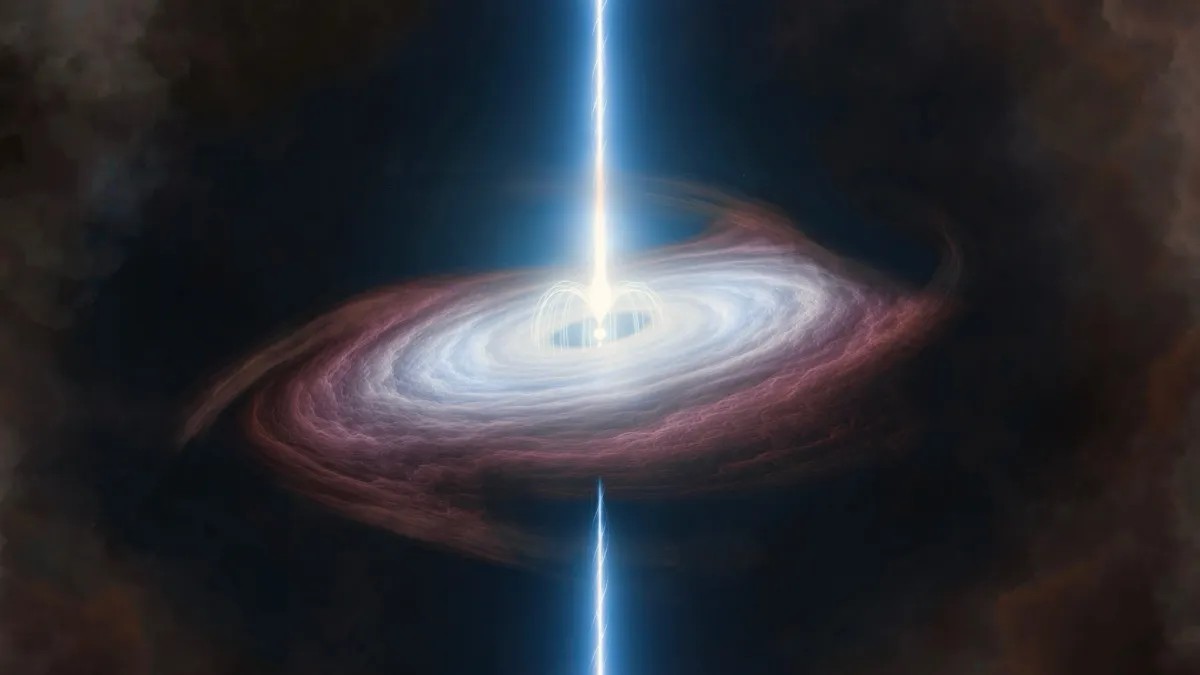
For the first time, scientists have directly witnessed the formation of a magnetar – an incredibly powerful, rapidly spinning neutron star with an intense magnetic field – during a superluminous supernova. This breakthrough, observed in the distant explosion known as SN 2024afav (approximately one billion light-years from Earth), confirms a long-held theory about the engines driving some of the universe’s brightest stellar deaths. The observations, documented over 200 days using a global network of telescopes, provide compelling evidence that magnetars play a crucial role in powering these extreme cosmic events.
The Supernova’s Peculiar Behavior
SN 2024afav was already remarkable for its brightness, exceeding typical supernovae by at least tenfold. However, what truly set it apart was its unusual luminosity pattern: instead of fading as expected, the supernova exhibited four distinct brightness fluctuations, with the time between each oscillation decreasing. This behavior puzzled astronomers until a team led by Joseph Farah at UC Santa Barbara applied the principles of general relativity to explain the phenomenon.
A Wobbling Accretion Disk
The key lies in the formation of an accretion disk around the newly born magnetar. As material from the supernova explosion spirals inward, it forms a disk that is almost certainly misaligned with the magnetar’s spin axis. According to Einstein’s theory of general relativity, a spinning object drags spacetime with it. This effect, known as Lense-Thirring precession, causes the accretion disk to wobble.
This wobble acts like a blinking turn signal, intermittently blocking and reflecting the magnetar’s intense light. As the disk spirals closer, it wobbles faster, explaining the decreasing intervals between luminosity spikes. This model, confirmed by months of calculations, finally provides a direct link between magnetars and superluminous supernovae.
Confirmation of a 16-Year-Old Theory
The findings validate a hypothesis proposed in 2008 by Dan Kasen of UC Berkeley. Kasen theorized that magnetars – the remnants of stars too massive to become black holes but still powerful enough to retain strong magnetic fields – could fuel the extraordinary brightness of certain supernovae.
Magnetars possess magnetic fields 100 to 1,000 times stronger than typical neutron stars (pulsars) and spin at over 1,000 rotations per second. Their rapid rotation accelerates charged particles to near-light speed, creating collisions with supernova debris that amplify the explosion’s luminosity.
Implications for Astrophysics
This is more than just observing a rare event; it represents a fundamental shift in our understanding of stellar death. “It is the first time general relativity has been needed to describe the mechanics of a supernova,” Farah stated. While magnetars aren’t the sole explanation for all superluminous supernovae (shockwave interactions and misaligned black hole accretion disks also play a role), this discovery provides irrefutable evidence for their importance.
The study underscores the power of combining cutting-edge observational data with theoretical frameworks like general relativity to unravel the mysteries of the cosmos. As Farah concluded, “This is the science I dreamed of as a kid.”