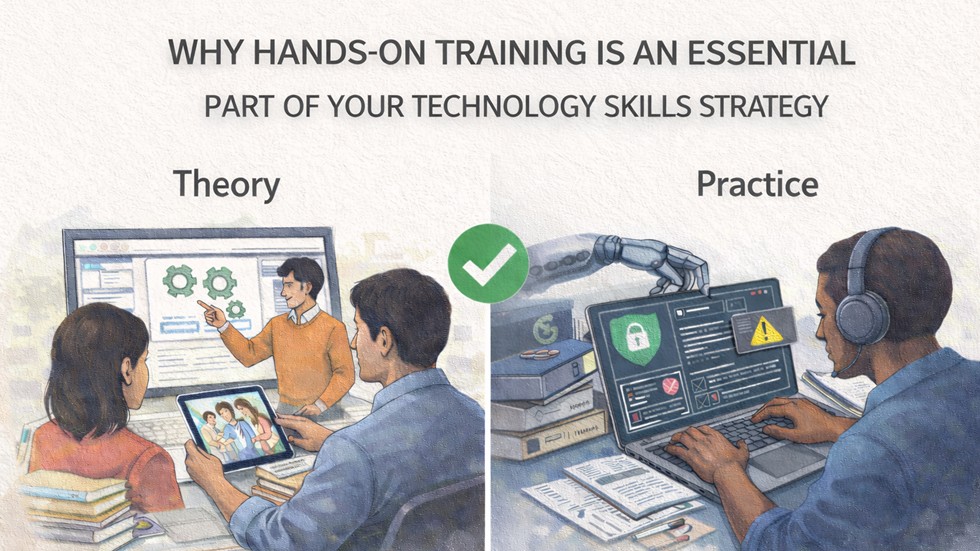
Organizations are adopting technology faster than their employees can keep up. From enterprise resource planning (ERP) to artificial intelligence (AI) tools, the rapid influx of new systems leaves many workers feeling overwhelmed. The core issue isn’t a lack of willingness to learn, but a reliance on traditional training methods that prioritize theoretical knowledge over practical application. Many employees can pass a test but freeze when faced with a real login screen—a gap that leaders must address to create a truly tech-enabled workforce.
The Rise of Immersive Learning Environments
The most effective organizations are shifting away from passive instruction and embracing hands-on training. Modern virtual IT labs provide secure, live environments that mirror real enterprise systems without the risk of disrupting production. Unlike simulations or walkthroughs, these labs allow employees to interact with authentic interfaces, configure settings, and experience genuine system responses.
Why this matters: Enterprise workflows are interconnected. Changes in one system (like human capital management) can ripple through payroll, analytics, and security protocols. Labs allow employees to explore these connections safely, understanding the consequences of their actions in a controlled setting. Today’s platforms enhance this realism with guided challenges, adaptive difficulty, and real-time feedback.
The 70–20–10 Learning Model: Bridging the Experience Gap
The 70–20–10 model suggests that:
– 70% of learning comes from practical experience,
– 20% from coaching and collaboration,
– 10% from formal training.
Many organizations overemphasize the 10% (formal learning) while underinvesting in the critical 70%. Employees often lack real-world practice before being expected to perform, leading to errors and inefficiencies. Virtual labs directly strengthen the experiential component by providing access to actual workflows, data structures, and decision points. Learners practice, make mistakes, and receive feedback without jeopardizing business continuity.
“Errors become learning opportunities, not production risks.”
Labs also reinforce the other elements of the 70–20–10 model. They complement coaching, peer learning, and shadowing, making formal instruction more impactful by allowing immediate application of new skills. Scalable difficulty ensures that both beginners and experienced employees are challenged appropriately.
Getting Started: A Practical Approach
Launching a virtual lab program doesn’t require a massive overhaul. Organizations that succeed often start with a quick win: a mission-critical, error-prone, or frequently used process. Payroll adjustments, software onboarding, data analysis, or customer support requests are excellent starting points.
The key steps:
- Identify a target process: Choose a task where hands-on training would have the greatest impact.
- Define “good” performance: Work with experts to map out the steps, decisions, and outcomes of a successful execution.
- Build the lab scenario: Recreate the process in a safe, non-production environment.
- Integrate with real-world reinforcement: Provide contextual reminders within live systems to reinforce learned behaviors.
Integration and Measurement
Modern labs integrate with learning management systems (LMS) and learning experience platforms (LXP), allowing seamless transitions from theory to practice. This tight sequencing improves retention and reduces drop-off rates. Labs also enhance instructor-led training by shifting sessions from passive explanation to active application.
The performance data generated (scoring, telemetry, error patterns) provides instructors, managers, and trainers with clear insights into learner strengths and weaknesses. This enables targeted coaching, shadowing, and stretch assignments based on demonstrated skills rather than assumptions. Finally, integrating labs into onboarding and role transitions provides HR leaders with reliable, performance-based skill signals.
Conclusion: Empowering employees to use workplace technology requires more than just knowledge transfer. Virtual IT labs offer a scalable, effective way to bridge the tech skills gap by giving workers the space to experiment, learn from mistakes, and build real confidence before touching production systems. This approach brings the 70–20–10 learning model to life, ensuring that employees are prepared to thrive in the modern workplace.