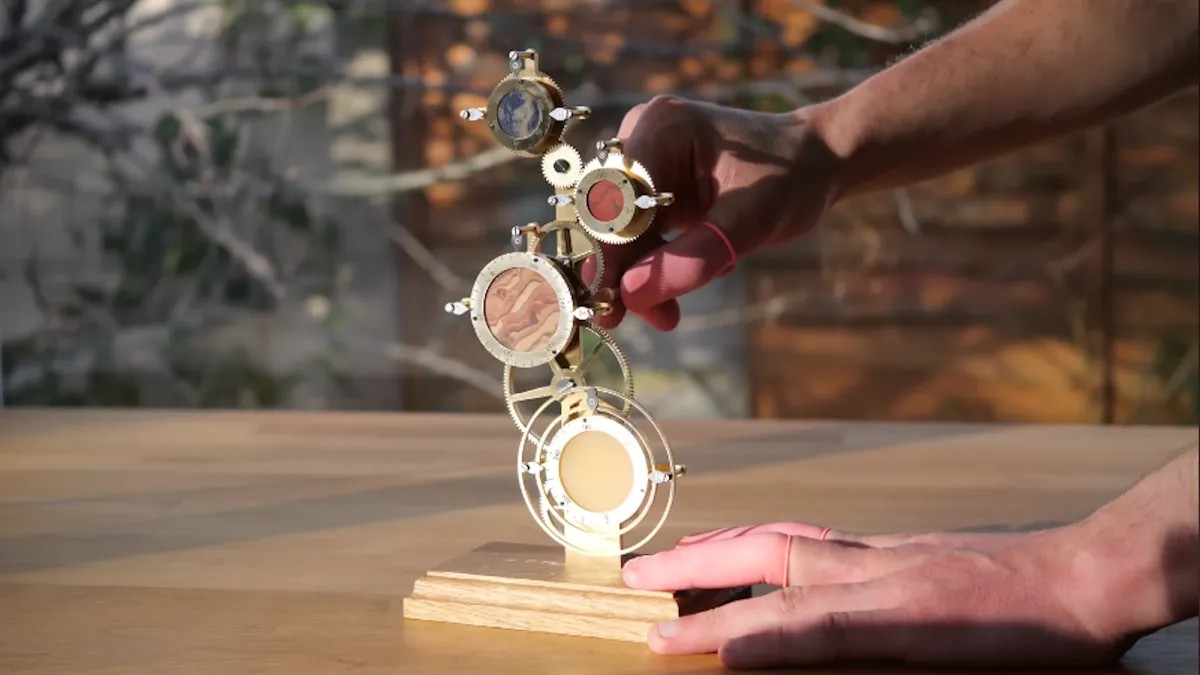
The challenge of coordinating activities across planets is growing more relevant as space exploration advances. While high-tech solutions will be crucial for future interplanetary communication, a U.K.-based team, Chronova Engineering, has demonstrated that even basic calculations can be performed with elegant mechanical precision. Their “Interplanetary Clock” isn’t just a novelty; it highlights the fundamental need for standardized timekeeping as humanity expands beyond Earth.
The Mechanics of Martian Time
Standardizing time on Earth is straightforward due to our planet’s consistent rotation. However, scheduling a call between Earth and Mars requires accounting for their differing day lengths. Mars, for example, has a day only slightly longer than Earth’s (24.6 hours), while Jupiter’s day is less than 10 hours long. This means that simple synchronization is impossible without a reference point.
Chronova’s clock addresses this using a complex arrangement of 131 custom-made gears. It displays the time on Earth, Mars, Jupiter, and Saturn, each showing longitude based on its prime meridian and indicating sunrise, noon, and sunset. The device’s beauty lies in its simplicity: the gear ratios are calculated to reflect planetary rotation speeds. Jupiter completes 2.5 rotations for every one of Mars, meaning its corresponding gear has 2.5 times fewer teeth.
The System 3 Reference Frame
One of the biggest challenges in constructing the clock was accurately measuring the rotation of gas giants like Jupiter and Saturn. These planets lack solid surfaces, making it difficult to establish a fixed reference point. Chronova solved this by using what’s called the “System 3 reference frame,” which tracks the planet’s magnetosphere as an indicator of core rotation. This allows for consistent measurements despite the lack of a physical landmark.
Practical Applications and Why It Matters
The clock isn’t just a theoretical exercise. The team demonstrated a scenario where a Mars settlement, near the Perseverance rover, wants to call Earth during Martian sunset. By rotating the clock to match the date on Earth and aligning the sunset pointer with Mars’ longitude (77 degrees in the example), the user can determine the corresponding Earth time. In this case, the call would come from Earth in the middle of the night.
The Interplanetary Clock illustrates a key trend: as space travel becomes more feasible, the need for standardized timekeeping will grow exponentially. It also raises questions about how we will coordinate activities across planets, not just for communication, but also for resource management, scientific collaboration, and even daily life in future off-world settlements.
This mechanical marvel isn’t just about telling time; it’s a reminder that the universe doesn’t operate on our schedules, and adapting to its rhythms will be essential for human expansion into the solar system.