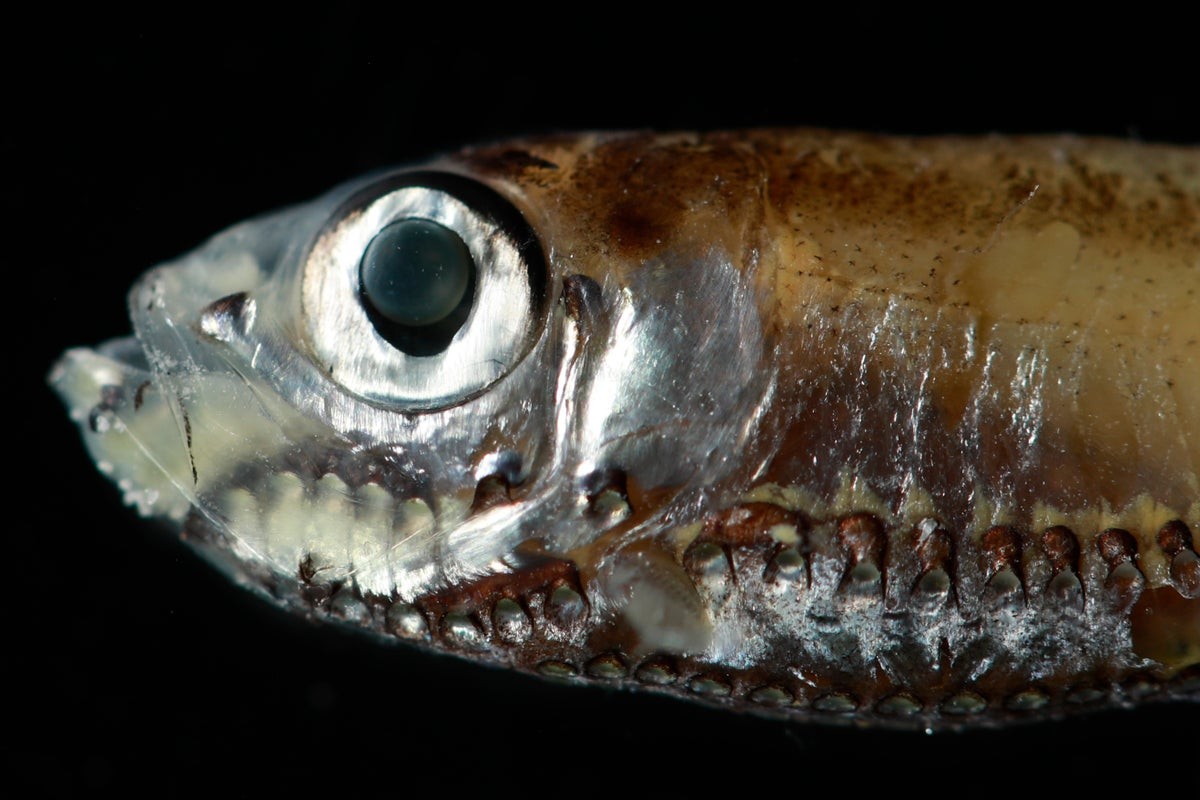
Scientists have discovered that some deep-sea fish use a unique type of vision that blends the functions of both rods and cones—the two primary light-sensing cells in vertebrate eyes. This discovery, published in Science Advances, may reshape how we understand the evolution of sight itself.
The Challenge of Deep-Sea Vision
The twilight zone of the ocean presents a unique problem for vision. It’s too dark for cone cells (which detect color and detail in bright light) to function effectively, but not dark enough for rods (which excel in low-light conditions) to perform optimally. This creates a visual “nightmare,” as described by Lily Fogg, a researcher at the University of Basel and lead author of the study.
Hybrid Photoreceptors in Action
Researchers examined larvae from three deep-sea fish species—hatchetfish, lanternfish, and lightfish—found in the Red Sea. They found photoreceptors that were not strictly rods or cones, but hybrids combining features of both. Hatchetfish retain these hybrid cells into adulthood, while lanternfish and lightfish appear to lose them as they mature.
This suggests vision isn’t a binary system (rods or cones) but rather exists on a spectrum. The hybrid cells likely allow these fish to see effectively in the dim, murky depths where they begin their lives.
Implications for Evolutionary Biology
This isn’t an isolated phenomenon. Similar hybrid photoreceptors have been found in jawless fishes, reptiles, and amphibians, suggesting this visual flexibility may be an ancient trait in vertebrates. The discovery challenges the traditional view of rods and cones as rigid categories and demonstrates how life adapts in extreme conditions.
“It’s a reminder that biology is rarely as simple as we think it is,” says Fogg.
The findings underscore how little we know about vision and how evolution can produce unexpected solutions to survive in even the most challenging environments.